It was getting late because no matter how you plan to get out of London by car, you are always going to have to add two hours. It’s not fair to those of us with busy lives in a city that never sleeps to request an estimated time of arrival. We will take the word “estimated” and squeeze out every ounce of uncertainty until it is a meaningless qualification that forces the arrival date to do all the work. It’s not like we don’t have good standing in the world of accommodation, but it must be put in its proper place: a base in which to prepare morning and perhaps evening food, hot drinks and a warm, comfortable bed. It is not a destination which will be valued by the seconds we can spend inside the property.
With that in mind, it’s the disconcerting moment, after a long drive and you’ve had a long day, or potentially a long flight, to arrive at an Airbnb to be forced into human interaction by the “host.” “Host” is doing a lot of work to the point of upsetting the nature of the dictionary.
Thanks for reading Dispatches from the Pavement! Subscribe for free to receive new posts and support my work.
Let me explain.
There are elements in which “Host” is entirely accurate to the point of traumatising the guest, when the guest in question is me. There are other elements where the “Host” label might as well be the new definition for an A-board that had been left out in the rain for so long it had developed a stalactite-esque appearance.
The check-in instructions were clear, and we were communicative in the days leading up to make sure we could access a bed for the night. Which is why, for the life of me, I couldn’t understand why, when we were given the code to the key box, sent the WiFi password 48 hours before check-in, along with a mammoth PDF with incomprehensible yet meticulously detailed instructions about how to use the thermostat, we were still having to meet the host in person.
That is not the convenience of modern life. Technology-supported hiring of unregulated accommodation is supposed to include the comfort of not interacting with those who oversee things. It is hard to put into words how jarring it is. One is more than happy to be welcomed by the luxury accommodation’s Hotel Manager when you are an esteemed guest, and the money spent warrants the personal touch, as I’m told – or so I’ve heard and seen on the BBC show Life Beyond the Lobby. The experience following this should be something that sweeps you off your foundation of reality into something otherworldly. A place so other than the hurry of the everyday that one immediately escapes into a dimension of relaxation.
But it is a modern crime of emotional weaponry when the ‘host’ in question meets you on the driveway grinning and waving, which makes the final parking experience to be placed under exam conditions. The car, full of your valuable luggage, is now in a quandary. Do we exit and lock the car? Does this make us seem distrustful of such an apparently friendly individual? I did not need this choice to be thrust upon me when I ran out of coffee and emotional strength half an hour ago, when we left the last A-road for a single-lane track with passing places suitable for tandem bicycles at best.
Rather than a short introductory speech, key handover, and wave goodbye, we are led into the property as if she is holding a lantern down forgotten corridors, as she illuminates the decor of the boot room and gives an expectant glance at us, where we both have to enthusiastically say, “Oooh, lovely!”
And it’s now all gone wrong too early when, as they open the main door for you and you walk into the largest lobby-cum-ante room, you accidentally give an over-the-top response to the welcome mat, and you have to escalate from there. By the time you’ve reached the main living area, you are screaming at the top of your lungs that you cannot imagine a more perfect location to catch up on The Celebrity Traitors; at which point you realise they have, for reasons hidden from the listing, decided not to put a TV in the lounge to allow for ‘peaceful escape from your usual everyday rituals’. It’s a good thing I never travel without my own entertainment, just in case such madness is thrust upon me.
Is this the conclusion? Can I retrieve my luggage now?
I do not see this happening when I am offered a tour of the cutlery drawer. This does not bring me joy. Even if there is a separate section for a cake fork.
The pressure comes because the British will feel this obligation intrinsic to the fabric of existence, that this is their home. They are proud of such a home. This is unlike when you are visiting a friend or family member’s new home for the first time. When they offer you a tour, you know there is a wealth of emotion that has got them to this point, and the joining of this with your presence is a warmth that allows a genuine and meaningful reaction as they show you the cupboard under the stairs.
But this is not that. This person is a stranger. And you are paying them for the use of their space, which they have cleaned and tidied, and half made an effort for minimal personal effects to not distract you, even if their DVD collection betrays that. Especially as there is no facility to watch them. You wonder how to broach the topic and decide to leave it.
Emotionally spent, as they showcase the newly installed ceiling rain shower, all you can muster is a half-hearted ‘super,’ and you have a hard time disguising your confusion as to how the double bedroom has been configured with two single beds that you’re going to have to push together when they’re gone and hope they don’t “pop in to see how you’re settling in” over the next couple of days before putting it back how you remember it.
The toilet on a septic tank is, without exception, unhelpfully labelled, so it is unclear whether they can be used at all or if regular bodily functions should be scheduled for the excursions to the nearby farmyard. This is, obviously, overlooked in the tour, and I’m so tired that it’s not a question that I’m able to ask. I’m not even comfortable asking, “Can I have a poo in there?” while pointing at a new door, to my own immediate family.
The “ooh, lovely” responses to each and every room have expelled all other autonomy from my being. I am a shell of a shell, wondering whether I’m going to need to extend our stay to recover from this onslaught of enthusiastic hospitality.
But this is far from the biggest problem I have with Airbnb. The hosts are people, all the same. They are trying their best, even if they aren’t taking my suggestions under advisement.
Airbnb sounds like a great modernised, 21st-century name. It is my nature and prerogative to take this brand name and chop it up into pieces. It comes from sleeping on airbeds in San Francisco, when some tech duo came up with the idea to ask, with a properly-thought-through-method-of-couch-surfing, people with spare spaces where airbeds could be inflated to hire them out through an app. Airbeds (inflatable beds) but as a cloud-based service.
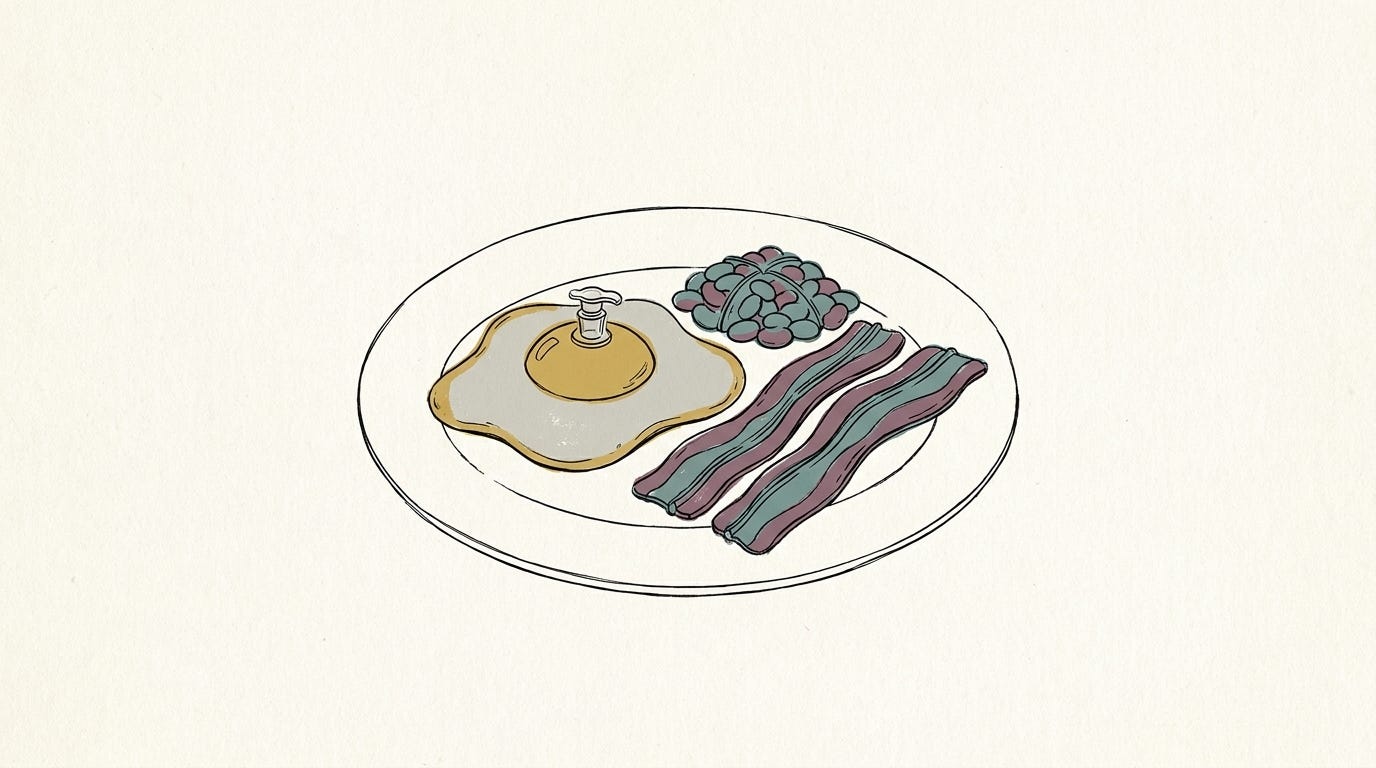
BnB is a modern take on the historic B&B that exists, mostly in seaside towns, but can be found anywhere, where they offer you two things beginning with B: Bed and Breakfast. You turn up exhausted from your coastline hike, go to sleep when it gets dark in what used to be some child’s bedroom who moved out decades ago and is now a converted single room with a sink in it, and, in the morning, they feed you with gallons of coffee and as much pig in various forms as they can fit on a plate in a pile carefully balanced against the pint of orange juice. It’s comforting and sets up a traveller well for the day ahead.
Inflatable beds are fine. They do the job and aren’t that uncomfortable. But I do not want an inflatable breakfast. The best that these hosts do in providing such inflatable breakfasts, as we have come to accept due to the Terms and Conditions of the website, is the laminated breakfast pages, outsourcing their obligations to the local cafe. “Here are some p…