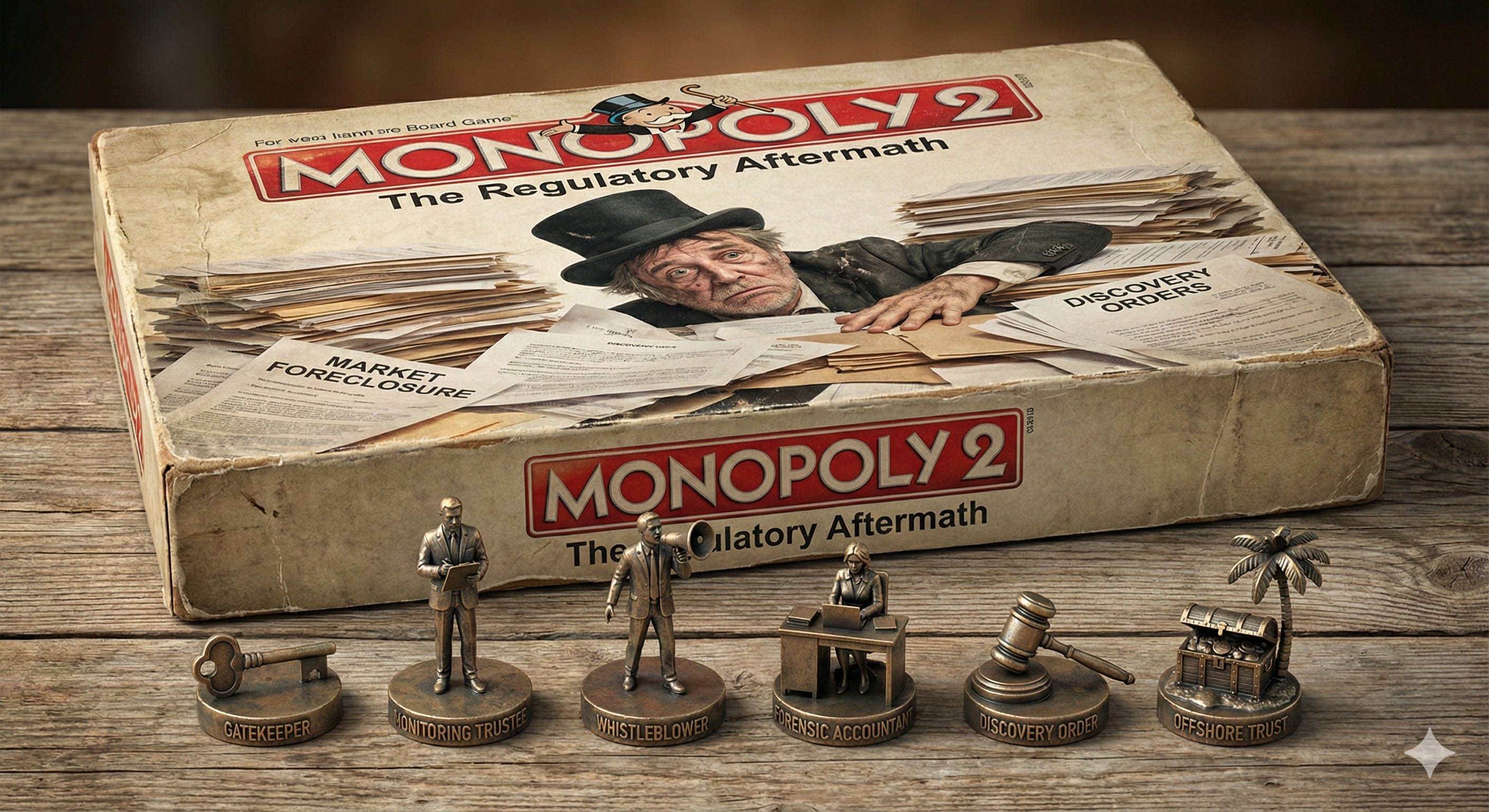
Before my parents retired to a slightly less remote rural home, the living room of their five-bedroomed house had a whole wall lined with board games. They have since downsized, and the diaspora of family “fun” is now scattered across Yorkshire and the South East of England. Monopoly was played less and less, but was brought out again this year. As the sun went down on Boxing Day, and my older brother inevitably bankrupted his extended family, I brought out my contribution: Monopoly 2: The Regulatory Aftermath.
The winner of the original game is designated ‘Gatekeeper’ and now holds the “special responsibility” of not allowing their conduct to impair genuine, undistorted competition. They built a monopoly; now they must divest it. This is enforced through ‘Divestiture Zones’. If a player lands here, the rules state they must ‘unscramble the eggs’ by selling a stand-alone business unit to a rival to restore market structure. The runner-up is assigned the ‘Monitoring Trustee’ token, which requires a salary payment every turn from the Gatekeeper’s assets and follows them around the board like a Facebook troll. Other tokens include the Whistleblower, who moves backwards around the board, and the Forensic Accountant, who is the only player allowed to enter the ‘Offshore’ zones to retrieve hidden cash.
When you pass GO, you must submit your compliance report. If the Gatekeeper tries to buy a new property, it is classified as a ‘Killer Acquisition.’ They must prove they intend to actually develop the site rather than just boarding it up to keep rent prices high. Since they cannot prove this, the asset is frozen. The only player holding any liquidity is the Gatekeeper, effectively stalling the economy. To restart the flow of capital, they must pay 10% of the annual turnover to the bank under the “Abuse of Dominance” ruling. If funds are required, assets must be sold at a fair and reasonable (competitive and financially viable) price. If no player agrees to the price, the asset is liquidated at the Gatekeeper’s expense.
Rather than ‘Chance’ and ‘Community Chest’, there is a “Discovery” deck, where you either produce documents or pay the equivalent legal fees. Other possible cards include Fixed Penalty Notices and broken social contract scenarios. ‘Free Parking’ is now ‘The Cayman Islands.’ Any cash placed here is technically yours, but you cannot use it to pay fines or buy bread because it is locked in a complex trust structure. You sit there, rich but functionally insolvent. Old Kent Road has been gentrified to within an inch of its charming former existence. Rent starts at £400, or you can try to purchase an artisanal sourdough loaf instead. Mayfair is inaccessible, thanks to being rezoned as an Offshore Holding Company requiring Non-Dom status.
If a player rolls a double, they can take another turn – known as an aggressive expansion. If they roll three doubles, this is known as “Market Foreclosure” and they go to jail. Jail is a Discovery Order. It requires the player to untangle the “Spaghetti Structure” of shell companies they created in the first game. The game pauses not because of red tape, but because nobody can figure out who actually owns the Water Works. Considering there is not enough cash to pay the bank, everyone is bankrupted in solidarity and we reach Total Market Dissolution.
We set up Settlers of Catan. As the board fills with little wooden roads and settlements, the atmosphere shifts from predatory to productive. We remember what a market is actually for: I have too much wood, you have too much wool, and we swap. It is a simple, agrarian exchange based on mutual need rather than coercive extraction.
As we roll the dice for sheep, the mood lifts. The “Regulatory Aftermath” was a necessary slog, but it served a purpose. It revealed that the dopamine hit of bankrupting your family is short-lived, while the structural damage takes years to unwind. We had confused accumulation with success. My brother would say he was “good at it” while others would argue, “that doesn’t make it ‘fun’.” The board is now clear, the assets liquidated. We are no longer Gatekeepers or Trustees, just a family trying to trade wheat for ore, agreeing implicitly that it is much more sustainable to build a village than to own a city.
Anyway, holiday’s over. Back to work everyone.