We are in a crisis of keeping, and we need to learn how to hold on to everything again. I have been walking around this truth for years, naming different faces of it, because the thing itself is too big to see straight on. I called it disposability when I was stooping to pick up wrappers and bottles, watching how a world of throwaway materials trains a throwaway mind. I called it drift when I looked at towns thinning out, their young drawn away by the golden roar of cities and empty promises, leaving the old to sit under dark windows in darker hills. I called it the dying of small fires when I noticed how the ordinary signals of presence are going out one by one in a long, quiet surrender to convenience.
All of that was prelude.
This is the next turn of the same thought: keeping is the human art of staying faithful to what has been put into your hands, and that art is failing at the level of ordinary daily life. We are not only losing traditions and places. We are losing the inner posture that makes any tradition or place survivable, possible, thinkable. From the smallest objects to our ability to belong to a place, we are forgetting how to keep.
We so often try to point to one cataclysmic event as the point where everything went wrong. You hear it all the time. “Where did we go wrong?” as if there was a singular moment when the pillars fell. I think most people can agree that we’re not living well, but pointing to some pivotal moment is not the key. Instead, we need to reevaluate the thousand small permissions and consolations and compromises we’ve made where we allowed the good old days to slip through.
The broken thing can be replaced faster than it can be repaired, so we replace.
The strained bond can be avoided easier than it can be mended, so we avoid.
The hard season can be fled more quickly than it can be endured, so we flee.
Objects matter here, though they are only the first lesson. The materials you choose, the way you pack food, the way you mend a gate or keep animals or refuse to let plastic touch what you harvest, these are a form of apprenticeship. They train your hands in permanence, and the hands train the heart.
When you insist that something be durable, you are practicing patience.
When you take care of a tool instead of treating it as expendable, you are practicing attention.
When you keep a tradition long enough to learn why it was built, you are practicing humility.
The same muscles that keep a jar in the pantry or a fire in the stove are the muscles that keep a marriage through lean years, keep a town through economic winter, keep a church alive when it would be easier to drift away, keep hope alive when the days are short and the headlines shout ruin. The modern world tries to convince you that everything is weightless, that you can pick up and go without consequence, that obligations are optional accessories. Anything worth having however carries weight. A home carries weight. A child carries weight. A place carries weight. A vow carries weight. A kept life is a weighted life, and that weight does not crush. It steadies.
The whole economy hums along whispering that whatever is difficult is optional, that whatever is old is suspect, that whatever asks your presence is trying to steal your freedom. You feel that whisper at the kitchen counter and in the parking lot and on your phone late at night. It presents itself as relief, as efficiency, as self care, as the reasonable thing to do. In truth it is a kind of training, teaching your hands and heart to default toward exit. Once your hands learn the rhythm of use and toss, your mind learns the same rhythm with vows and neighbors and even your own sense of duty. That is why a people can be surrounded by abundance and still feel hollow. A life can be made fluent in convenience and still fail at the basic work of being human, being part of a community, of living well. Keeping feels slow because it resists that rhythm. It is the long obedience of ordinary days, and ordinary days are where the battle is won or lost in a thousand thousand small decisions to compromise or to hold.
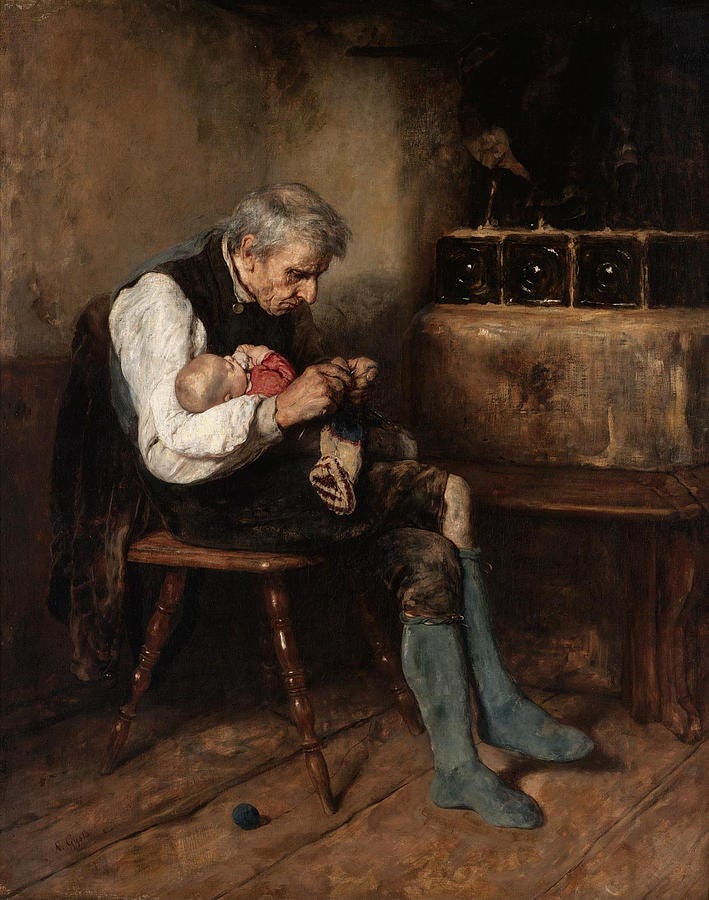
Keeping is learned by proximity, and especially by the nearness of generations to each other. A child does not become rooted because you tell him that roots matter, he becomes rooted because he grows up among adults who are rooted, who know the land and the people and the calendar of the year like they know the rooms of their own house. A young man learns how to carry weight because he has watched older men carry it without theatrics, watched them meet the hard parts of the year with presence rather than distraction, seen them keep the hearth work and the neighbor work and the village work in a way that makes endurance feel ordinary. An old person remains whole because she is still threaded into the daily life of a family, not visited as a relic but relied on as kin. When those bonds thin, the skill of keeping collapses.
Children become a category to manage instead of souls to welcome.
Young adults become a mobile labor force drifting between cities and screens.
Elders become a quiet problem handled by emotionally distant professionals.
When we choose to silo ourselves, to compromise on our relationships instead of to keep them, each group loses something that only the others can give. The young lose models of steadfastness. The old lose the dignity of being needed. The middle lose the language of responsibility because responsibility makes sense only when it runs both ways across time. In a kept world, you do not just love your people. You are useful to them. That usefulness takes form and becomes the very shape of what it means to belong to a people and a place.
The cultural repair we need will not arrive with a single grand solution. It will come the way winter light returns after the solstice, almost imperceptibly at first, by small brave acts of saying no to compromise and greasy ease done again and again until they shape a new season.
It will come when men and women decide to be present where they are needed, not only in emergencies but in the plain hours when nothing glamorous is happening.
It will come when young people are invited to stay and shown that staying is valuable and honorable.
It will come when children are treated as fully human members of the household and the town, not inconveniences to be hidden away.
It will come when elders are put back into the center of family life so that their knowledge and dignity can do their quiet work.
We are in a crisis of keeping, yes, but crises are also thresholds. If we want the world to be human again, we must relearn the old posture of standing watch, of enduring. We must learn to hold on to the living things given to us now. Land, children, seasons, light, each other.
This dark part of the year teaches that the fire does not keep itself.
Neither does a culture.
Neither does a family.
It hinges on keeping.
It hinges on you.