Author’s Note: this essay is part of the Reports from the High Wood series, a weekly premium report from our homestead that offers enduring lessons for living well in a wounded world. If you're drawn to green paths, perennial values, and timeless beauty that resists the modern glare, you're in the right place.
Normally these Sunday posts are for paid subscribers only, but the nature of this essay makes it feel right that this post should be available to everyone.
Here are some of our past beekeeping posts that will give context if you are new here:
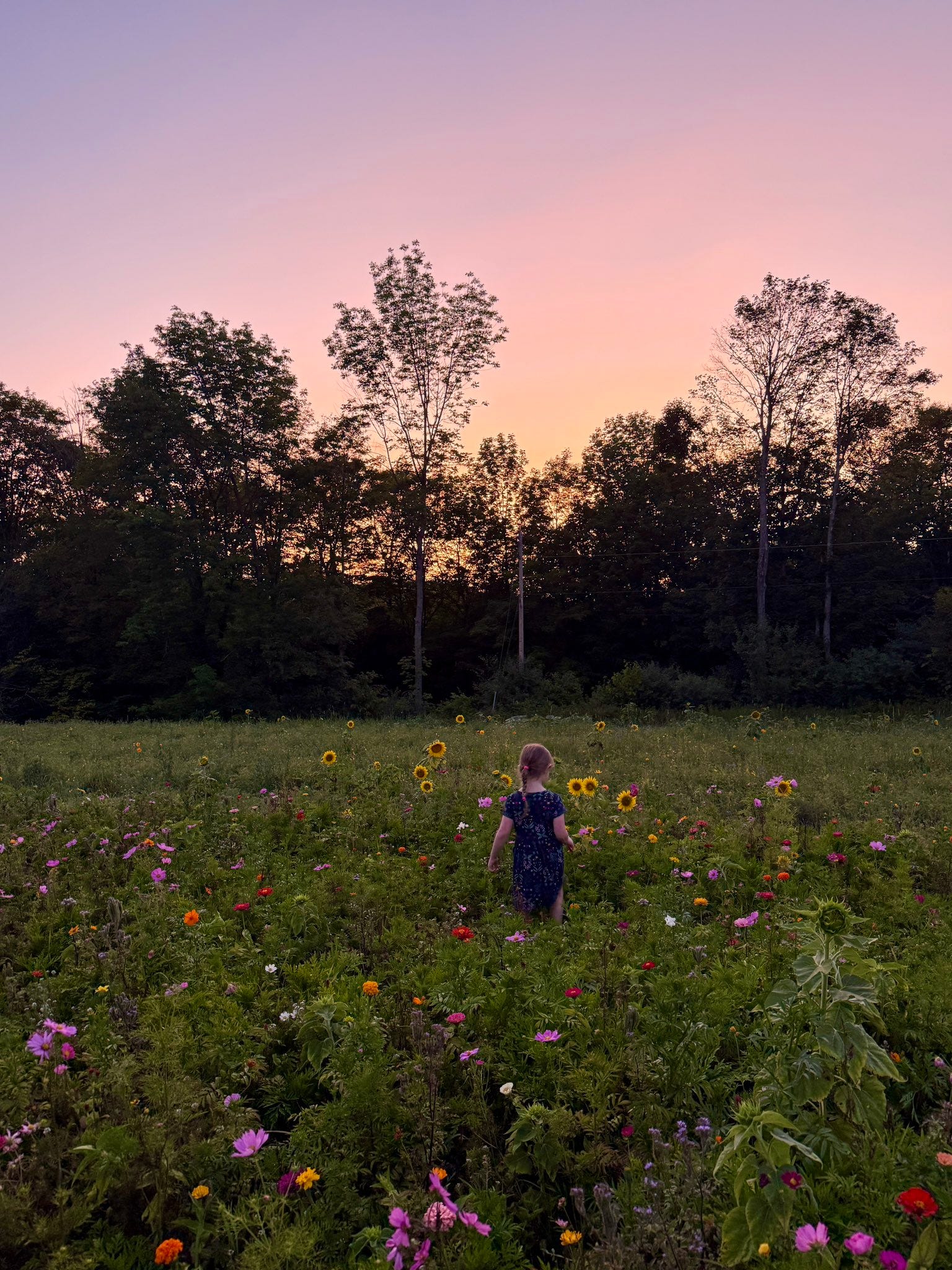
"You could charge for this, you know." The kind woman I did not know remarked as she cut a handful of zinnias and marigolds from our meadow. She was visiting from another state, staying with my friend and neighbor who I saw swimming earlier. I invited them to walk up to our home and cut flowers. Her comment caused me to reflect not only on the possibility of tourists cutting flowers and taking photos in our meadow for money, but the morality, authenticity, and general ethos of the idea. Two weeks ago, another friend walked up from the village with her daughter and her daughter's boyfriend. These beautiful teenagers spent one of their final evenings together before leaving for college by putting the flowers from our meadow into each other's hair. I smiled as they stood there in the field, looking like Oberon and Titania holding court, unaware of summer's fade. Could I ever bring myself to charge a stranger for such a thing? Would it be right? Would it be better to leave the meadow a secret for friends and friends of friends to come and leave with a bouquet for their table? What is even the purpose of the Humming Meadow?
We live in a time when everything is bent toward transaction. The smallest pleasures are weighed for their commercial potential, packaged, branded, and sold back to us as a curated experience. Even the flowers are not spared; wild bouquets and meadow walks appear on glossy flyers promising wellness, mindfulness, reconnection. To resist this “agri-tainment” not easy. We are told we must monetize the hours we spend, the skills we carry, even the beauty that happens to fall on our land. I am not immune to this. I write here, I keep bees, I tend a homestead that asks for both labor and investment. Yes, we care deeply about beekeeping, the land, and creating something good and perennial but there is also a practical wisdom in selling honey, in asking readers to support words worth writing.
Yet there is also a line that must be drawn if one hopes to live in alignment and equilibrium with the good green pattern.
Not every moment, not every experience, not every gift of place should be folded into the ledger. Our wounded modern world may need fewer things for sale and more things given freely, without calculation or branding, without the heaviness of an exchange. There must be some part of our lives—a table set for family, a forest path known only to neighbors, a good old ritual—that remains unpriced.
Perhaps this is because, while in the meadow this evening, I sensed we are actively living in “the good old days”. I know it in my bones when I watch my daughter chase after our black cat through the meadow with an armful of zinnias. I know it when I see my wife at dusk, standing barefoot in the grass, holding our youngest while moths relieve the butterflies’ watch over the meadow. I know it in the steady rhythm of the hives, in the sting and the sweetness that mark this work as ours. These days are fleeting, precious, lit with a kind of unselfconscious joy. The business is still small enough that it does not consume us, the children still young enough that they do not pull away. Even the meadow itself feels fragile, an ember of soil and seed that could easily be snuffed out by carelessness or greed. Were I to charge for entry, to make the flowers a product instead of a gift, I would lose something essential. I would no longer wave to a stranger who has wandered up the road from the village and mean it when I say, “Take some home with you.” I would no longer welcome a friend of a friend with scissors in hand and feel no need to count the stems. These are the years when such hospitality is still possible, when the gate is open, when we do not guard ourselves against loss because what we have feels abundant.
In time, this ease will change. The children will grow, the business may harden into necessary edges, the meadow will pass through its seasons and become something else. I do not fool myself that the wheel will pause here. The dandelion gives way to the clover, the clover to the goldenrod, the goldenrod to the asters. So too with us. What we hold today will be asked of us tomorrow, and if we are wise, we will give it gladly. To cling too tightly is to miss the gift of the season we are in. Better to live as the flowers do, spending themselves fully while the light is theirs, trusting the good green pattern to carry on. If we can live this way, even for a time, we will have left enough behind—honey in the jar, flowers in a stranger’s hands, memory pressed into the hearts of children—for something beautiful to grow after us.
Echoes from an Old Hollow Tree is a reader-supported publication that in turn supports our family tradition of beekeeping. Please consider becoming a free or paid subscriber to get updates when we begin to sell honey, candles, and more.