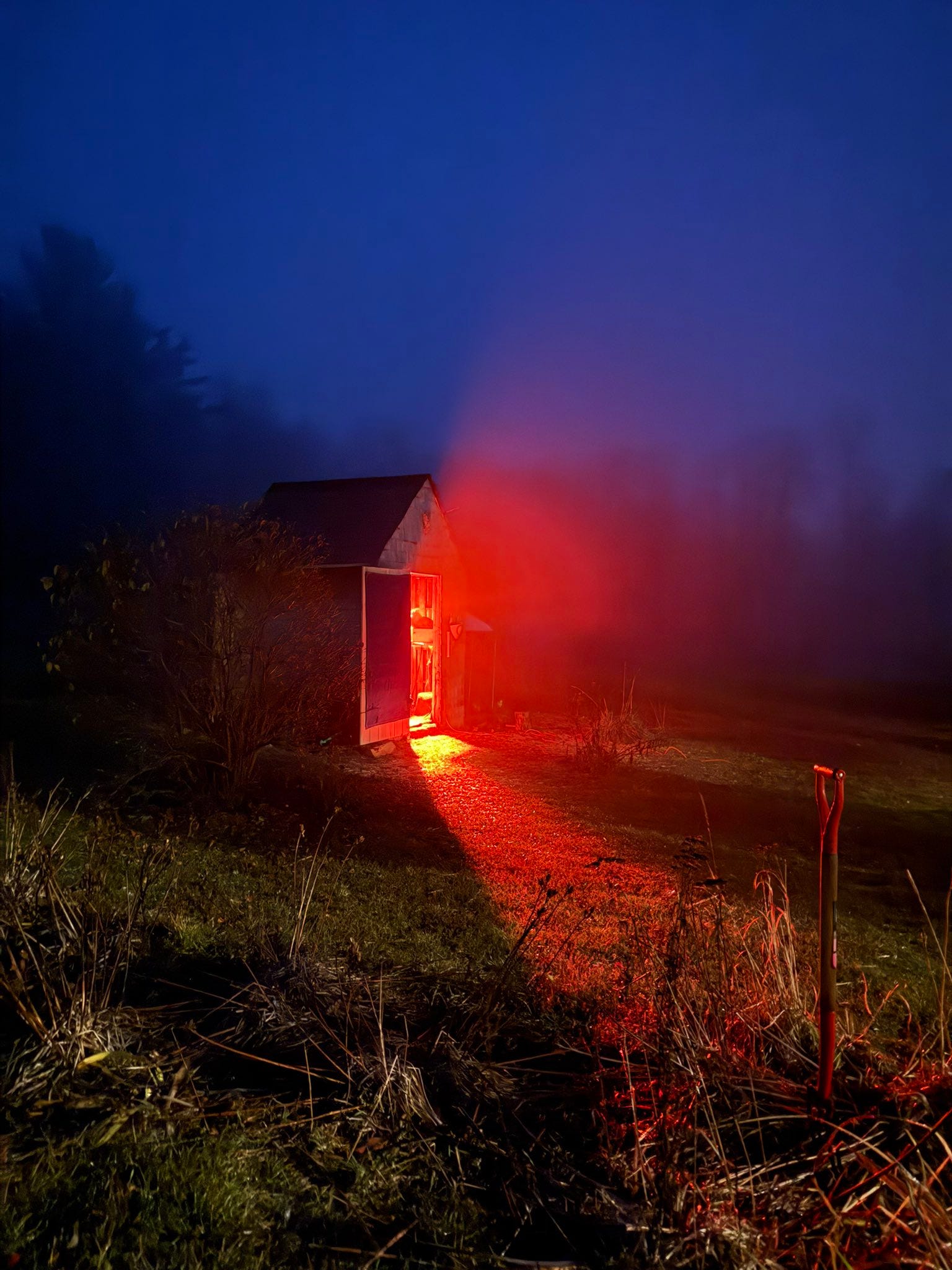
November contains a sort of harsh clarity. We see this first in the natural world; anything extraneous is shed. The trees drop useless leaves and limbs, the hives expel the drones, the animals become discerning in their movement, hibernate. The darkest stretch of the year, the heaving black throughfare leading to the solstice, does not allow for many frills. It is a time to conserve all things necessary and reject the ancillary. This is—like so many elements of the natural world—an invitation to reflect.
First, the act of shedding to the fundament in the natural world.
Second, the same act in ourselves.
Third, the rebellion of this austerity.
In the northern places, this stripping-down arrives early and without apology. The first hard frost rigors the fields, and what once sprawled in green excess now contracts into its essential, sharp lines. The marshes dull to pewter, their summer shimmer and buzz replaced by a quiet, skeletal geometry. Oaks and maples stand newly honest, their canopies surrendered, revealing the stark architecture beneath—angles, joints, and axes that summer’s abundance concealed. Even the coastline simplifies: tides pull back debris, winds flatten the dunes, and the ocean grows colder, darker, more deliberate in its motion. There is a sense that the land itself is tightening its belt, drawing resources inward, refusing all ornamentation. What persists does so because it must; what falls away does so without ceremony. This seasonal austerity is a lesson in instinct, in the ruthless intelligence of survival. The northern wild places do not cling to what cannot be carried through winter. They pare themselves to the minimal, the durable, the true. In this bareness, this disciplined retreat to the fundament, the landscape offers its quiet catechism: to endure, one must return to what is necessary, and let the rest go.
So too with us. The frost falls, the snow arrives, and we—however consciously or not—take stock of what we will continue to carry. The abundance of summer, the swimming holes and holidays and easy dreaming of all the good plans to come give way to fundamental needs. Indeed, even in our modern lives full of so many conveniences and ease, this holds true. The cold sets in and our gaze shifts from the horizon to the hearth. The dark arrives and we find ourselves gently rocking a sick child and twice-checking the latch on gate.
We stop planning and building to focus on the fundamental; our family, our home, our health.
Precautions are taken so the children never have to think about warmth or food.
An unwelcome noise outside causes you to stand a little longer peering out into the dark than you would have in the languid days of June.
Such is the invitation of November; you are called to shed your summer dreams and turn your entire focus to the immediate, the necessary, the true. This is good, the forced setting of priorities, the reframing of perspective. Whatever auxiliary hopes and small decadences remained are shed to reveal what matters. Warmth. Nourishment. Family.
Yet even within this season of bareness, there arises a kind of rebellion. It is quiet, human, and defiantly warm. We gather in kitchens that glow against the dark, coaxing abundance from our stores as if to remind winter that it cannot have everything. Its grasp may claw from the woodline all the way to the door but there, we proclaim, it must cease. The feast, in November, is an affirmation that austerity cannot fully lay claim to the human spirit. We roast with ceremony transforming the red harvest into something communal and light-bringing. Around a long table, we answer the starkness outside with laughter, with candlelight, with the laden plate passed from hand to hand. It is a refusal to let the season’s spareness diminish us. Instead, we meet the cold by gathering close, by feeding one another richly, by insisting that gratitude and generosity still have a place even as the world narrows. Though we stand in the dark and take stock of the fundament, this feast is our counterpoint to winter’s demand for simplicity: a reminder that while the natural world hunkers down, we are creatures who rebel by way of fellowship, by creating warmth where none is given, by celebrating audaciously the very abundance we have just finished paring down.
It is a paradox in a way, yes. Such is the way of things however, those lessons learned standing here in the early winter-dark.
Please subscribe to support our family’s beekeeping tradition.
Living the Year - Three Acts to Embody This Time
* Take a deliberate walk in a wild or quiet place and practice “noticing what has been let go.” Choose a trail, shoreline, or field and walk slowly, paying attention to what the season has stripped bare: the fallen leaves, the exposed branches, the drained marshes, the stillness of animals. As you observe, name (aloud or in your mind) one thing in your own life that can also be shed; maybe it’s an obligation, a lingering expectation, a distraction masquerading as necessity. Let the landscape teach you where to loosen your own grip.
* Shed to the fundament in your physical environment. Walk through your home room by room with a box or bag in hand, and ruthlessly discard or donate one non-essential item from each space. Something that no longer serves warmth, nourishment, or family. This mirrors the natural world’s stripping of leaves and debris, forcing a return to durable essentials like a secure hearth and stocked pantry.
* Rebel through a defiant feastGather your household or close loved ones for an intentional November meal (like our American Thanksgiving), lighting candles and sharing stories of gratitude around the table, explicitly toasting to the warmth you’ve conserved. This acts as a quiet rebellion, transforming pared-down resources into abundance and insisting on fellowship against the season’s austerity.