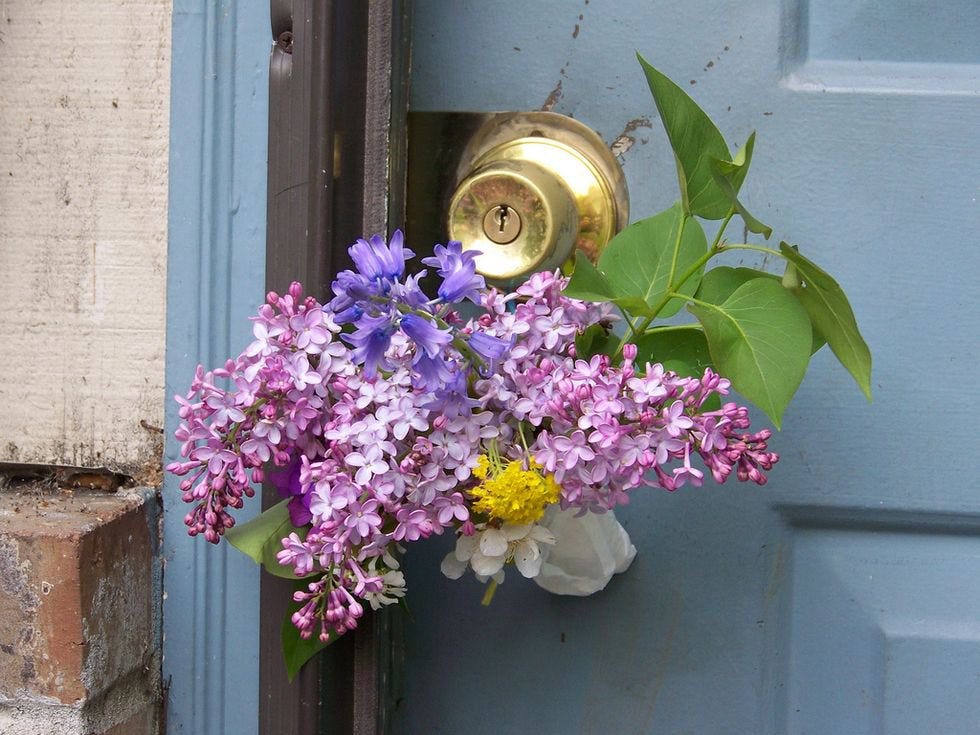
Picture it: two little girls run up to a door with a glint of benevolent mischief in their eyes. They’re carrying something, something colorful you can’t quite make out. They hang their little parcel on the door with a piece of ribbon or twine, knock, and run away. You spy their delivery: a paper cone filled with forsythia, daffodils, and pussy willow. The happy victim of the good prank looks around befuddled, notices the parcel, reaches in and pulls out a piece of chocolate that made its way under the flowers. They look up and down the neighborhood street but the girls have hidden behind a nearby bush, stifling their laughter behind cupped hands.
This is a May basket, and it is a tradition we are rapidly forgetting. It is a tradition we are losing.
The merry month of May approaches and with it May Day or Beltane depending on your pleasure. Nearly every culture in the northern hemisphere has some kind of celebration of fertility around May 1. How could they not? Life abounds. My aunt told me a story today of how she and her sisters would go “a-maying” to collect whatever wild flowers were blooming to decorate their door and the doors of their neighbors, leaving them in little baskets made of paper or just tied to the door. Some variations of the custom require anonymity, a sort of ding-dong-ditch. Some involve candy, baked goods, or even small trinkets. It is a sort of reverse trick-or-treating which is incredibly appropriate knowing that you are on the opposite side of the year from Halloween! Whatever the case may be, a May basket always has flowers and it is always given to herald the good green spring.
Traditionally, farmers in Northern Europe would turn their cattle out of the barn into the fields this time of year. The old Celtic tradition would also involve passing the livestock through or over fire as a sort of ward against an ill-fate. Young men and women too would jump over the fires to improve their virility or fertility! Some farmers around me still have parties this time of year to celebrate releasing their cows or other stock out to pasture. Growing up, we always had a bonfire and still do. There is so much to celebrate this time of year and yet we barely talk about it, let alone actively observe it. When you talk about May baskets, a-maying, “bringing in the May” or some other variation of the May Day tradition, someone will inevitably remark “Hey, my mother did this!” or “We did this as kids but not anymore.”
Well, why not? You can and you may need it now more than ever.
We should be reveling in the abundance of new spring life, heralding it in, shouting its arrival. We have become too staid, too fearful of seeming odd or off, of having our joy being mistaken for weakness and used against us. Our culture claims to celebrate random acts of kindness, but when was the last time you saw one? Something beyond a perfunctory volunteer opportunity or donation to the thrift store, something that showed a neighbor or someone in town that they were considered, thought of, loved for a brief moment?
So, how do you even make a May basket? Ultimately, the goal is to celebrate and remind your intended target that spring has arrived and we are the better for it. It needs to include the wildflowers blooming around you; daffodils, forsythia, hyacinth, anything that is bursting with life. You can buy them—sure—but harvesting the flowers yourself, especially on the evening of May Eve (April 30) would be in keeping with the good old way. You can make it into a bouquet, wrap it in a little twine, and hang it from a neighbor’s door knob. It can be that simple. If you want to take it a step further and give your children something to do, you can fold construction paper into a cone, fill it with flowers, and slip in some candy or even something you’ve baked. Maybe something to really evoke spring like a lavender cake or cookies made with honey.
Perhaps you really want to keep things as organic and low budget as possible while delivering your May joy. Find a forked branch, tie twine around the two legs and set your local wildflowers therein. This also works well as a standing decoration if your branch is long enough.
Whatever medium you choose for your May baskets, the point is not perfection: it is participation. It is choosing, deliberately, to acknowledge and celebrate the good green pattern unfurling before you, to lend your own small voice to the chorus of good things that grow. It is so easy, in a world so drawn to the novel and sleek, to forget the old ways, the quiet ways that once wove neighbor to neighbor and neighbor to land. These traditions, these good old ways, are not so far from us as we think. They lay quite literally at the roadside, in the fields, the forests, waiting for you to reclaim them.
If you remember even a scrap of this tradition from your own childhood, if your mother or your grandfather or a forgotten neighbor once left a basket on your door, then you already carry the ember. You already know what to do. If you do not remember, if this is your first whisper of May baskets and a-maying, then all the better. You have the honor of reviving it, of giving it fresh life with your own hands.
There is no committee coming to save these things. There is no special interest or lobby eager to revive the customs of your ancestors. No official proclamation will decree that May baskets must be made, that flowers must be gathered, that neighbors must be gladdened by some small, ridiculous, beautiful gift on a bright May morning. It is ours to choose. It is ours to lose.
Choose.
Go a-maying. Run wild and good and secret with your children, your friends, or with your own happy self. It does not matter if you are a grandmother with her children’s children or a young bachelor with his rowdy friends; snip the flowers by the roadside, fold the paper cones, tie the twine. Knock and run. Laugh behind the bushes like the good old things can still happen. They can. They can because of you.
Anything good that can happen will happen but only if we let it. Only if we reach out our hands—mud-streaked, pollen-dusted, treat-sweet, thorn-scraped—and make it so.
May is almost here.
Make the basket.
Surprise your neighbor.
Keep the tradition alive.
Echoes from an Old Hollow Tree is a reader-supported publication. To receive new posts and support my work, consider becoming a free or paid subscriber.
Author’s Note: this week, our usual schedule needed a small shift. You’ll receive the premium Report from the High Wood on Wednesday, and the free Echo from an Old Hollow Tree today. Imploring my readers to make May baskets was too important to wait until Wednesday, as May 1 is Thursday. Sometimes people need time to pick flowers.
If you’re not yet a paid subscriber, now is a wonderful time to join. The exlcusive Reports from the High Wood offer practical lessons, hard-won insights, and a deeper look at the real work of tending land, family, and tradition—all shared so you can carry something steady and useful into your own life.
There’s something special on the horizon: on May 3, we’ll be receiving twelve new packages of honey bees for our hives—a major leap for us, and the largest expansion we’ve ever undertaken. We’ve never scaled up like this before, and the lessons we’ll be learning (and sharing) will be real, raw, and hard-earned.
This is a rare moment, a once-only season of growth and challenge that won’t come again in quite the same way. Paid subscribers will get a front-row seat to it all—and the insights, mistakes, and victories we gather along the way will be yours to carry into your own work, homestead, or dreams.
Thank you for walking this old path with us.