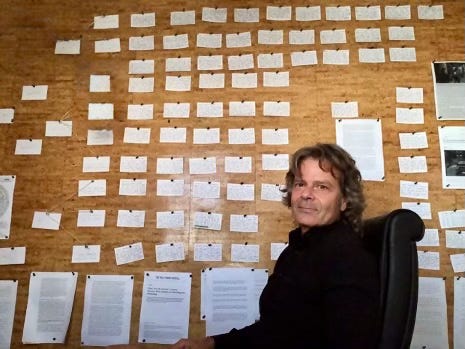
I suppose it’s because I had a good night’s sleep that I feel better than yesterday. I thought I couldn’t write a single word because of the alarming lack of relevance. Writing fiction requires a massive focus on a story that sometimes makes no sense, and sometimes it truly does. Navigating between these two extremes is quite intense and certainly not for the faint of heart.
I had the bad luck of growing up in a time when the plot seemed useless. In fact, I could say the novels I loved were a kind of chaotic mess.
When did I begin to appreciate a plot? That’s easy! Writing my first manuscript, I ran a free-fall plot, which brought about a large number of characters. So, at the time of ending such an orgy of creativity, the protagonist looked like a bit player.
Of course, that little crack went unnoticed until I began to receive the feedback of my first agent, who in a moment of candor, said:
“You could have written seven novels if you had had a plot.”
Needless to say, Mrs. Kerrigan was right. She had a business to run, books to pitch for big publishers, not a lab of crazy ideas, but a literary agency.
A friend of mine was way more graphic:
“Next time, cut the bologna in thin slices.”
That was bound to happen. So, with the first lesson learned, my second novel was a tour de force. But I missed out on Cervantes’ trick of giving voice to 600 characters. On the contrary, I ran a mix of triangle affair and coming-of-age novel.
And yet, I did not run the distance, the 120,000 words that make a good brick of waste paper a beautiful printed ephemera to fill the windows of a bookstore. On the contrary, I fell short because I had no idea what a canonical novel was. A behemoth of five hundred pages. Otherwise, your literary dreams will go to the pile.
A younger version of me thought a page turner a thing of the past. Like when Tolstoy wrote novels like War and Peace –or Cervantes ran a carousel of freaks he certainly would have met once in the funny pages of Don Quixote.
Lesson learned, the result was the corkboard, the card notes, the three acts, the rolling scenes, and the facts that give speed, flow, and beat to the characters. At the back of my desk, I want now order, not menacing chaos, which might destroy or diminish my creative efforts. No board, no compass to get through the day.
And the actual version of me is making peace with the idiot I am self-portraying in this mirror of ink – or whatever are these winged words because you are hearing me.
All I want is to run the distance, flow like a f*****g river if I have to, and manufacture something to remember, beyond all sorts of ephemera.
Yesterday, Alan Ball was in town, the screenwriter of the film American Beauty and TV series Six Feet Under. And hearing his masterclass was certainly a shock for me. That a multi-awarded screenwriter could blame the poor creative zeitgeist in such terms was mind-blowing.
And I’m quote:
“It’s depressing. All they want now is something that looks like something that has been successful. The competition is fierce. Everything is tremendously oppressive. It seems that the fear that floods everything is also in the writers’ rooms and especially in the directors’ rooms. Creativity is dead. That’s why I’ve left it. I’m writing a novel. And I’m enjoying it a lot. You know why? I don’t have an opinion on what I do. No one is intervening in my creative process. For once, I am alone. For once, no one is going to control me. Anything is possible. And it’s perfect.”
End of quote.
I’m already handwriting word by word Allan Ball’s utterance in one of my cards, and punching it quickly on the corkboard, to avoid that such wisdom thins itself out as the foam of days.
And all because of you, my silent friend. Nothing I do on a daily basis is because of me. If I had my way, I would settle for being something between a clown and a conman.
And certainly I have those personal traits, given the Jungian shadow I cannot see. In moments of extreme clarity, I feel like walking home in a daze and broke after betting all my riches on the horses. Yeah, a struggling writer is closer to a professional gambler than you might think.
It helps if you have plenty of courage to fail big and don’t dwell on it, or if you sell your poor soul to the very Devil. Or both. It’s always about faith. I’m not a man of the cloth, but certainly I am a man on a mission.
During the pandemic while taking care of my old man, a karmic chance like no other I could imagine, what really changed me was confronting the fact of what shoes I had to fill after he passed away. After mourning him for two years, it’s time to let it go.
And it’s time to reach the goal of this podcast. It wasn’t my intention to write essays or a journalist column but fiction, because that was the Substack shelf I chose. Books and Fiction. The goal was narrating my own work, and someday have it all done to upload it to the audiobooks platforms like ACX and whatnot.
If Alan Ball, the guy who wrote about a plastic bag dancing in the wind as the most beautiful clip the character named Ricky Fitts could show to Jane, the ultimate and freak teen girlfriend, has switched to the art of sewing words, it’s because he trusts in the might of abstraction without limits of any given written language.
The freedom you have in a blank page, the quiet epiphanies you try to tame with just words, and how much craft you put into a simple dash to elaborate a concept.
I won’t miss out on those days of heaven ahead of me.