Hello Friends,
It’s getting to be something of a cliche to say “Another hard week!” I hope you have found the things that help you make change in the world.
The short story I’m working on lost its voice somewhere in the middle, so I have to work on landing that. I wanted the final scene to be both wacky and poignant—in other words, to have the flavor of life that teaches and nurtures me. I haven’t gotten that down yet—it’s a tough mix—but I persist. For encouragement, I started to read Truth is the Arrow, Mercy is the Bow: a DIY Manual for the Construction of Stories by Steve Almond. And there is much that is encouraging, many good ideas on how to lay the foundation of a story. But this made me laugh and I want to share it. If you are an avid reader, but not a writer, you may be surprised. If you are a writer, you are nodding along:
Let me start by stating something I hope we all have in common, which is that I find writing excruciating, a form of self-imposed exile with a side order of shingles.
Banned books and Sold by Patricia McCormick
Last week I included the list of the top eleven banned books of the 2023-24 school year and discussed the first three:
* Nineteen Minutes by Jodi Picoult
* Looking for Alaska by John Green
* The Perks of Being a Wallflower by Stephen Chbosky
and you can look back at that post on Perks and at this one on Alaska if you want to see why I think those books belong in the high school library.
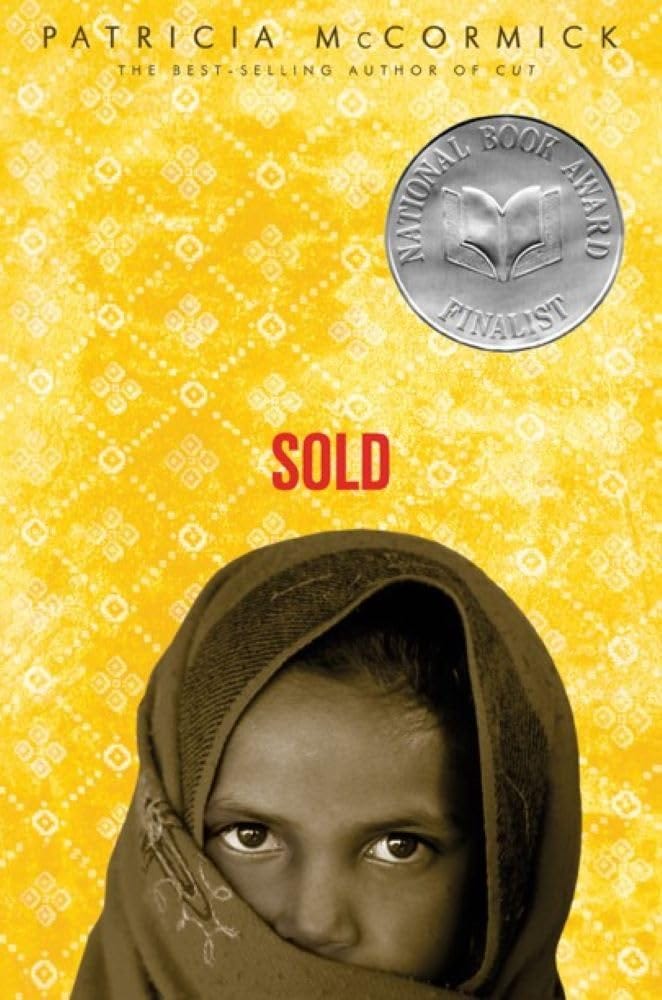
The fourth book on that ‘top banned books’ list is Sold by Patricia McCormick. We had multiple copies in the library and it was pretty popular. A librarian can’t read all the books in her library (we had a big library for a high school—over 40,000 books)—and Sold was one I hadn’t read.
I’ve discussed previously how librarians select books based on reviews and awards. As it happens, I’d read another book (Cut) by the author, Patricia McCormick, and found it very good, realistic, and hopeful about family trauma and therapy. In addition, it had wide appeal to our students and was accessible to all, even those who were reluctant readers. I booktalked it to classes. So when the reviews on Sold came out, it was a must purchase. And then it was a National Book Award Finalist.
With the other books I’ve discussed, I’ve posted my thoughts from years ago—thoughts I had when I first read the books. I thought it would be fun this week to read Sold and discuss it since it’s next on the list. So, read it I did, this Thursday.
Sold is about a thirteen-year-old girl, Lakshmi, who lives in poverty in a small village in the mountains of Nepal. Her stepfather gambles away money the family doesn’t have. He has a crippled arm and does no work of any type because of it. However, he is able to ride a motorcycle, gamble, go to the tea house daily and meet up with friends. Lakshmi’s mother tells her that it is better to have him than no man at all, an assumption the reader knows isn’t true, one based only on the patriarchal rules of the culture.
When a monsoon washes away the family’s crops, they are desperate. Lakshmi is told she is being sent to India to become a maid in a rich woman’s house. She doesn’t object, thinking she can save her family and send her earnings home. She imagines they will be able to buy a tin roof for their hut. Her mother is sad because she wanted Lakshmi to continue with school. But she instructs Lakshmi on how to gain favor as a servant and believes she will see her after a period of separation.
What neither mother nor daughter knows is that Lakshmi’s stepfather has sold her into sexual slavery. (The publisher’s summary says ‘prostitution,’ but that’s not the right description.) When Lakshmi figures out her fate, she hopes to earn her way out. But the old woman who runs the brothel is deeply cruel—perhaps sadistic is a better word—and also makes it impossible for Lakshmi to get ahead by charging for food, clothes, medicine, 50% interest on the money ‘loaned’ to her parents, etc.
When a possible opportunity for escape comes, Lakshmi doesn’t know what to believe as she has been lied to so many times by so many people, always being put in danger.
While this is a novel about a very dark topic, it is full of beauty and hope. The narrative is a novel in verse, very brief and very poetic. In Nepal, Lakshmi has the open heart of a poet, seeing the beauty in nature all around her, eloquently describing it. Even in the brothel, she makes friends with some of the other girls and learns a bit of English and Hindi from the child of one of the women there.
So—as this book is about a very difficult topic, why have it in the high school library?
* Trafficking of girls (and boys) is a topic that seems to interest conservatives, a thing they claim to want to put an end to. (Remember the Pizzagate conspiracy theory?)
* Information is power. The author interviewed trafficked girls and activists fighting for them to present this realistic portrayal.
* Knowledge of these terrible but very real circumstances engenders empathy.
* Empathy may engender action. Many high school students form clubs, get a teacher to be their advisor, bring guest speakers, and raise funds to fight for good in the world.
* High school activism is a foundation for a life of concern and goodwill for humankind. Even if a student doesn’t get to this step, they’ve done the first step: read the book.
As PEN America has pointed out, 57% of the books banned in the 2023-24 school year had sex or sex-related topics. And, yes, some of them have normal, sexually-active-teen issues. But a good number are like Sold, books that are frank looks at abuse. Which is important for this age group (see bullet points above.)
In an interview, author Patricia McCormick states that her goal is to “tell this heartbreaking story from the point of view of one individual girl. … I believe that young adults want to know what's happening to their peers on the other side of the world, but that media accounts, by their very nature, cannot usually go beyond the surface. To me, there is nothing more powerful—or permanent—than the impact of a book.”
Now—here’s an ask of you. I usually mention that I’m going to include all the spoilers because you are most likely an adult and are not going to read the banned book. This time, I didn’t include the most important spoilers. I want you to read Sold. It’s so short—it’ll take about three hours, four if you look back over the lovely descriptions and read them aloud to yourself. It’s the perfect book to use to see for yourself what is going on in these banned books. The time investment is minimal; the reward is great. Think about those 57% of banned books having a sex-related topic. Should we address these topics with teens?
What I’m reading
As mentioned above, I’m reading the writer’s guide Truth is the Arrow, Mercy is the Bow by Steve Almond. I’m about 25% into it. So far, good ideas. Recommend for writers.
I read Sold this week, see above for detailed account.
I’m listening to Hollywood Park by Mikel Jollett. A friend (who is one of our readers here!) recommended it since the library of my former hometown has selected it for a citywide read. Plus, it has the cult connection, which I am always interested in. Jollett spent the first years of his life in the Synanon cult, separated from his parents and raised ‘by the universe’—much like an orphan. I thought the book would be about this, but it opens with him, his mother, and his brother escaping. And while he’s a small child, the fallout is incredible. And that’s what the story is about.
Just for fun: do you have a favorite?
Before we move on to the library news of the week, I thought you might enjoy this. I asked my son for help on switching up my ‘donate once’ button since PayPal was not allowing it. I’ve gone to ‘Buy Me a Coffee.’ I told my son I liked four photos I had taken that could be the background for the donation button. Here they are (these are NOT clickable—just for fun!)
The photos with the skeletons are from my Pilates teacher’s yard at Halloween. She’s…