Struggle is a never-ending process. Freedom is never really won, you earn it and win it in every generation.— Coretta Scott King
Hello Friends,
I hope you have been enjoying the Olympics. We had a birthday celebration this weekend, and I got to try a Himalayan restaurant (Indian, Nepali, and Tibetan food) and have ultra-chocolatey cake (recipe below). I’m also happy that my vision has cleared up a bit.
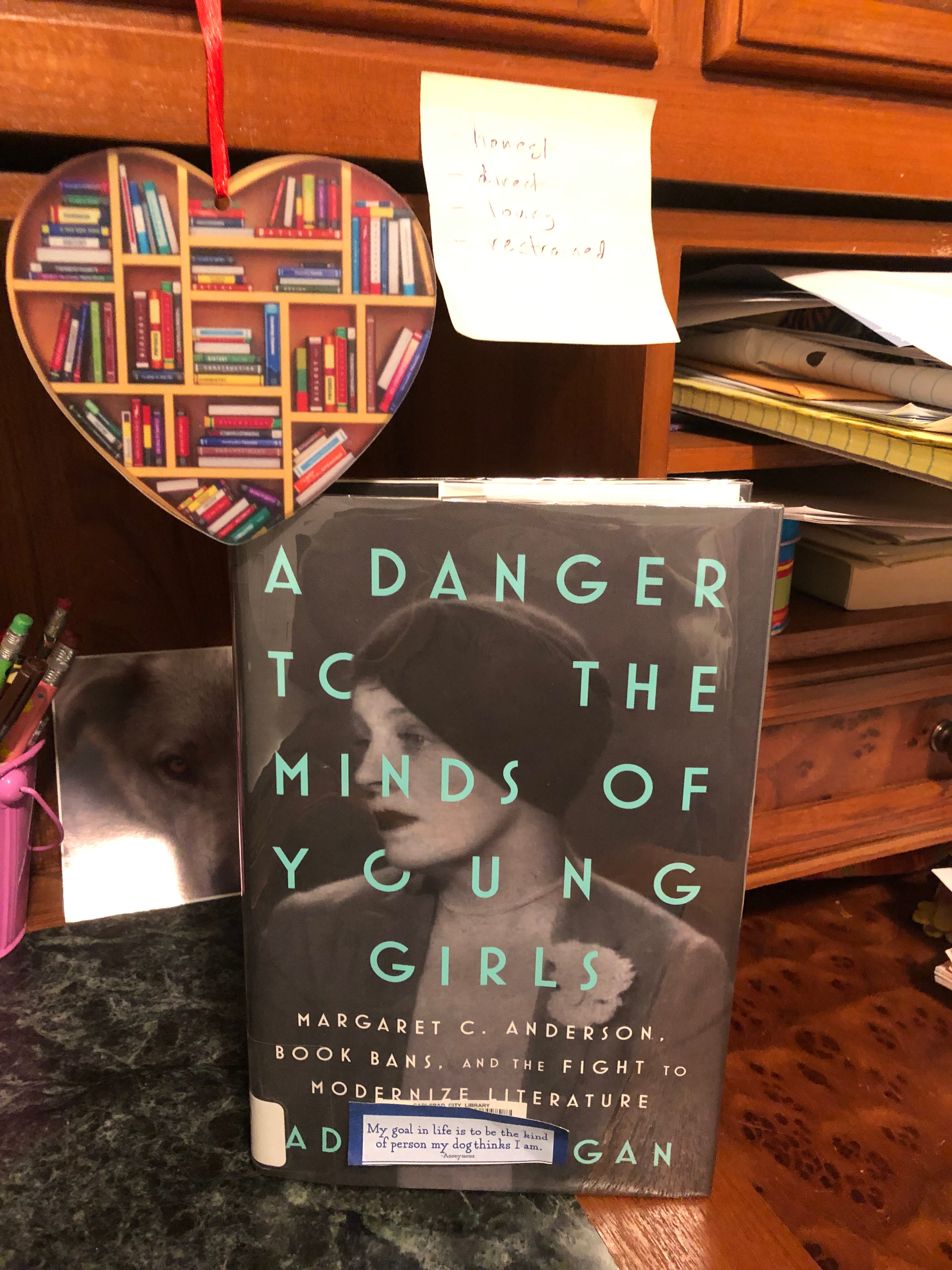
Today I want to chat up A Danger to the Minds of Young Girls: Margaret C. Anderson, Book Bans, and the Fight to Modernize Literature by Adam Morgan. After that I have a little on the new author scam industry, abetted by AI, which allows the scammers to act like they’ve read books they know nothing about.
A Danger to the Minds of Young Girls
“The Red Scare made Americans paranoid that anyone they passed on the street could be a bomb-wielding anarchist, and Comstock and Sumner’s book-banning campaigns stoked fear that reading modern fiction and poetry could turn young women into disease-ridden lesbians and prostitutes.” (3)
On October 4, 1920, Margaret Anderson was arrested and charged with publishing a ‘filthy, indecent, and disgusting’ work of fiction—an excerpt from James Joyce’s Ulysses—in The Little Review and distributing copies through the Post Office Department in violation of the 1873 Comstock Act. A Danger to the Minds of Young Girls is the story of what led to this incident and what followed.
Anderson was born in Indianapolis to an affluent and conventional family that included a depressed father, a controlling mother, and two sisters who shared some of her adventures. In 1908, she headed to Chicago, which was in artistic and literary bloom. At the time, Anderson was supported by her parents, who sent her sister to live with her in an effort to keep her on the safe side of societal norms.
Margaret worked at various journals, increasingly more prestigious, eventually landing at The Dial, the most influential literary magazine of the time. There, she held various positions and learned many of the practical aspects of publishing a magazine. She met the “most prolific artists and writers” and by 1913 was gathering support to launch The Little Review. She did so in 1914. Though she was unable to pay contributors, she published many great writers because “[m]ost … magazines and publishers that could afford to pay poets and writers in those days were not—yet!—interested in the bizarre, mystifying, sexually explicit, or politically radical writing Margaret would champion in The Little Review.” (38) The list of contributors include the literary rockstars of the period. Conrad Aiken, Amy Lowell, and Sherwood Anderson were early contributors.
In a stroke of luck, in 1916-17 Ezra Pound, who had previously been published in The Little Review, petitioned Anderson to publish him and T. S. Eliot in each issue, James Joyce when he liked, and Wyndham Lewis if he “comes back from the war” (93)—all writers “too odd and obscene to be published in major magazines that paid contributors.” (94)
Pound wanted a guarantee of 5,000 words per issue and eight issues per year. If he could get this, art collector, patron of the avant-garde, and lawyer John Quinn, would pay the authors. (They needed a source of income.)
The deal was made and began in April 1917. In 1918, The Little Review started to publish sections of Ulysses serially. By 1919, it was being censored—copies were held at the post office and later burned—and by 1920, Anderson and her co-publisher and life partner, Jane Heap, were on trial. This period contains the heart of A Danger, which includes long quotes from the published sections of Ulysses which were deemed obscene, as well as what Anderson and Heap self-censored in an effort to continue the serialization.
Thanks for reading Be a Cactus! Subscribe for free to receive new posts and support my work.
Supporter of the avant-garde, lawyer John Quinn (mentioned above as the one who paid Little Review contributors Pound, Joyce, Eliot, and Lewis) ended up representing Anderson and Heap at their trial. While he was on the cutting edge in art and literature, he was socially conservative—it may be more true to say homophobic and racist. He, therefore, resented working for Anderson and Heap as he didn’t approve of their relationship. In truth, he hoped to have the case dropped if the women agreed to stop publishing Ulysses. He believed this would help sales of the novel when it was published because Little Review readers would want to finish it.
Over the life of the magazine, Anderson’s choices sometimes threatened its existence through the loss of her patrons. Her support of the anarchist Emma Goldman was especially controversial among her early donors and subscribers. In 1914, Anderson’s father died at the Central Indiana Hospital for the Insane in Indianapolis of a hemorrhagic stroke caused by a ruptured blood vessel in the brain. His death ended Anderson’s parental support. Her mother, whose conventional morality was ruffled by everything Margaret did, cut her off when she refused to abandon the magazine. They never saw one another again.
Anderson is courageously undeterred. I feel that her early (extreme) privilege was necessary to her undaunted sense of the importance of her work. Still, she proves stalwart. Out of money and evicted from their apartment after expressing support of Emma Goldman, she and Heap create an encampment on a Lake Michigan beach north of Chicago. Later, they break into a house in California. When they learn the owner is the local sheriff, they convince him to rent it to them.
In fact, much of what takes place in Danger feels like the story of another world, both the weirdness and the luck. At times, Anderson and Heap live in French castles. When Anderson’s sister divorces, she and Heap adopt her children only to later leave them in Paris with Gertrude Stein and Alice B. Toklas, who then adopt them. (Wouldn’t you love to read the biography of those boys?) Unbelievably, Anderson, an accomplished pianist, gets the Mason & Hamlin Company to give her a new piano in exchange for free advertising each time she moves into a place where she has room for one (by my count, four pianos).
Anderson and Heap published their last issue in 1929. Ulysses would be published as a complete novel in Paris by Sylvia Beach, who didn’t fare much better than Anderson for all her support of Joyce.
In her introduction to the 1972 edition, Flanner describes the process by which “Ulysses,” …. was brought about:
Ulysses was the paying investment of his lifetime after years of penury, Sylvia said, while hardly acknowledging the fact that the publishing costs almost wiped out her Shakespeare and Company. The peak of his prosperity came in 1932 with the news of his sale of the book to Random House in New York for a forty-five-thousand-dollar advance, which, she confessed, he failed to announce to her and of which, as was later known, he never even offered her a penny. “I understood from the first that, working with or for Mr. Joyce, the pleasure was mine—an infinite pleasure: the profits were for him.”
( Janet Flanner, introduction to “Paris was Yesterday,” quoted in “By way of Books and Their Makers: Sylvia Beach and James Joyce” by Macy Halford, March 5, 2010, “The New Yorker.”)
After they end publication of The Little Review, Anderson and Heap both join a cultish group of followers of George Ivanovich Gurdieff.
“By following him, his students could evolve their minds into something semi-divine—and if enough human beings did the same thing, their collective consciousness could prevent the destruction of the universe.” (190)
After a serious car accident, “Gurdjieff spent most of his time writing and dictating a manuscript that would become Beelzebub’s Tales to his Grandson, an allegorical representation of his trackpads that reads like a Byzantine science fiction novel.” (192)
It’s a strange turn in their previously admirable lives.
A Danger includes a good deal of background for each major character or influence that we meet. We learn what William Carlos Williams wore and that Ezra Pound was engaged to Hilda Doolittle twice. While the lives of literary superstars might interest English majors, I think some readers will find the book a bit saggy and off point in these interjections.
We also get the background of the many women that Anderson and Heap conduct affairs with and of those they partner with after their breakup. (Opera singer Georgette Leblanc is Anderson’s second significant love, and they remain together until Leblanc succumbs to cancer.) So many people circle one another in a dance of changing partners that it’s hard to keep them straight, and I’m not sure they all contribute to the story.
Ultimately, though, Anderson’s life is worth the tale. Wild and wonderful as it is, it makes a good read and adds to the literary history of Chicago of the first quarter of the 20th century.
I had requests for strawberry shortcake for the last two birthdays. This time, there was no special request, so I felt like going back to an old favorite—Hershey’s Cocoa Cake. This is super easy to make. I plan to make a slightly more complex chocolate cake for St. Patrick’s Day (Guinness stout, coffee, ganache filling are all involved), but this week, I just wanted something straightforwardly sweet and moist that screamed chocolate.
Here’s the cake recipe. Here’s the frosting recipe.
For Writers
AI Aids Publishing Scams- If you’re a writer with any published work, I’m sure your used to the emails that say, “If you’re interested in having a book featured in our upcoming campaign, please reply with up to three titles you would like to include.” Or something close to that. And you know that it’s a scam because they don’t mention you specifically or the title of any of your works.
Now that scammers are using AI, they can name books and say something about their themes or plot. But it doesn’t take much wariness to I figure out that someone is just trying to get into your bank account. I saw two interesting Stacks about that this week.
Phil Christman published about it this week, but it’s behind a paywall.
While Cati Porter knew she was being scammed, she decided to engage with more than one of these emails. As she said “Doing my due diligence--so you don’t have to.” Then she goes a little deeper. (NOT recommending you engage with scammers—just check this out to see what happens.)