Hello Friends,
I had a great time last weekend at my ‘soft launch’ for Keep Sweet, which will officially launch June 21. Beautiful venue, lots of friends and family. A dream come true! I hope to post about that journey—my first book launch was on the day of my mom’s funeral—next week. Meanwhile, I’m back to wondering about America’s cultish behaviors. This is long, a deeper dive, so I’m holding off on “What I’m Reading,” etc. Also, if you’re in a hurry, treat the last section about specific cults like a sidebar. Or go ahead and listen to the audio while you cook, clean, or push the swing. The week’s banned book news is here.
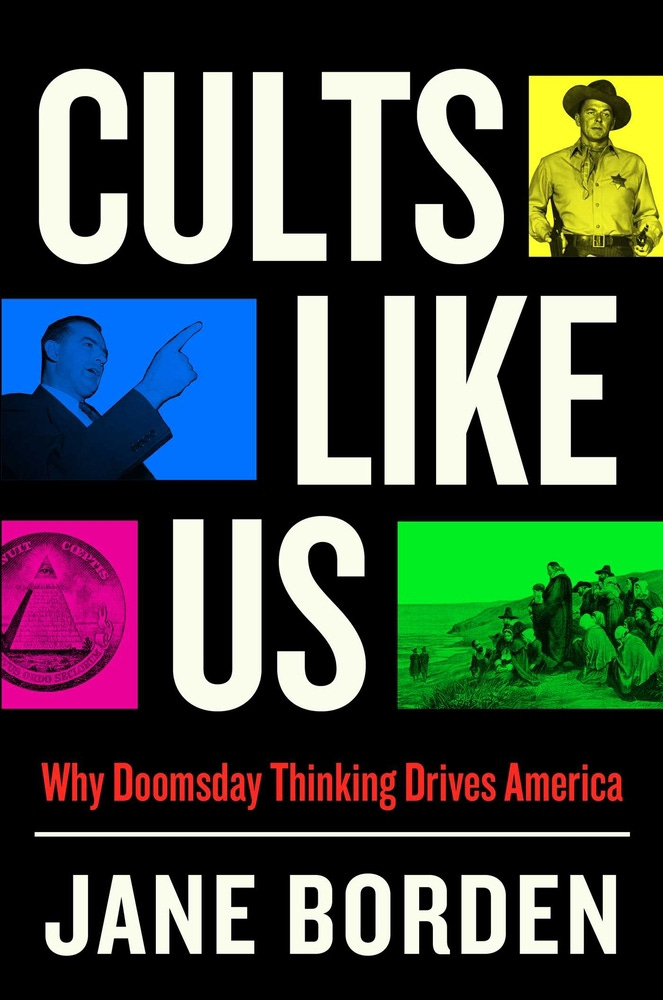
Cults Like Us: Why Doomsday Thinking Drives America by Jane Borden
If you have been a subscriber for a while, you know I have been exploring the question of cults, and, lately, the question of Donald Trump’s popularity in the United States. (Which, granted, may be waning now that he has had a chance to put his ideas into play.) It has always seemed to me that there’s a connection between Trump’s popularity and cults. In seeking an explanation for the connection, I recently read Wild Faith: How the Christian Right is Taking Over America by Talia Lavin and discussed it here.
Wild Faith didn’t answer my questions in that it only accounts for the 14% of voters who are evangelical Christians and not the other 36ish % who also picked Trump repeatedly. In Cults Like Us, I found an answer. Not a perfect answer, of course, but one that makes sense when we look at American thought over time. That overview starts with the Puritans.
While admitting that the Puritans were not a cult (ask yourself who the charismatic, all powerful leader was—there wasn’t one), Borden argues that their arrival to what is now Massachusetts in 1620 brought the beginning of a still active doomsday culture. This current culture in the U.S. is not limited to religious groups, but has gone secular big time with the help of the media we consume—advertising, movies, and now online influencers.
Cults Like Us argues that Americans think in apocalyptic terms because the Puritan/Pilgrim concept of our country as a shining city on a hill—our notions of exceptionalism and, the flipside of that coin, persecution—undergirds all of our thinking.
In an author’s note and then in an introduction, Borden discusses Puritan thought. This is pretty much a requirement since most of us only learn that they were involved in the first Thanksgiving and, seventy years later, conducted the infamous witch trials. Those trials ended in the hanging of 19 people and two dogs as well as one man being pressed to death. This witch hunt effectively ended their community, and they were absorbed into the population at large. How did they manage to so thoroughly self-destruct?
The Puritan work ethic, one practiced in the United States, is based on the idea that pursuing a calling (i.e., working) is the best way to glorify God. Having a calling is an external sign that a person is among the chosen rather than the damned. In addition, as a doomsday culture, the Puritans awaited the end of the world, and their leaders predicted it frequently. (E.g., Cotton Mather predicted it for 1697, 1716, 1717, 1727, and 1736. He died in 1728, so he stopped making predictions at that point. ;-))
Puritans believed it was their duty to destroy sin in others, and they did not allow dissent. It’s no surprise that a high-control group like this ends up accusing one another of practicing witchcraft.
The way the group destroyed sin in its members was to control their “behavior, beliefs, and information intake, all via high pressure to conform. Mandatory church attendance. All transgressions made public. Residents forced into informants.” (17) In addition “Puritans were so obsessed with obedience, as most high-control groups are, that rebellious children could even be sentenced to death. Fortunately, no child received this sentence, but the fear it instilled and made commonplace was effective enough.” (18) Parents who were too indulgent of their children risked their own salvation. High levels of affection were reserved for God.
Once Borden establishes this as the foundation of her argument, she delineates the characteristics of a cult. For the sake of clarity and compression, I’m going to make lists here, which is not the structure of the book.
Psychologist Robert J. Lifton defines cults as having three characteristics:
* a charismatic leader who increasingly becomes an object of worship
* coercive persuasion or thought reform (i.e., brainwashing)
* economic, sexual, and other exploitation of group members by the leader and the ruling coterie.
To these, Borden adds her own characteristics:
* the leader enjoys unchecked power
* the leader exploits people, specifically by manipulating their latent beliefs and desires
* the leader almost always exhibits some kind of narcissistic personality disorder
* groups can be of any size
Since thought reform (brainwashing) is central to cult success, Borden includes the criteria that define it:
* information and communication are controlled
* perfection and purity are demanded
* sins and faults are openly discussed and excoriated
* doctrine and leadership are ultimate truth and beyond criticism
* personal experiences are subordinate to ideology
* language and thought-terminating clichés are used to force conformity
* everyone in the outside world is evil
* experiences are orchestrated to appear spontaneously mystical.
She also notes that sociologists agree that cult-like thinking surges under specific circumstances—in times of:
* technological revolution
* social upheaval
* crisis
The bulk of Cults Like Us is made up of chapters, each of which covers a single characteristic of a cult and has many examples that fit the bill, some small, some with large followings:
* our desire for strong man to fix our problems and punish those who aggrieve us
* the temptation to feel chosen, which justifies acting on our base desires
* our knee-jerk anti-authoritarianism (in this meaning, an authoritarian is often a coalition of powerful and evil people who conspire against good guys like you and me—a sort of antagonist. I mention this because the the cult will follow an authoritarian that it believes will fix its problems, say, a fascist); anti-intellectualism
* our impulse to buy and sell salvation on the open market
* the belief that hard work is holy, while idleness is a sin
* how quickly and easily we fall into an us-versus-them world view
* a need for order which makes us vulnerable to anyone screaming chaos and then offering control.
* She also explores what she calls an eighth credo, which is the grace-nature divide, which distinguishes and creates a hierarchy between humans and the rest of the planet.
One last important element of cult thinking is that they have an apocalyptic vision of the end of the world. A lot of the religious (particularly Christian) groups have this in common. They get it from the New Testament Book of Revelations, so Borden takes some time to discuss it.
“Revelation is not simply the title of this work. It’s the title of a genre. Many works in the genre were produced during the first and second centuries, times of great economic, and martial strife, which were always marked by increases in end time thinking, and the accompanying vision of how it will go down. But of the revelations produced around then, only John’s had stood the test of time. First, its vague and coded language—likely employed to save himself from Roman retribution, via plausible deniability—has allowed groups throughout history to plug their own enemies into its narrative. It’s beloved mostly for its violence. One persecuted group after another has found solace in its visions of its own oppressors squished inside the wine press. We are vengeful creatures, we humans, we grapes of the Earth.” (35)
End Times cults in the United States have been so numerous that I don’t want to go over the examples here. (However, I include some in the list at the end of this post.) Suffice it to say that Borden discu…