Hello Friends,
I’m finishing up early again this week because I am going to go hang out with a friend whose mother died last week. I think I’m going to skip all that I feel about the world at large (and, boy, is it a lot) and just jump right into thoughts on books.
AI and stolen books
When I read this week that Meta used the illegal pirate site LibGen to train their AI, I knew my collection of short stories, Acts of Contrition, wouldn’t be among the pirated works because it was never available digitally. But I saw this article and decided, what the heck, I’ll put my name in the search engine:
Meta’s Massive AI Training Book Heist: What Authors Need to Know
The Atlantic published a search tool that allows authors to check if their works are in LibGen, an illegal pirate site AI companies copied for their AI systems. … [T]his new list has more than 7.5 million books that were copied, at least in part if not in full, by Meta and other AI companies for their AI systems. It is not clear whether Meta downloaded and used every book in LibGen.
I’d forgotten one thing. I have a short story in an anthology (Best Stories from the Saturday Evening Post Great American Fiction Contest) and it was published digitally. It’s on the list. Ugh. What a weird feeling it is when someone scoops up your work.
AI book summary
I’m thinking about what Bill Gates said this week about AI taking over lots of human work in the next ten years and that we will have the two-day work week.
As AI takes aim at the workplace, Gates admitted there will be professions that see much more change than others. In his conversation with Fallon, he singled out doctors and teachers as two pathways that will experience replacement—but to the benefit of society as a whole.
“With AI, over the next decade, (intelligence) will become free, commonplace—great medical advice, great tutoring,” Gates said.
That’s a very positive view of the situation. I’m far less sanguine about the advice we get from AI. Here’s an example. One of my sons sent the family this, which is Amazon’s AI-generated book summary.
“Customers find the book easy to read and interesting. They appreciate the insightful and intelligent rants. The print looks nice and is plain. Readers describe the book as a true work of art. However, some find the content boring and grim. Opinions vary on the suspenseful content, historical accuracy, and value for money.”
Another of my sons guessed Moby-Dick—a good guess, I thought. (Note: if you want to read Moby-Dick because it’s an American classic but haven’t been able to get into it, get the audiobook from Recorded Books narrated by the fabulous Frank Muller. Only that recording!)
The correct answer?
Mein Kampf by Adolf Hitler.
I’m not so sure that AI is the teacher I want.
“That Librarian” Amanda Jones will be in Conversation (Online) with the LA Co. Library
Amanda Jones is going to be in an online conversation with the LA County Library. Although I have a library card, I didn’t need it to register. It appears to be open to all.
April 10, 2025 6-7 PM (PT)
https://visit.lacountylibrary.org/event/13216324 to register.
Note : I wrote a post about Amanda Jones’s That Librarian.
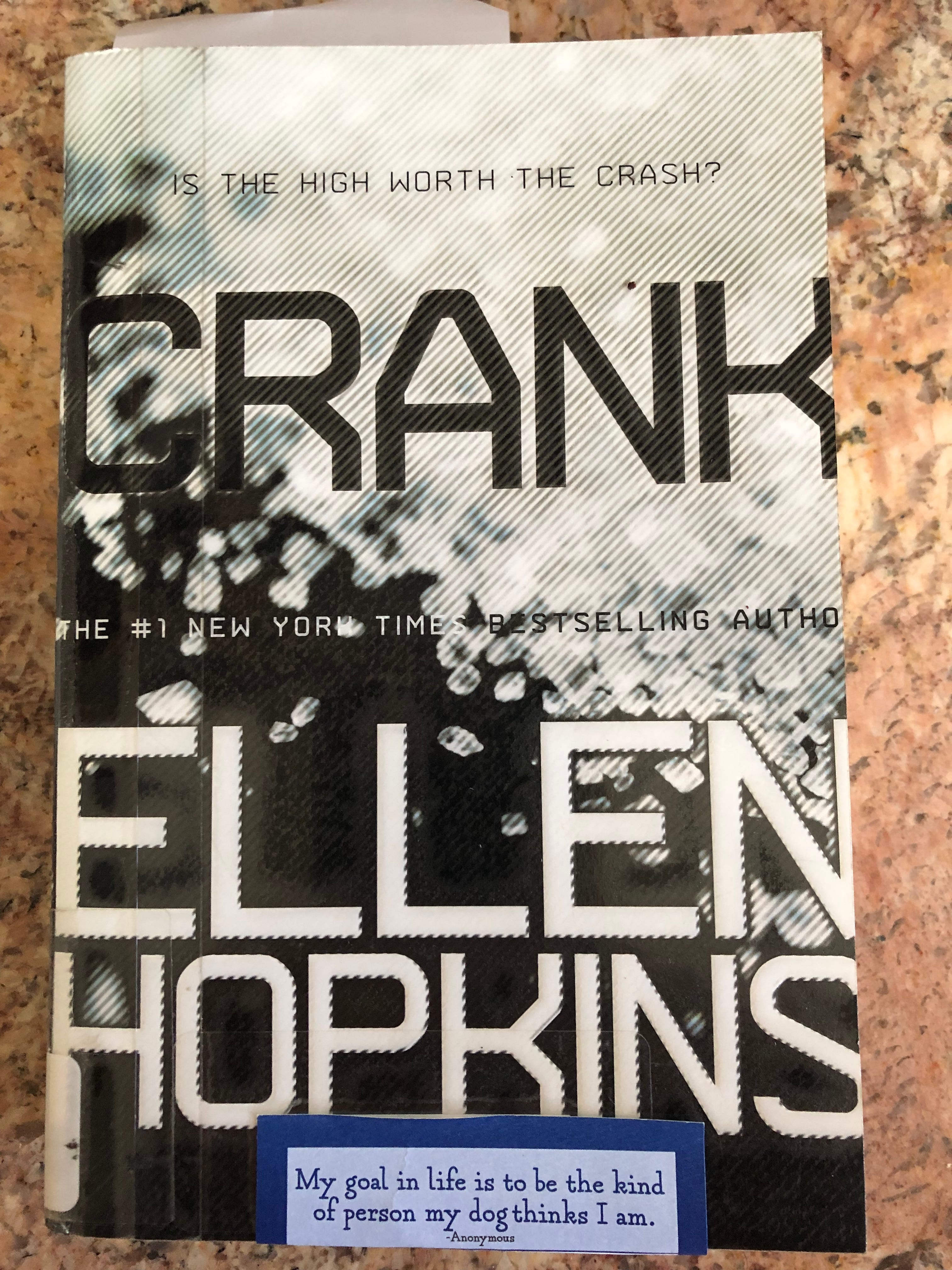
Crank by Ellen Hopkins
I promised to discuss Crank this week. Here we go.
Crank is #6 on the top banned books list. I’m going to go ahead with lots of spoilers because you are probably an adult who has already read Crank or are into other kinds of books at this point.
Back in the day, I didn’t write anything down about Crank because it was immediately popular in the library where I worked. In other words, I didn’t need to ‘hand sell’ it. I concentrated on other good books that the students might not have heard of yet.
I think Crank was immediately popular for several reasons. The biggest is that it’s about a well-behaved high-school junior, Kristina, who becomes addicted to “the monster” very quickly after visiting her addicted (and incapable/zero parenting skills) father. Kristina’s mother doesn’t want her to visit her father because she fears what will happen when she is living in a drug-fueled environment. Her fears become a reality. Left without adult supervision, Kristina crushes on a neighborhood boy who introduces her to drugs.
While the relationship doesn’t work out, Kristina quickly finds the high school drug dealers when she gets home. She blames a lot on her mom and successfully hides her addiction for a while even as her grades slide and her behavior changes. She takes on an alter ego that she names “Bree.” Bree is bolder than Kristina. She flirts with boys and takes chances with new cliques.
Much of the book focuses on the unraveling of Kristina’s relationship with her mom and her stepfather. Her stepfather knows that Kristina is using, but her mom is unwilling to believe it until it is impossible to ignore. Her mom tries to take control with UFN—Until Further Notice—grounding. But Kristina is no longer obedient and steals away from the house whenever she thinks she can get away with it.
Eventually, Kristina is date-raped by a popular boy named Brendan (who knows her only as Bree). It’s a brief scene on the page (not ‘off camera,’ so to speak). Here’s the beginning of it.
While there are many things about this novel that the censors object to, including the drug use and the way Kristina talks about and treats her mom, this scene is also one that censors argue doesn’t belong in a teen book. Later, Kristina has consensual sex with a nicer (less popular/less cute) guy.
If you’re older and didn’t read Crank in high school, you might be thinking about Go Ask Alice as you read this now. The author of Alice claimed that it was a real teen’s diary, but this is a lie. It’s one of many fake diaries the author wrote. If you remember reading Go Ask Alice and didn’t know it was a fake, check out more info in this footnote.
However, Alice has been in libraries for decades and many adults see it as a warning against drugs and hanging out with people who are involved with drugs. Crank also feels like this sort of book although the writing is much better. Whatever reading Go Ask Alice did to your life (drugs, rape, runaway, prostitution all in that book), that’s kind of what Crank does for newer generations.
Wait—Go Ask Alice didn’t turn you into a drug-fueled prostitute living on the streets? Huh.
I want to make a few more arguments for Crank beyond the one I have made for many books, including Crank: reading about difficult life experiences and trauma is the best way to be introduced to those things.
Crank is also a book that can cultivate a habit of reading. A study of adolescents grade 6-12 showed that large print books increased their engagement in learning and enjoyment in reading. Now, I know Crank isn’t a large print book, but it has the same advantage: lots of white space on the page. Readers turn pages quickly and the reward of accomplishment comes quickly. That the books are heftier (Crank is well over 500 pages) gives readers a sense of achievement. They go on to read other books (often other Ellen Hopkins books, which are also challenged and banned at a high levels).
In addition, Crank is well written. The plot certainly engages the reader, but the poetic language also drives that reader forward.
In an afterword, author Ellen Hopkins discusses in what ways Crank is based on her family’s real life experiences. Her daughter became addicted after visiting her addicted father. The family descended into a sort of hell: a drug dealer comes calling for money owed him. Her daughter breaks into the house, steals from her family and forges checks in Hopkins’s name.
When her daughter lands in prison, Hopkins is glad she will finally get the help she needs.
“Six years, watching my daughter go from the talented, beautiful girl with big dreams to a meth-wasted, twice-convicted felon. Six years, expecting the phone call that would let us know self-destruction was total. Thank God, that call never came, and that eventually, …