Hello Friends,
Tonight, I’m picking the winners for the book giveaway and will be sending the books out ASAP (hopefully tomorrow). Thanks to those who participated.
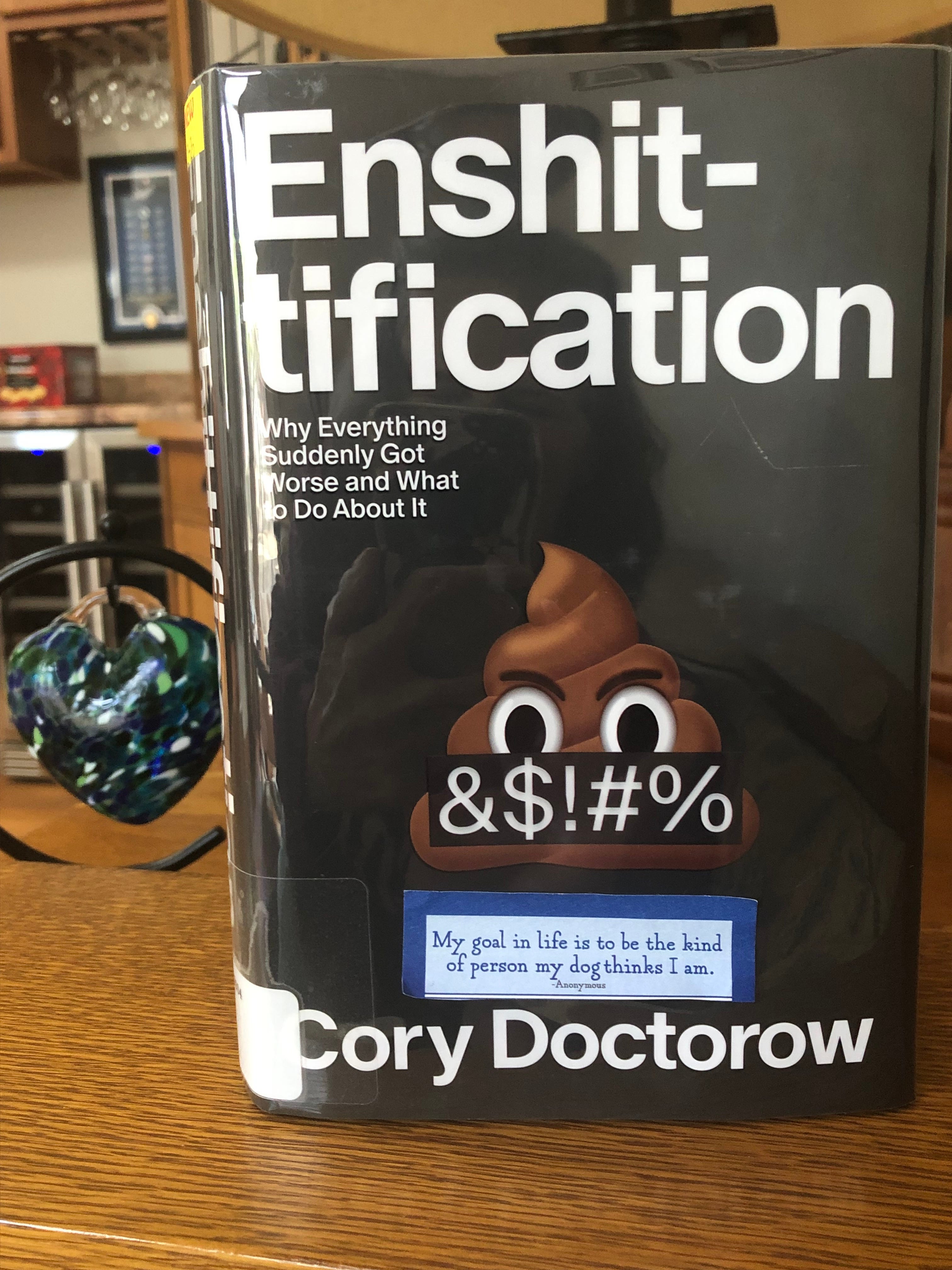
Today, I’m discussing Enshittification by Cory Doctorow and then following up with some links for writers. This is a ‘Part One’ because there are many issues Doctorow illuminates, and then he concludes with some ideas for changing online culture. These deserve a discussion as well.
Also—I mentioned this in Friday’s “Library and Banned Books News,” but if you only read Sunday’s book discussions: I will be changing the schedule in a week or two so that there is only one post per week, on Sunday. The Library/Banned Books News will alternate with the book discussions. Two reasons for this:
* I feel the world is just so much right now and people are dealing with an onslaught of information.
* I want more time to work on a novel that I have finally started! (Yay!)
Enshittification: Why Everything Suddenly Got Worse and What to Do About It by Cory Doctorow
I’d like to explore Enshittification in depth because I think the story it tells is important for all of us. There may be three parts to the discussion (not sure). I encourage you to get your hands on the book ASAP and read along. If you want to borrow it from the library, it probably has a hold list, so put your name in now. 😊
“You Are Not Just an Ambulatory Wallet”
“It’s not just you. The Internet is getting worse, fast. The services we rely on, that we once loved? They’re all turning into piles of s**t, all at once. Worse, the digital is merging with the physical, which means that the same forces that are wrecking our platforms are also wrecking our homes and our cars, the places where we work and shop. The world is increasingly made up of computers we put our bodies into, and computers we put into our bodies. And these computers suck.” (3)
Doctorow notes that he is an Internet activist who’s been working for digital human rights for decades. He calls our era the Enshittocene, which has been caused by specific policy decisions at ‘middlemen’ platforms that connect business customers to end users or connect workers with their customers. Some of the bad actors he discusses are eBay, Amazon, Apple, Microsoft, Uber, Google (connects publishers and advertisers to searchers) and Facebook (connects people who want to socialize rather than search).
So, what is enshittification?
Doctorow names it in four steps:
* First, platforms are good to their users.
* Then they use their users to make things better for their business customers.
* Next, they abuse those business customers to clawback all the value for themselves.
* Finally, they have become a giant pile of s**t.
Why Do We Stick Around if the Platform is So Bad?
There’s a cost for leaving these spaces even though it’s become a hassle to be there. For example, if you leave Facebook, it’s likely the people you hang out with will not be available to you on another platform—it’s hard to get other people to switch. So when Facebook realized that it could make money from advertisers and publishers, they did so by spying on the users and then using an algorithm to target advertising based on what the users were interested in. Eventually, Facebook stopped being good for business customers as well by increasing the price of targeted ads and, at the same time, not showing the ads to the users that the advertisers had selected.
Thanks for reading Be a Cactus! Subscribe for free to receive new posts and support my work.
Is It Truly Evil?
All the platforms discussed have engaged in downright evil behavior, but Amazon is among the most egregious in that their policies affect everyone, including people who have never used their platform. Let’s look at their story. Other platforms are variations on the Amazon theme.
Amazon also started out as good for users. It had a lot of investors with a lot of money which it used to subsidize goods (sometimes selling them below cost) and shipping. It had a generous ‘no questions asked, postage paid’ return policy.
Early on, Amazon couldn’t lock people into using it the way Facebook could. So it came up with the idea of Prime membership, which creates lock-in because customers are paying for shipping a year in advance. Quite the incentive to shop on Amazon. In addition when you buy audiobooks, movies, and most e-books and e-magazines from Amazon, you’re permanently locked into Amazon‘s platform because the projects are sold with digital rights management. There’s a form of encryption that will force you to view or to listen to those products using apps that Amazon controls. If you leave Amazon and delete those apps, you lose all the media you’ve bought from their platform—an incredibly high cost of switching.
Amazon was good to its business customers until it wasn’t. Because Amazon tracks so many users and people stop there for almost anything, Amazon has been able to extract higher discounts from the merchants who sell there. This brings in more users, which, again, makes the platform even more indispensable for the merchants. They have to go there—allowing Amazon to keep requiring deeper discounts, and on and on.
It finally comes to stage three, the pile of s**t stage: Amazon using tactics to shift value from the business customers to itself. It started tracking merchants’ best-selling items and cloning them and, at the same time, moving the original seller’s items far down on the search results. The original product doesn’t show when a person searches for it specifically. It shows the Amazon clone instead. Amazon also charges merchants a lot of junk fees that are pitched as optional, but in effect, they’re mandatory. Prime is an example. If a merchant doesn’t include prime shipping, then people won’t pick them. They are pushed so far down in the search results that they’re basically nonexistent. Yet another thing merchants must do: Use fulfillment by Amazon, a service where the merchant sends items to Amazon’s warehouse, where they’re packed and then delivered. It’s more expensive than comparable or even superior shipping services from other shipping companies, but if a merchant ships through a third-party company, then it gets dropped down in the search and ceases to exist. Amazon is gouging its merchants so much that it pays nothing to ship its own goods (which compete directly with those merchants’ goods).
All this turns into higher prices for customers. Merchants pay Amazon “through the nose.” Amazon junk fees add up to 45 to 51 percent of what it earns on the platform. So merchants raise prices on their products, not just for Amazon customers, but as a whole. For reasons that are unclear to me (seem like a loophole and a cheat at the same time), this is necessary for Amazon to stay clear of the US Federal Trade Commission’s antitrust lawsuit against them. So, we’re all paying the ‘Amazon tax’ no matter where we shop.
Doctorow makes similar enshittification arguments for Apple, for its iPhone, and for Twitter. (However, many people were able to leave Twitter when Musk came along and turned into the Nazi platform it is.) Enshittification is well worth reading to see how Apple and Google are in cahoots. (Don’t believe Apple when they say they are not tracking you.) But, wait! There’s more!
How Did We Get Here
Doctorow shows why this Enshittocene spread so far and so fast by looking at the world that companies operate in.
Any company would want to charge as much as possible for goods and services while they spend as little as possible, paying the lowest possible wages, giving customers the lowest quality products, and selling them with the highest prices. What stops them is if workers could quit over low pay; if their suppliers would stop shipping products when their invoices are unpaid; and if the customers would turn away because of the high prices. But our enshittifiers are effectively monopolies, so the markets and the competition to stop them don’t exist. Add to this that they’re not regulated by the government.
Part Two will discuss how all this happened: how competition, regulation, interoperability of computers, and worker power all slipped away. Meanwhile, repeat reminder: I recommend you get your hands on the book. If you want to borrow it from the library, it probably has a hold list, so put your name in ASAP.
A Few Links of Interest for Writers
What is AI Voice?
Authors and Money (or Lack Thereof)
Authors Hoping to be Published