Hello Friends,
Everyone I know is focused on giving right now, which is pretty nice. However, I found myself getting stressed out on ‘Giving Tuesday’ because there were innumerable worthy groups I wanted to contribute to. I did manage many by carrying over to Wednesday. One thing I don’t like is when I donate to a charity, and they send me an email the next day saying something like ‘There’s still time to donate!’— making me look back because I think I must have screwed up.
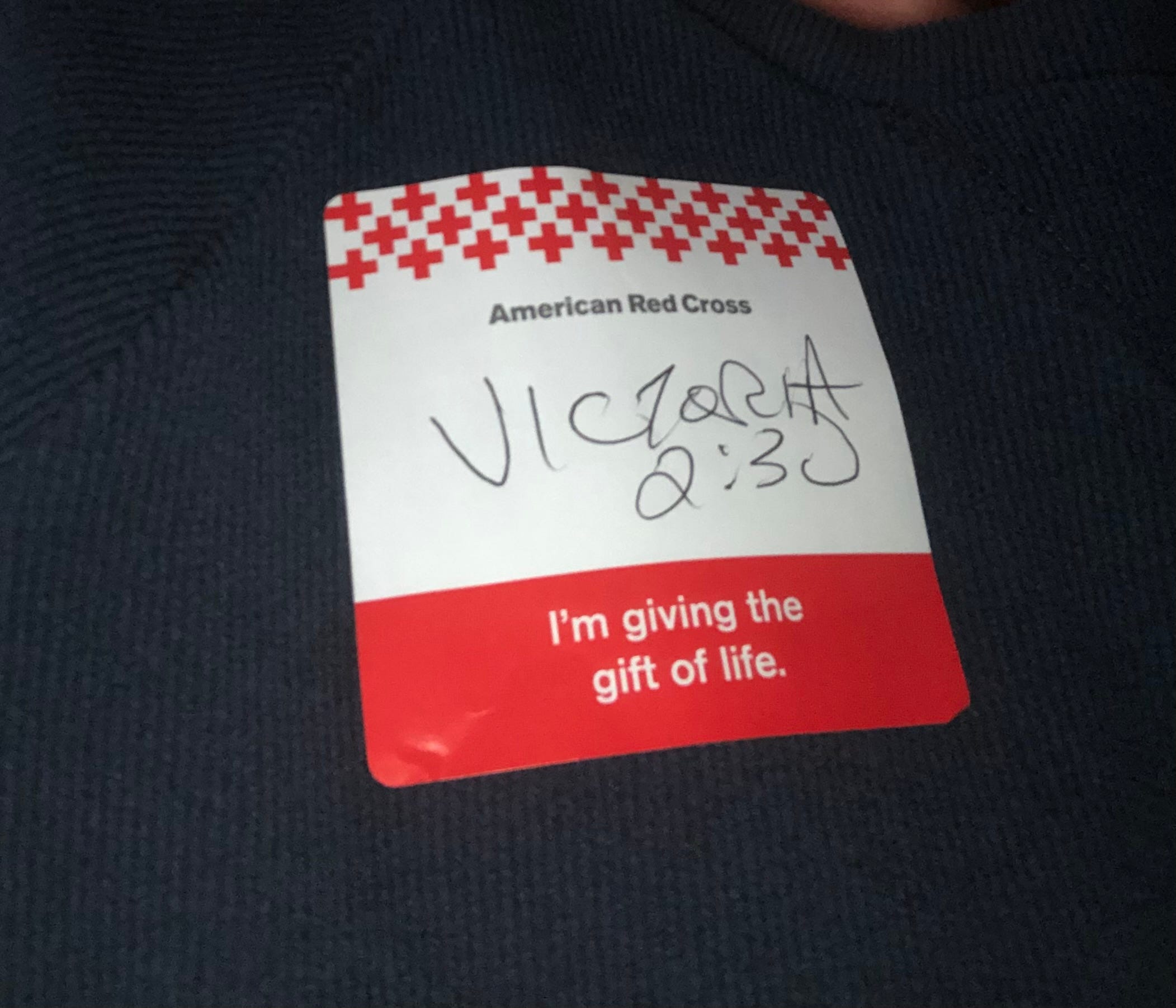
My latest blood donation was in November. They gave me these crazy PAC-MAN socks. Thanksgiving time seems to be sock time for the Red Cross. (Last year it was socks with the TV sitcom Friends theme.) If you’re in the middle of deciding what to give to which charities, giving blood is one of the nice things to do. 😊
Gifts for Book Lovers/Gifts that Do Good
Novel Teas
A friend gave this tea to me as part of a book launch gift when Keep Sweet came out. It’s fun for book lovers and authors. The tea itself is good enough (though not great) and each bag tag has a quote related to books.
Good Store
Everyone I know in the teen/YA book sphere loves John and Hank Green. Their books are lovely. I booktalked them frequently and got high school nonreaders to give reading a try! Most teen readers love, love their books. They’ve made a lot of money on their work, and decided it was enough (in itself, a wonderful and wild decision when we think of the rapacious billionaires running our country). Now, they are working to make the world a better place. Through the Good Store, you can support maternal health in Sierra Leone, fight to end tuberculosis, and to save coral reefs.
* 100% of the profits from Sun Basin Soap and the Awesome Socks Club go to Partners In Health—specifically to support the construction of the Maternal Center of Excellence in Sierra Leone.
* 100% of the profits from Keats & Co go to Partners In Health to support their Tuberculosis Project in Lesotho. Tuberculosis is the world’s deadliest infectious disease—yet it is entirely preventable.
* 100% of profits from EcoGeek purchases go to the Coral Reef Alliance—specifically the Maui Watershed Restoration project.
I have been drinking the Keats & Co. teas (after John Keats, English Romantic era poet who died of TB), especially the Earl Grey. They are so good! Great quality, yummy. For the holidays, I added the purchase of teas, coffee, and wacky socks for friends and family.
Also—If you have friends who haven’t read Everything is Tuberculosis, that would also be a nice gift. I discussed it here:
More Books
For all book lovers, here’s a reality check my friend Laura shared with me. If book titles were honest. Enjoy!
Thanks for reading Be a Cactus! Subscribe for free to receive new posts and support my work.
Indie Presses
I’ve often mentioned that it’s lovely to buy small press books. Here’s a list from LitHub that you might use to select gift books that you might not otherwise be aware of: 100 Notable Small Press Books of 2025.
And—a quick self-promo here—my books are from very small presses. Keep Sweetis for people fourteen years and up. (Topics are for mature readers.) Teens work to escape from a patriarchal cult. Timely.
Elizabeth, the protagonist in “Keep Sweet,” Victoria Waddle’s latest release, is fourteen years old and living in a rural “Community” with her parents, three sister wives, and 16 siblings under the thumb of a “prophet” who controls everything, from their pets and candy consumption, to who they will marry and have children with. When he decides Elizabeth will marry her cousin, Elizabeth’s future seems doomed. But when she turns to the “helper” inside her and recognizes the power of her own intuition, she starts asking questions and finds her own voice. — Cati Porter
Book Exchange
Something I think is fun is to add a book I’ve read to the gifts I am giving family and friends. This is especially true if what they want is a donation to a worthy cause. I make the donation, but it’s fun to open something, right? I take books from my shelf that I believe they will like and wrap them up. Right now, I’m looking at some of my family book club books. I have more than one copy of some of those, basically new. I want to give two of my friends the same title so we can all talk about it later.
If you are horrified that I give away lots of books, let me justify it through my library training. At work, I had to remove thousands of books—yes thousands. They became too worn or out-of-date; as science advanced, the material became misleading (‘We’ll go to the moon someday!’ ‘AIDS is a 100% death sentence’); people lost interest in the topic (a pop star, etc.). There are so many reasons to remove books and make way for new ones. So—I try to do that in my own life as well.
Sacrament by Susan Straight
I mentioned last week that I was reading this. It’s an especially good choice for Southern California readers and nurses anywhere, but the family love and friendships will appeal to just about any reader.
The American Revolution
If you or loved ones have been watching The American Revolution on PBS, you might want to get the companion book. ( I have it on my wishlist for Santa.) The series includes information that isn’t in many sources on the Revolutionary War, particularly the role of American Indians on both sides.
I’m thinking there are other good books on the topic, which should be of peak interest right now with the coming of the 250th anniversary of the Declaration of Independence. Here is an article excerpted from a new book, so you can see if you like it, and two books I enjoyed when they were published. There will be renewed interest in them now. They, too, include information about the war that I had never learned before.
Declaring Independence: Why 1776 Matters by Edward J. Larson
Give Me Independence: On 1776, the Pivotal Year For What Would Become America from LitHub
EDWARD J. LARSON CONSIDERS THE IMPACT AND LEGACY OF THE AMERICAN REVOLUTIONARY CAUSE
From Declaring Independence: Why 1776 Matters by Edward J. Larson
1776 by David McCullough
As a book about a momentous period of history, 1776 is short—under 300 pages excluding the endnotes. Its brevity is part of its success—it’s a tightly woven story of the trials and triumphs of George Washington and the Continental Army. The reader meets many players in the American Revolution from both sides of ‘the pond.’ David McCullough has won both the Pulitzer Prize and the National Book Award; his writing skills shine here.
Previously, I had only read of King George III as a madman, and was surprised to find him pretty reasonable in this account. I learned why the leaders of the British Army and Navy made some costly decisions that, on the surface, appear blundering and foolish, but on closer examination, had merit. I understood why Washington ‘crossing the Delaware’ is so famous an event. I even learned about William Lee, the enslaved man who served with Washington, always by his side and in the thick of things.
Though the success of the American Revolution depended on many people—and they are given credit here—George Washington is the star of the book. He takes the most ragtag, miserable group of diseased, undisciplined men, who several times flee from battle (you won’t read that in your history book!), and wins a war for independence. Success didn’t follow a straight line, and many important battles were lost along the way, causing Washington to despair and his second in command (Charles Lee) to privately question Washington’s ability to lead.
1776 began so badly for Washington that he wrote to Joseph Reed (an adjunct general):
“I have often thought how much happier I should have been if, instead of accepting of a command under such circumstances, I had taken my musket upon my shoulders and entered the ranks, or, if I could have justified the measure to posterity, and my own conscience, had retired to the back country, and lived in a wigwam.”
Reed, along with Charles Lee, came to criticize Washington for indecision—which was, as 1776 shows, a valid criticism. But Lee is the worst sort of backstabber. In an encounter that seems like it should have come from a fictional tale of intrigue, Lee wrote a letter to Reed about Washington:
“[I] lament with you that fatal indecision of mind which in war is a much greater disqualification than stupidity or even want of personal courage. Accident may put a decisive blunder in the right, but eternal defeat and miscarriage must attend the men of the best parts if cursed with indecision.”
This letter was accidentally delivered to Washington, who opened and read it. You’ll be surprised to find out what he does in response. (And don’t worry, fate will eventually deal with Lee.) Persevering through these kinds of trials points to Washington’s leadership abilities. As I read, this story was one of the most memorable in the book because my mind jumped to the stories of some politicians today who whine about being criticized and then throw temper tantrums.
Another scene that struck me was the story of Henry Knox and the movement of cannons from Fort Ticonderoga (upstate New York) to Boston. That’s 300 miles in the dead of winter—horrific conditions—with 120,000 pounds of artillery. This was both brilliant and almost impossible. It’s the kind of thing that inspires true admiration. A worthy read.
Revolutionary Summer by Joseph J. Ellis
The summer of 1776 is the revolutionary summer that Ellis discusses in his book, one in which the fate of the war for independence looked pretty bleak.
Ellis says of Washington’s ragtag army, ‘They were not the kind of men you wanted living in your neighborhood.’ They spit tobacco every few feet, mocked their officers, and were undisciplined and unable to hold their ground in a fight. Ironically, the fact that so many of them turned and ran in the first battles in New York that summer gave Washington the chance to reorganize without the massive losses he would otherwise have had.
New York was strategically significant in 1776, in part because of the Hudson River. So it was an obvious place for an early clash between the British and the states. And it proved particularly difficult for Washington and his rebel army. New York was full of loyalists who didn’t want to be defended against the British. As the British landed, many New Yorkers hailed them as saviors. Washington was in a no-win situation; his retreat from it was nearly miraculous.
How did these newly United States ever pull off a win in the Revolutionary War? As Ellis tells it, they learned that they just had to keep from losing and the British would succumb because they were fighting from too far away with too little direction. He also details the story of the Howe brothers—Admiral Lord Richard Howe and the younger General William Howe, who commanded the British due to his proven military brilliance as a regimental commander and his notable courage. These men, while well-positioned to win this war, saw themselves as peacemakers and diplomats. This is not so odd as it seems—you’ll understand why as you read—but this view deeply hurt their strategy in the end. They really weren’t winning hearts and minds. (Hum . . .)
Still—things did have to change for the Continental Army if they were going to win battles. The new country had to invent and standardize the rules of the army, and admit that having ‘turnstile’ soldiers, who left after a year of service, couldn’t work. Just as the men were finally learning what it meant to fight a battle, they were heading back home. And yet to have a standing army was something that the colonies had always objected to—it smacked of the imperial government they were trying to throw off.
While the action around New York was coming to a head, the United States not only had to standardize their army. They had to declare their independence. The story of how Thomas Jefferson was chosen to write the document is genuine fun. (Ben Franklin, the rock star of the period, couldn’t stand writing by committee and didn’t want to create a document that would be edited by others later.) At the time, Jefferson’s first two paragraphs were regarded as a “rhetorical overture, the flamboyant windup before the real pitch.” As we know now, “We hold these truths to be self-evident,” etc. are some of history’s most famous and most important words.
Because of Ellis’s fluid writing style, the summer of 1776 comes alive for the reader. In addition to Washington’s early lack of resolve (later eliminated), the unimaginable success of the Continental Army’s retreat from New York, and the burning of that city, we see: Jefferson writing the Declaration of Independence; John Adams coming to realize the significance of what he is involved in; John Adams’s relationship to his wife Abigail and the significance of their letters to each other; the importance of Benjamin Franklin and how his opinion of American independence evolved.
Some reviewers note that the topic of Revolutionary Summer has been written about ad nauseum. And yet, for those of us who know little about the details of this historic moment, Ellis is the perfect choice. It’s brief—not including the endnotes and index, it’s well under 200 pages. There are also some helpful color illustrations and black and white maps. Perfect for celebrating a 250th anniversary.
Thanks for reading! Let me know what books you are giving as gifts this holiday season!