Hello Friends,
There are some things I wanted to discuss about this crazy week, so I’ll put off the final discussion of Enshittification. Next week we’re starting the new schedule of alternating the “Library and Banned Books News” with these review posts rather than having both within one week. So—next Sunday is about libraries and censorship.
¡Sí, se puede! Yes, we can!
I read in two newspapers that California is changing its Cesar Chavez holiday to “Farmworker Day/El Día del Campesino.” I’m glad my state is continuing with the honor. I’m over being heartbroken over the loss of idols. I think it’s best to celebrate ideas and movements that have helped people rather than any particular man. If you need some helpful reading on the Chavez abuse news, these may be useful:
This guest post on the Contrarian by Maria Cardona.
Let us be absolutely clear: none of these horrific revelations erase the very real gains made in farmworkers’ rights through years of grueling, backbreaking organizing. Those victories belong to an entire movement. Yes, Chávez was a leader — but so much of the unacknowledged credit belongs to Dolores Huerta and to the women who powered that movement from behind the curtain.
However, the farmworkers movement is not defined by an individual — and never has been. As Speaker Emerita Nancy Pelosi noted, “A movement is about the people — not any one person — and its strength lies in the values it upholds. We can honor the farmworker movement — and the generations who sacrificed to build it — while also confronting painful truths. No legacy is above accountability.” While we are shaken to our core, we continue to honor the tens of thousands of farm labor activists.
Anne Lamott gives us hope, as always.
Thanks for reading Be a Cactus! Subscribe for free to receive new posts and support my work.
And here’s some good news from this week’s Reasons to be Cheerful because it’s important to remember that everyday people work to correct past mistakes, even devastating ones.
The Native Seed Farm Safeguarding California’s Future
At Heritage Growers, every acre is being cultivated to repair ecosystems and help the Golden State meet its ambitious conservation goals.
California is widely recognized as one of the world’s most important biodiversity hotspots, supporting thousands of endemic plant and animal species, more than any other US state. However, California’s Biodiversity Initiative notes that its wetlands, riparian woodlands and forests have “suffered extensive losses,” with “an estimated 80–90 percent” of its biologically diverse landscapes altered or lost in the past 150 years. Development, agriculture, invasive species, climate change and increasingly intense wildfires are among the culprits. Reestablishing native vegetation is crucial to reversing those trends.
Right after I posted Friday’s “Library and Banned Books News,” the librarian in Rutherford, TN said she will not move those 190 YA (mostly LGBTQIA) books out of the teen section because it violates the First Amendment Rights of the teens. We’ll see what ensues, but it’s a reminder that good people are out there fighting.
Iran and Its People
I read a couple of articles this week about the choices Iranians are now having to make.
Iranians Weigh Tough Choice: Stay or Flee from the LA Times
What the War Has Done to Iranians from the New Yorker
And one closer and more personal, a text convo between the New Yorker Journalist Cora Engelbrecht and “Hadi” in Tehran. There’s Hadi’s early sense of hope about the war, the fulfillment of a lifelong wish for the death of the Supreme Leader, Ayatollah Ali Khamenei, which later turns to despair when the regime itself stays in place. I’m not sure whether you can access the article if you’re not a subscriber, but it’s very worthwhile. Here.
“As for me, my situation is clear,” he added. “I want to remain close to what’s happening. I’m staying here in the middle of the war until the very end, until my home, what I consider my home, is taken away from me.”
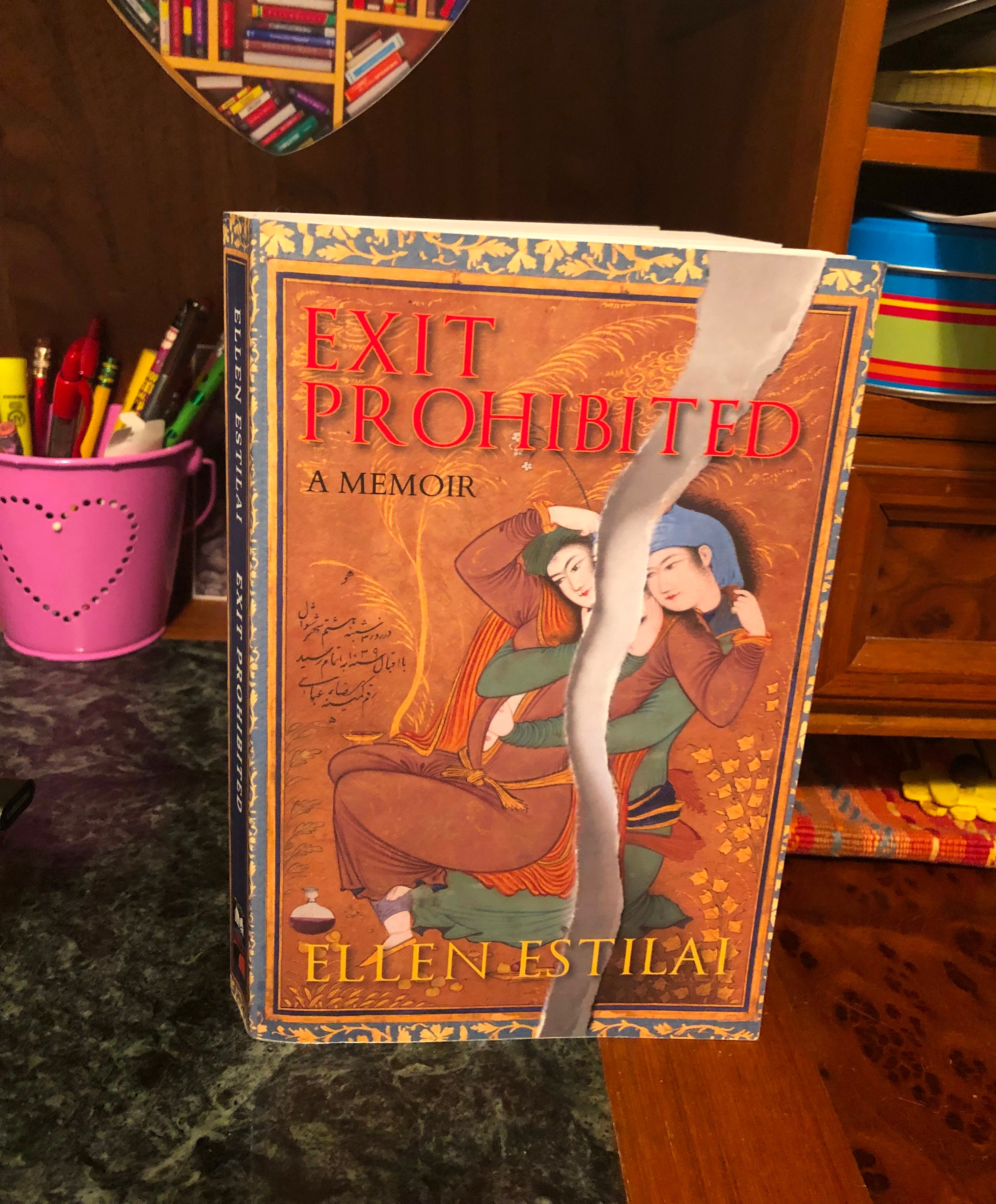
After reading these, I thought of a wonderful memoir about Iranian culture and history, about leaving Iran after the 1979-80 revolution. Exit Prohibited deals with the same question: should we stay or should we go? I know the author, Ellen Estilai, through the Inlandia Institute, a literary nonprofit.
Opening the Door on Iranian Culture
Exit Prohibited by Ellen Estilai
At the end of July 1980, Ellen Estilai, her husband, and their two daughters are leaving Iran. The decision isn’t easy. Ellen met and married her husband, Ali, in Davis, California, a decade earlier when they both attended university. Ali always planned to return to his homeland after earning his PhD in genetics. As a “first student,” his foreign education was paid for by the Iranian government on the promise to return and with his father’s house as collateral. After Ali graduates, Ellen goes with him, later giving birth to their children. Though she plans to spend her life in Iran, the 1979 revolution and its repressions make staying impossible. And while all four members of the family have permission to leave, Ali is detained at the airport. His passport is confiscated, and he is told he’s on the mamnou’ol khorudj — exit prohibited — list.Ellen and her daughters take off for Switzerland with plans to continue on to the United States. But they’ve no idea when they will see Ali again. She wonders: “Who would want to prevent Ali from leaving Iran? Which officious bureaucrat, which backbiting colleague, which sly neighbor could have written the letter or made the phone call? And just what is Ali being accused of? Having an American wife? Not being Islamic enough? Working on saffron?”The author moves from these thoughts to an examination of her life in Iran. Though hijab is not required under the shah’s rule, many Iranian women continue to wear headscarves, knee-length coats with long sleeves, and pants underneath. Those that don’t are eyed suspiciously as too westernized. As one of them, and a foreigner to boot, the author is sometimes distrusted. Yet she immerses herself in the culture and learns Persian. Her in-laws are a large, happy group who welcome her without hesitation. Their open-heartedness and gatherings, “a celebration of connectedness, of old roots and new growth,” satisfy a need that is not met in her small family of origin. Unlike her mother’s anxiety over hosting gatherings or guests, Iranians believe that a guest is God’s gift.Life in Iran is far different from what the author is used to. With few convenience foods available, she finds herself cooking much of the day. Itinerant street vendors call through the neighborhood selling coats and pants, watermelon, crystal dishes, and more. Though she is not convalescing, Ellen feels like Jimmy Stewart’s character in Rear Window. As she watches the drama in the courtyard and on the balconies, she discovers a good deal about her neighbors’ lives.
The author also learns cultural norms. Taarof is the necessary offering of compliments and ceremonial courtesies (“these endless streams of pleasantries took so much valuable time”). The fatalistic worldview that everyone has their own ghesmat (kismet) prevails. Nonetheless, this view allows for a tradition of warding off the evil eye by preparing hot coals in a brazier and tossing in esfand (wild rye) seeds. And, of course, there is the ever-present samovar because tea is a part of all interactions, business or pleasure.Ali lands his dream position as a professor in the Biology Department at the University of Tehran. He secures funds to create a new department, the Department of Cellular and Molecular Biology, and to purchase new equipment. Though his hopes of improving Iranian education appear to be coming true, some people are envious of him.Meanwhile, Ellen completes her education in English Language and Literature and begins working at the new Tehran Museum of Contemporary Art as Manager of Education. The author’s discussion of the museum — architecturally, it’s a paean to Iranian culture, but the artwork has dual foci in Iranian and western art — peeks into, and is a harbinger of, the cultural conflict that comes to consume Iran a few years later.As the author learns about Iranian culture, readers do as well. They are immersed in the beauty of Isfahan, its art and its “exquisite, sublime, and ethereal” interlocking patterns. The friendliness of Kerman, Ali’s hometown, is on display as is the routine of daily life, of being a working mother and being part of “a large, boisterous family that was endlessly interested in one another’s business.”
The narrative is infused with humor. (“As dull as it was, Days of Our Lives provided me with many random but potentially useful phrases, such as ‘Mickey aqim-e?’ [Mickey is sterile?]”) Like most Westerners, Ellen knew little about the modern political situation in Iran. Along the way, she unearthed historical imperialism. During the previous century, both Britain and Russia/the USSR had meddled in Iranian politics. The CIA led a coup in 1953 that overthrew a democratically elected prime minister. After moving to Iran, the author hears stories of the SAVAK, the shah’s secret police, and its engagement in political repression. With her newfound knowledge, she wonders — along with everyone she knows — how life under Khomeini could be any worse.During Ali’s sabbatical of 1978–79, Ellen and Ali travel back to the home of their alma mater and their meeting place, Davis, California. Thus, they are out of the country during the fall of the shah and the installation of Khomeini. Uncertain of the reality of daily life in Iran, they choose to return to Iran at the end of the sabbatical.Still, overall, readers understand the melancholy of Ellen’s departure from Iran. While she has enriched her life in a new landscape, with a new language and new traditions, and with a large, loving family, there’s no doubt she must exit. She’s worried about the future of women with talent and energy in the Islamic Republic, including her own daughters. “I knew what I wanted for them. I wanted them to know their foremothers. I wanted their voices to be heard. I wanted them to have a place at the table.”With their dreams no longer attainable, the Estilais have a new challenge in negotiating Ali’s exit. The complexity of the author’s experience and her relationship to Iran before and after the revolution makes a compelling memoir. Readers learn not only about a culture and its history but also about the dual immigrant experiences of Ellen and Ali and their inspirational ability to restart their lives.
Writer Issues, Reader Issues
AI
The NYT posted a little quiz with five sets of two paragraphs. The object is to pick the one of the two paragraphs in each set that you think is better. One is AI-generated. One is from a fairly well-known writer. It’s interesting to see how good AI paragraphs are—keeping in mind that they are generated from a vast store of real human writing. But I wonder if AI generation could sustain a complete short story, an essay, a novel, memoir, or any nonfiction book. What’s the cumulative effect?
Apparently Hachette found a horror novel worthy of publication which it has now canceled after reports that parts were AI-generated. The author claims that someone she hired to edit the self-published version used AI. She is pursuing legal action.
Horror Novel ‘Shy Girl’ Canceled Over Suspected A.I. Use from NYT (Gift link)
On Thursday, a day after The New York Times approached Hachette citing evidence that the novel appeared to be A.I.-generated, the company said it was pulling the book from publication. By Thursday afternoon, the novel was removed from Amazon and the Hachette website.
And Here’s the quiz if you’d like to try it. (Gift link)
Great literature may not strike us as the best reading in a single paragraph:
Thanks for reading! Take heart. I believe the old ‘darkest before the dawn’ proverb. We’ll see you out on the streets on Saturday.