Hello Friends!
Several kind people reached out to me this past week with messages of good will. Thank you! I think the ‘endless’ headache has finally departed. I have a lot of important info this week, so if your reading time is limited, don’t forget that you can listen to the audio! Part 1 is about hybrid publishing. If you are a reader but not a writer looking to publish a book, feel free to go to Part 2 on book ban news and cults.
One aspect of Be a Cactus is looking at small press publication. I’ve talked about some small presses I like and what the experience of publishing with small presses has been like for me. I haven’t yet discussed hybrid publishing because I have no experience with it. But I've been thinking about it recently as a possible pathway to publication for my future work.
As often happens, when I think about something, I start to see information about it. One of the things I read on Substack was Brooke Warner’s post “Debut Fiction: Does Age Matter?”
If you haven’t read it, do. While admitting to unicorns (Lessons in Chemistry was written by Bonnie Garmus, who turned 65 just before the book debuted), Warner shows how unlikely it is for an author to debut with a traditionally published book if she is 45 or older. She concludes “I would argue that making it past the gate requires a mix of the following: hard work; talent; and (by and large) being under 50.”
Warner is the publisher of She Writes (for women authors) and SparkPress, both hybrid presses. Much of the fiction she publishes are “beautiful books” by women over 50. “It's freeing to make decisions based on the quality of an author’s writing alone, and not to be burdened by what the marketing department requires—star quality, that “it” factor, or that potential hypervisibility that acquiring editors are hoping for when they sign debut fiction authors. This is the reality of the modern publishing world.”
She Writes Press was the first hybrid publisher to be named Independent Publisher of the Year (2019). Their explanation of their model:
Unlike self-publishing platforms that publish whatever comes through regardless of quality, SWP is a curated press that works with authors to ensure that their books will be well-received in the marketplace. Unlike publishing houses, which buy the majority stake in your book but often don’t deliver when it comes to providing the editorial and marketing help you need, SWP gives authors an experienced editorial and production team, while allowing them to retain full ownership of their project and earnings.
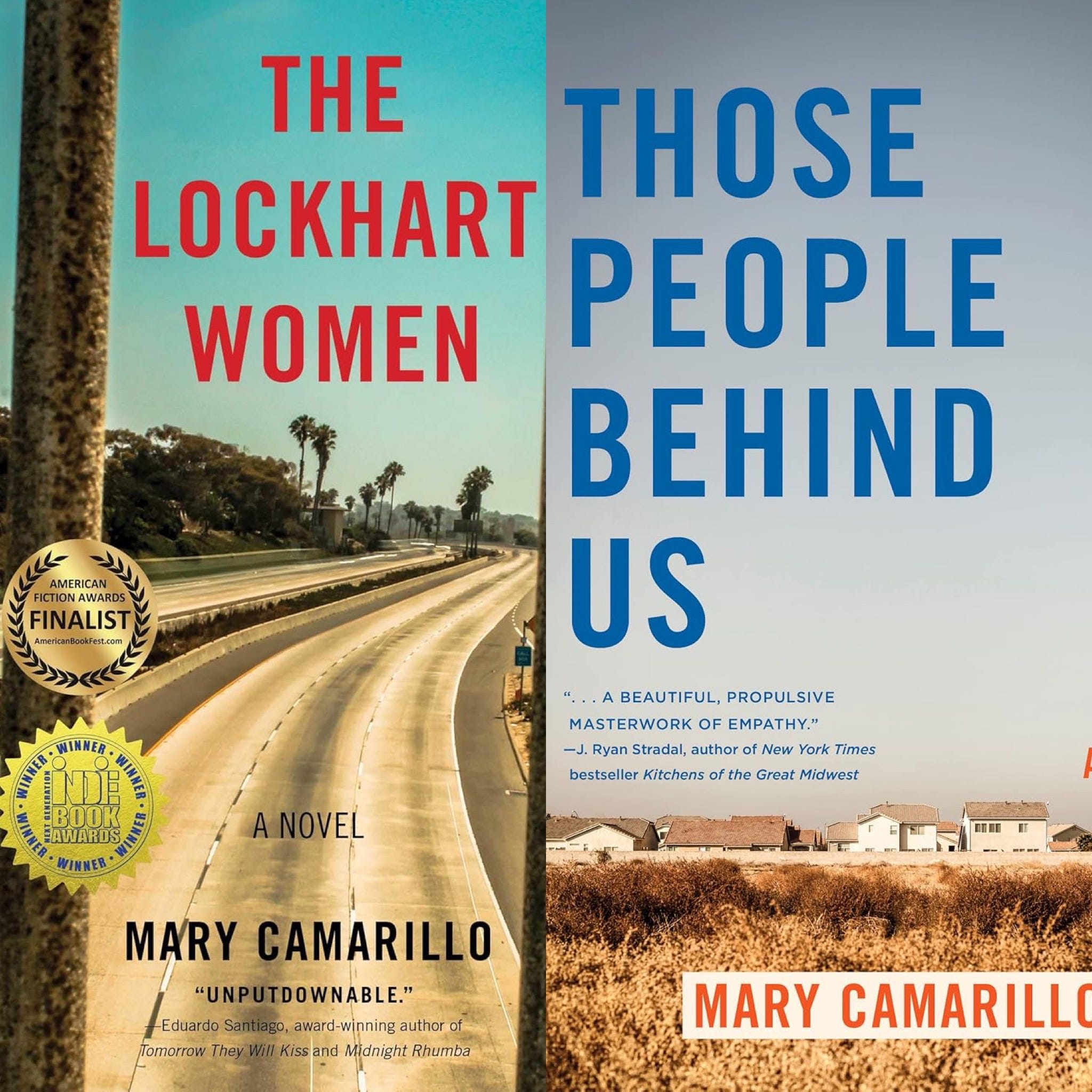
As it happens, I know someone who has been published by She Writes Press. Mary Camarillo is the author of The Lockhart Women (2021) and Those People Behind Us (2023). I thought it would be fun—and educational— to hear from someone who has experience with them. I interviewed Mary by email.
Mary, thanks for being willing to share with Be a Cactus subscribers! I enjoyed the Southern California vibe and settings of your books. However, the issues in each are universal or, in the case of politics, at least national. Would you like to describe a bit about your books? What was the pitch you used when you queried She Writes?
Both of my novels are set in the city where I live, Huntington Beach, California, although I tweaked the name to “Wellington Beach” in my second novel. My stories are about the Southern California that I know, that doesn’t include celebrities or extraordinary wealth. My characters work at the post office, the gym, or the real estate office. They shop at Target and think a night out at The Cheesesteak Factory is pretty special. They don’t own ocean front property but they do enjoy living ocean-adjacent.
My characters are often described as not all that likable. I agree but I also argue that they are very human and I hope that my readers find something familiar and something to root for.
For my first novel, The Lockhart Women, I submitted the first 50 pages of the novel to She Writes Press and was accepted as a Tier 1 author, which meant they believed my novel was ready to go. I also had to provide chapter summaries. I was pretty thrilled to be accepted. I’d been querying agents for this novel for more than a year. Some agents never responded. Some rejected me immediately. Some wanted to read more pages, said they liked my voice and my work, but they didn’t believe they could sell the novel.
In hindsight, I understand why. Books are expensive to print and distribute. Publishers want a guarantee on their investment. And as Brook Warner pointed out in her post “Does Age Matter,” I’m an older author (72 now) with no platform or celebrity. But I’m also stubborn. I really wanted this book out in the world. I find it incredibly sad when other authors tell me they’ve gone through a similar process and just put the book in a drawer and given up.
She Writes touts the fact that their books can get professional or traditional reviews, which is not the case for self-published books. As a former librarian, I know that library book selection depends on professional reviews. I used to use Booklist, Library Journal, SchoolLibrary Journal and Kirkus. (I took Kirkus with a grain of salt. They could be unnecessarily derogatory.) I think these four are pretty standard. Were your books reviewed in trade publications and, if so, did any of the four I’ve listed include your work?
She Writes Books are eligible for reviews but it is up to the author or their publicist to submit the book for review. I submitted both of my books to Kirkus for review, somewhat nervously because I’d heard about how snarky they can be. It’s also expensive, around $500, although they offer discounts occasionally. I didn’t get a starred review, but I did get pull quotes that I was able to use as blurbs and for publicity.
Unlike self-published books and books from small indie presses, She Writes has a distribution channel through Simon and Schuster. This is vital to having books land in bookstores and libraries. Have you seen your novels in either of those places? Have you been able to have book events (such as a book launch, reading and signing) in either? Do you feel that you have a relationship with local book providers that you wouldn’t have had if you’d self-published?
She Writes Press recently switched to distribution through Simon and Schuster. The transition has been very rocky so far. They are working to resolve the problems, but even though there is plenty of inventory in the warehouses, my books are not currently available through all the channels. I’m frustrated.
Prior to the switch, She Writes Press used Ingram, which meant that our books were available at all the usual online sources as well as in libraries and in bookstores. I anticipate that this will eventually be the case with Simon and Schuster. My local Huntington Beach library carries both of my novels. I’ve also seen them on the shelves of local bookstores like LibroMobile in Santa Ana, Vroman’s in Pasadena, Arvida Books in Tustin, and Barnes and Noble in Huntington Beach.
I did both of my book launches at LibroMobile and I’ve had book events at my local Barnes and Noble and at Bel Canto Books in Long Beach. I also did a really fun book tour for my second novel through California with stops at The Book Jewel in Los Angeles, The Bookworm in Camarillo, The Book Loft in Solvang, Books Inc. in Campbell, Ruby’s Books in Folsom, and East Village Bookstore in Sacramento. We made a great road trip out of it, visiting friends and family, and taking in some concerts and museums.
I made a point of establishing relationships with local book providers before my books were published which helped in getting my books on their shelves. Even if a book is distributed by Ingram or Simon and Schuster, there are still some bookstores (like Book Soup in Hollywood) that prefer that the author consign the books. I’ve experimented with that. Consigning is more work but still doable and is also an option for self-published authors.
She Writes has an …