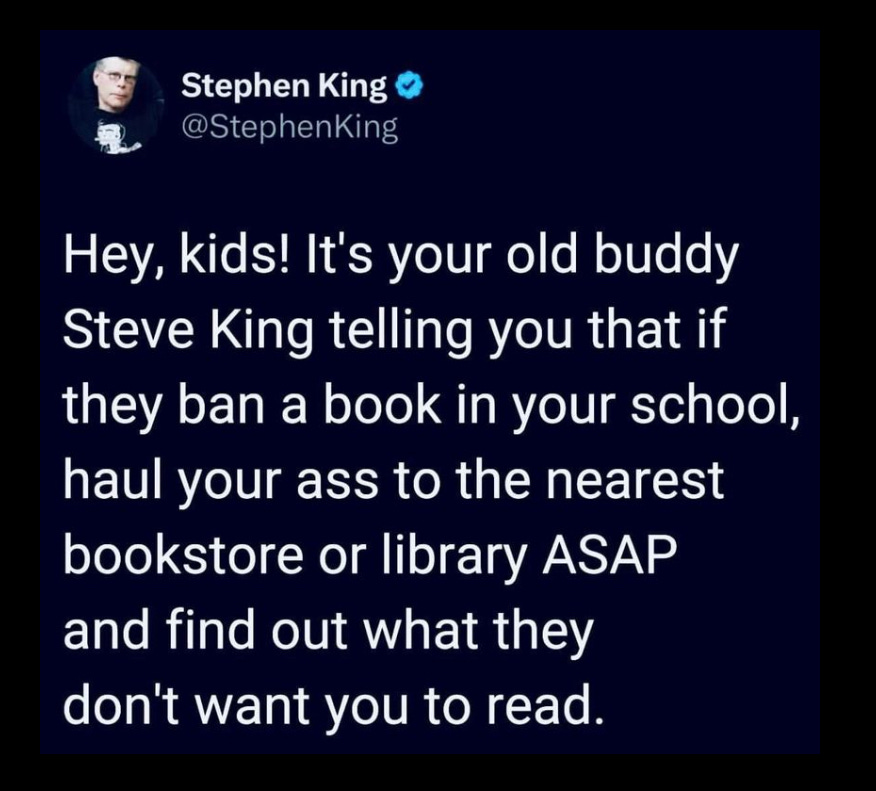
“Let them buy books” is not the answer
Because I’m a retired high school librarian, well-meaning social media acquaintances often share a quote from Stephen King: “Hey kids! This is your old friend Steve King telling you that if they ban a book in your school, haul your ass to the nearest bookstore or library ASAP and find out what they don’t want you to read.”
Their posts are followed in the comment section by expressions of solidarity against book bans, accusations of making porn available to kids, and snarky comments on King (‘Your books were better as movies!’). What I don’t see is a discussion of the school library or its purpose.
This saddens me. Too many well-meaning people suggest the solution to book bans in school libraries is to remove those libraries from the conversation. To do so shows disdain for its mission of serving all students.
What’s the mission?
I worked at Title I schools throughout my 35-year career as a public educator. The high school where I spent most of my time as a teacher librarian has a total minority enrollment of 96% and 84% of its students are economically disadvantaged. Most receive free breakfast and lunch. The staff runs clothes closets and a weekend backpack program, sending kids home with snacks and meals for their families to eat when school is not in session. They have a Thanksgiving dinner giveaway for the neediest and sponsor a Christmas gift drive. Teachers purchase graduation gowns for needy seniors.
While it’s hard for people removed from poverty to imagine, there are kids with no access to the public library, nevermind money to buy books. Parents work night and day. Public libraries may not be within walking distance; public transportation can range from abysmal to nonexistent. If these kids, years earlier, lost a library book, the resulting fine would include the cost of the book plus processing. Food insecure parents can’t prioritize paying that fine. The child is banned from checking out any more books. For so many reasons, kids need access to the full range of books their school libraries provide.
Let’s choose to accept it
So the fight for challenged books to remain in the school library is essential. As banned or removed titles have come up in news stories over the past few years, I haven’t needed to rely on memory to tell me why I selected them for my libraries. I regularly ‘booktalked’ them to classes. To prepare for these talks, I read the books and then wrote reviews. I decided to create a blog, School Library Lady, and post those reviews. This was primarily an organizational tool for me—by tagging each post with keywords, I could pull up any subject a teacher wanted discussed.
With titles I’d booktalked now so frequently censored, I look back at what I wrote because these essays show—in real time, without revision—my purpose in, and justification for, purchasing those books. Here on Substack, I the hope that giving people a window into a school librarian’s thought process will create understanding.
I’ve featured older books like Speak by Laurie Halse Anderson, still being removed after 25 years, to show how important it is to allow books that depict sexual assault. I include evidence of readers confirming that this novel saved their lives. I look at more recent books as well. Since Ta-Nehisi Coates’ latest book The Message includes a piece on the banning of his book Between the World and Me, I look back at my thoughts from 2016, at why I bought it, and why I was promoting it to students.
For each book I discuss, there are common justifications for its inclusion in the school library. Often, for nonfiction, it covers important aspects of American history. For all genres, it supports the school’s mission of providing for the needs of every student; it lets students know they are not alone in their traumas and tragedies; and it engenders empathy for others. Such parameters are what we should all be discussing when we’re deciding whether a book belongs in the school library. In the only place where a student might find it.
We should never succumb to book removal with the excuse that kids will find the book elsewhere.
Part 2: Library book challenge and ban news
Friends, I was going to link to some mainstream religion and cult stuff this week because I’m down to the last 24 hours of checking copy edits on my upcoming novel (Keep Sweet) and am in that mode. But—there’s a lot going on in the book censorship arena! So, let’s focus on that. I’m going to start with a great Substack to follow for those worried about book censorship (in schools or public libraries) in their state. I’m following with some end-of-the-year lists and then leaving other topics for last. However, all are worthy of your consideration. I hope you have the chance to view each one.
Well Sourced from Kelly Jensen is a great Substack for those interested in the freedom to read. It’s particularly vital for those living in states where book banning is an issue. Jensen follows bills that come before state legislatures, so you can be aware of what’s happening and contact your representatives to oppose laws that would cancel books and criminalize librarians for having those books in the collection. She also lets you know if an anti-book-ban bill is up for a vote, so you can call your representative and express support for it. Here’s this week’s post:
The 11 Most Banned Books of the 2023-2024 School Yearfrom PEN America
I’m guessing you are familiar with many of these titles. Details on each are in the linked article.
* Nineteen Minutes, by Jodi Picoult, 98 bans
* Looking for Alaska, by John Green, 97 bans (I discussed on Substack here.)
* The Perks of Being a Wallflower, by Stephen Chbosky, 85 bans
* Sold, by Patricia McCormick, 85 bans
* Thirteen Reasons Why, by Jay Asher, 76 bans
* Crank (Crank Series), by Ellen Hopkins, 76 bans
* Identical, by Ellen Hopkins, 74 bans
* The Kite Runner, by Khaled Hosseini, 73 bans
* The Handmaid’s Tale, by Margaret Atwood, 67 bans
* Water for Elephants, by Sara Gruen, 66 bans
* Tricks, by Ellen Hopkins, 66 bans
More Books Banned in 50 or More School Districts in the 2023-2024 School Year
* A Court of Thorns and Roses by Sarah J. Maas (I discussed this title in a Substack post here.)
* Empire of Storms by Sarah J. Maas
* A Court of Mist and Fury by Sarah J. Maas
* A Court of Wings and Ruin by Sarah J. Maas
* The Absolutely True Diary of a Part-Time Indian by Sherman Alexie
* The Bluest Eye by Toni Morrison
* The Color Purple by Alice Walker
* A Court of Frost and Starlight by Sarah J. Maas
The Most Popular Banned Books in Florida from Electric Lit.
’Most popular’ doesn’t mean ‘most frequently banned.’
Conceived and supported by Paul English and Joyce Linehan, in partnership with Bookshop.org and Electric Literature, Banned Books USA made over 900 banned and challenged titles available to all Florida residents. Anyone living in Florida could order a banned book for the cost of shipping via the Banned Books USA website, and as a result, nearly 1000 books were mailed to individuals from Pensacola to Key West.
Here are the most requested:
* Pride: The Story of Harvey Milk and the Rainbow Flag by Rob Sanders (Banned in the Palm Beach County School District)
* Anne Frank’s Diary: The Graphic Adaptation by Ari Folman (Banned in the Palm Beach County School District)
* Beloved by Toni Morrison (Banned in the Escambia County School District)
* The ABCs of Black History by Rio Cortez (Banned in the Miami-Dade School District School)
* The 1619 Project: A New Origin Story created by Nikole Hannah-Jones (Banned in the Escambia County School District)
* The Hill We Climb: An Inaugural Poem for the Country by Amanda Gorman (Banned in the Miami-Dade School District)
* Gender Queer: A Memoirby Maia Kobabe (Banned in the Manatee County School District)
* And Tango Makes Three by Peter Parnell and Justin Richardson (Banned in the Escambia County School District)
* A Court of Thorns and Roses by Sarah J. Maass (Banned in the Clay County School District)
* To Kill a Mockingbird by Harper Lee (Banned in the Palm Beach County School District)