To be the instrument of God’s peace is not to confine oneself to the field of personal relationships, but to concern oneself also with the problems of human society, hunger, poverty, injustice, cruelty, exploitation, war. - Alan Paton
There can be no keener revelation of a society’s soul than the way in which it treats its children. - Nelson Mandela
Hello Friends,
I hope you have a happy Thanksgiving. Like most people, I’m thankful for my family, my good luck, and more. But I’m also thinking about “the problems of human society.” This week I’ve been thinking a lot about kids because of the Epstein files and all the news surrounding them.
Here’s a great takedown of Megyn Kelly’s argument that 15 year olds aren’t kids.
Did you have a chance to see the video released by Epstein’s victims? A powerful reminder that they were children.
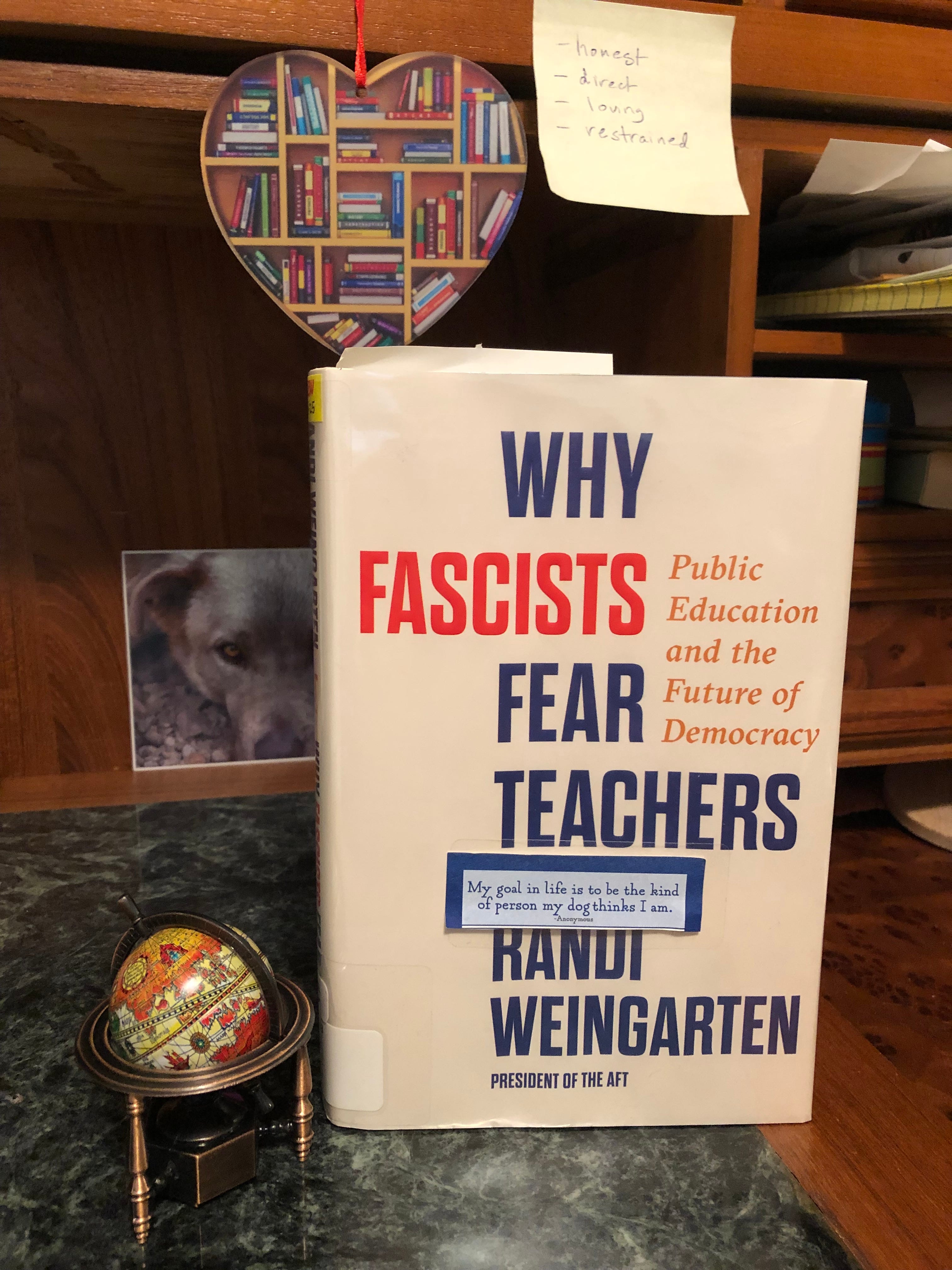
Since it’s a good week to look at some people who spend a great part of their lives caring about all kids, I thought I’d look at Why Fascists Fear Teachers by Randi Weingarten.
Thanks for reading Be a Cactus! Subscribe for free to receive new posts and support my work.
Why Fascists Fear Teachers by Randi Weingarten.
Why Fascists Fear Teachers: Public Education and the Future of Democracy is a compact little book, about 5 x 7 inches, a sort of photograph frame for a snapshot of public education and its role in a democracy (hint: cornerstone). Of the 244 pages, the introduction is 30 pages and the endnotes, with links to back all of the book’s assertions, is 59 pages. Being short, this text focuses on four foundational things that are important to the future of our students and the well-being of our nation—but are antithetical to the fascist anti-government, anti-pluralism, anti-opportunity agenda:
* teachers teach critical thinking;
* teachers foster safe and welcoming communities;
* teachers create opportunity;
* and teachers build strong unions.
Fascism here has a broad definition and includes the oligarchies and authoritarianism we are currently witnessing. Weingarten quotes Jason Stanley‘s definition of fascism: “ultranationalism of some variety, ethnic, religion, cultural, with a nation represented in the person of an authoritarian leader who speaks on its behalf.” She also quotes Timothy Snyder explaining that it’s hard to create an academic definition of fascism because its point is to reject reason in favor of will.
I wish the title of Why Fascists Fear Teachers had been “Why Fascists Hate Teachers” because the word ‘fear’ implies that educators have power over fascism. That remains to be seen. What we do know is that the far-right culture wars cost public schools nationwide more than $3 billion in the 2023-2024 school year alone.
I picked up Why Fascists thinking it was a book for teachers (that’s me), but it’s not. Generally speaking, teachers already know what the book asserts. However, they might want to read the section on unions, which reminds us of how their existence is beneficial for all but the elite classes.
Since this is a short book, both positive and didactic, a general primer, I’ll give you a quick look at its ideas. I thought it’d also be fun to share some quotes.
Critical thinking
“Liberty cannot be preserved without a general knowledge among the people.” —John Adams
A free society depends on free minds. FDR: “Democracy cannot succeed unless those who express their choice are prepared to choose wisely. The real safeguard of democracy, therefore, is education.” (35)
Weingarten discusses how authoritarian regimes co-opt or circumvent norms and institutions that are meant to support basic liberties including the opportunities to think and choose for oneself. I don’t think it was hard for her to find examples, some of them outrageous enough that we couldn’t have imagined them even a decade ago. Think of Oklahoma’s state superintendent trying to force all OK schools to teach the Bible—the Trump Bible, which he intended to buy with taxpayer money. Of course, historical and current-day examples of book banning fit nicely into this chapter. She then moves on to what is actually taught in public schools and defends that against the ‘woke agenda’ charge.
Safe and welcoming communities
“The good Education of Youth has been esteemed by wise Men in all Ages, as the surest Foundation of the Happiness, both of private Families, and of Commonwealths.” —Benjamin Franklin
There’s an interesting story here about President LB Johnson teaching in a segregated Mexican school when he was a young man earning his college tuition. It likely influenced his later support of civil rights and voting rights.
It goes without saying that fascists don’t want a safe and welcoming community for all. Examples of how schools provide services for all kids abound; dental support including teeth cleaning for students in an impoverished community is a good example of how educators reach out to support the whole student (the community schools model). Weingarten also discusses the more obvious safety issues that educators are worried about in all schools, particularly: guns and school shootings, and the harms of social media and other new technologies, including loneliness.
She points out that oligarchs who make money on algorithms that harm young people are not friends of public education. We should not be handing over government leadership roles to them (Elon Musk and DOGE) or even giving them the best seats in the house for a presidential inauguration.
“To be clear, fascists and autocrats and far right extremists don’t want to help all students, nor do they want to strengthen public schools. They don’t want to teach students about the painful parts of American history, and they don’t want to level the playing field for children living in abject poverty. Because their goal is to exploit problems, not solve them. They want to divide Americans, otherizing those who are different while attacking pluralism and diversity, inclusion, and equity as the problem. These extremists try to pit us against each other and distract us so they can rig the system for themselves. When the far right gets enough people to believe that diversity is a threat and opportunity is a zero-sum game, they use the anger and resentment they foment to defund and destabilize public education.” (7-8)
Creating Opportunities
“Educate and inform the whole mass of the people. … They are the only sure reliance for the preservation of our liberty.” —Thomas Jefferson
This chapter dives into the connection between attacks on public education and the history of segregation in the U.S. School vouchers began as a way to continue segregating schools and have been proven to do little more than deliver taxpayer money to families who already had their kids in private schools and, thus, could afford to do so without that transference of funds away from public schools. Meanwhile, public schools are depleted of funds. “Oligarchs and extremists do not believe in education for all. In fact, … many fight against the fundamental idea of education for all, privatizing public resources, while questioning whether we should even have public schools.” (106) Examples of this include the conservative economist Milton Friedman, who, in the year after Brown v. the Board of Education, wrote a manifesto proposing school vouchers as a strategy for privatizing education. Friedman later supported fascists such as Chile’s authoritarian military dictator Augusto Pinochet. He helped Pinochet institute universal school vouchers in Chile, which research showed were largely found “‘to have exacerbated inequality, reduced public school enrollment, and [had] minimal to no impact on …