My husband was away. The dog had already been walked, fed, and pooed. I didn’t have any classes to teach. On the calendar: one morning call and a dance class at night. Ten glorious, uninterrupted hours. When does that ever happen?
I washed my hair, slipped into a matching black cashmere tracksuit so soft it felt like wearing a long-haired kitten (I wear this at some point every day. Highly recommend). I looked like the poster child for cozy productivity, the kind of woman who should be writing chapters of her memoir while sipping a London Fog (my dream!). This was it. Today, I would write, create content, film b-roll, and finally catch up on everything I’d been putting off.
And then I opened Instagram.
A Trap You Didn’t See Coming
A soulful yogi meditation coach I follow suggested scrolling through photos from every October over the past decade. She claimed October is “the month of creation and newness” and that your October photo archive would prove it.
I had plenty of time, so I tried it.
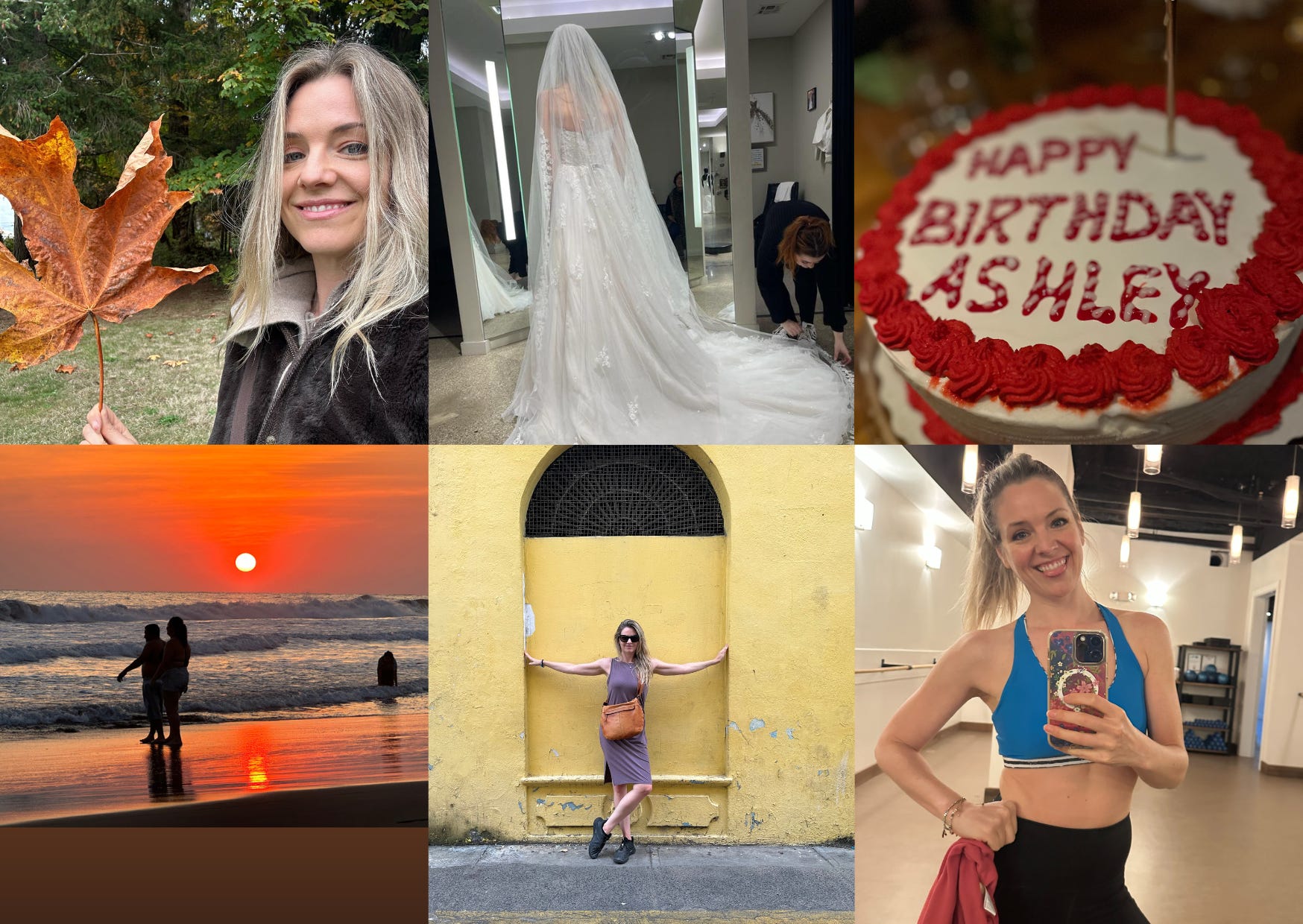
And she was right. In October 2024, I started teaching barre officially, finally getting paid as an instructor. In October 2023, my husband and I left for five months across Central America, after the home we’d been living in for seven years sold. In October 2022, I found my wedding dress, and I also began a ten-month hypnotherapy training. October is apparently my month. It’s also my birthday month, which feels like a decent enough cosmic excuse. (If you’re curious, try this exercise. I was surprised.)
But soon I was eyeballs-deep in photos and catapulted into the past. Us eating pupusas in El Salvador. My brother visiting with the kids. I started texting old friends their glowing portraits, even pinging my former manager with a picture from ten years ago. And since I was already in my archives, why not start an album of prints for the house? Soon I was swimming in a decade of images and an ocean of memories.
By the time I surfaced, I was hungry. So I made myself a peanut-butter-and-banana bowl—literally just those two things in a bowl—and a London Fog. Delicious, but not exactly forward motion.
It was 1:30 p.m. I still hadn’t written a word.
The Dog Knows
My eyes met my dog’s eyes. He stared back, wagging his tail. “Not yet, Thor,” I told him, as if bargaining with a toddler. Instead, I unrolled my yoga mat. Maybe a stretch would trigger oxygen, which would trigger inspiration. It didn’t.
The hours kept sliding away. By late afternoon, I was rationalizing a nap, telling myself I could listen to a hypnotherapy podcast about procrastination at the same time. Two birds, one subconscious. I woke up groggy with Thor glaring at me like I was ruining his career.
“Two birds, one subconscious.”
So much for my productive day. Sneakers on, leash in hand. We went for a walk.
Procrastination Isn’t Laziness
On that walk, I circled around what procrastination really is. Is it a task I don’t want to do? Or an emotional state I don’t want to feel?
A podcast I’d bookmarked, How to End Procrastination Now on The Art of Accomplishment with Joe Hudson and Brett Kitsler, argued that procrastination isn’t laziness; it’s avoidance. Not of the task itself, but of the emotions it stirs: fear, self-judgment, doubt.
“Procrastination isn’t laziness; it’s avoidance. Not of the task itself, but of the emotions it stirs.”
That made sense. Every week, before I know what I’m creating, I feel it. The pressure of the blank screen. The not-knowing where to begin. Or sometimes, too many beginnings, all competing for attention. When that happens, I ask: what idea excites me most? Once I find it, I make my offer. I write the first sentence, and then the next and the next. It’s a vulnerable moment, splashing that paint onto the canvas.
And then the self-doubt sneaks in: This isn’t very good. It’s boring. No one wants to read this. All you write about is how you struggle to write! Talk about irony.
As I realized, I wasn’t dodging the work: I was dodging how the work might make me feel.
Shifting the Emotion
The podcast offered another way: don’t fight procrastination. Change the emotion of the doing.
How do you do that? Something I’ve been getting into the habit of is — finding a quiet place to sit or lie down, breathing into the feeling, and trying to locate it. It’s not always obvious. I allow the emotion to wash over me. (The ego will resist. Remind yourself: you will not die. This is just an experiment.)
1. Name what you’re avoiding. Maybe it’s feeling like a beginner, like you’re failing, like you’re not good enough, or like an imposter. Spend time with this sensation and get to know its texture.
2. Imagine you’re an exquisite instrument. This is a new thought experiment I’m playing with. I imagine that I am a cello from another century with the potential to produce beautiful music. The negative emotion is a signal that I’m out of tune. I simply need to be tuned.
3. Make it playful. The tuning process is about finding where I enjoy the thing I’m procrastinating on. So go ahead and start playing around. Pretend it’s bad karaoke, not Carnegie Hall. Imagine smearing finger paint like a toddler, or start writing in a stream-of-consciousness manner with cuss words and bad grammar.
4. Bank the good feelings. Journal the tiny wins so your nervous system remembers that creating something is a matter of being “in process” and doesn’t equal humiliation. Your process is private, and it’s where play happens.
*I made a video tutorial about how I track my creative endeavour using google sheets. I’ve had feedback from friends, who use it, and love it! It’s been a game changer for me.
When you shift the emotion of the task, even a little, the procrastination starts to dissolve. Instead of an enemy, it becomes a signal. A compass. Permission to play and to be ‘in process.’
I saw a video this week with Meryl Streep talking about how process in acting isn’t for other people to see because “the process” looks like bad acting. I loved that she said this. The video showed short clips of her and other actors playing and experimenting. Indeed, they did look silly.
The Signal: What You’re Actually Avoiding
When I got back from my walk with Thor, I estimated my husband would be home in an hour or so. I pulled out my computer and wrote a messy, ugly, stream-of-consciousness draft of this essay, merely documenting and describing how I wasted the day. All of the insights, reflections, and polishing came days later.
So yes, I wasted my perfect day. But I also walked away with this: procrastination isn’t a sin—it’s a signal. It points to the emotions hiding underneath, the ones worth noticing. And when I look back on that day, I think I needed to meander. Maybe it would serve us better to actually schedule a little procrastination into our lives.
I have a monologue to memorize for an upcoming workshop, and I can feel myself procrastinating. But instead of shaming myself, I’m going to try to listen. Because if procrastination is pointing at something true like the fear of not being good enough, or the fact that you don’t actually want to do the thing—the worst thing is to ignore it. The better move is to play your way back in, or admit it’s not for you.
Procrastination is a signal. The question is whether you’ll follow where it’s pointing.
Question for the comments: When you procrastinate, what emotion are you dodging—fear, self-doubt, boredom, or something else? And what negative thought tends to sneak in?
Was this helpful? If so, tell me in the comments. And if you want, I’ll make a short guided meditation you can play the next time procrastination comes knocking. And hey, if this resonated, sharing it helps other “professional procrastinators” find it too.