Hi friends,
This Canadian Thanksgiving, I was grateful for something we rarely toast: free speech—the chance to say what I believe about love, creativity, politics, or the weird mystery of being alive—without getting punched.
However, lately that freedom feels fragile. Sometimes I think hitting “publish” has replaced skydiving as our generation’s adrenaline sport. I’m lucky to use my voice, and I hope to use it for good.
A voice is a profound thing, isn’t it? It’s the heart and mind turning into sound…air, breath, intention.
A few words can start wars or create peace. I think of Truman’s command that dropped the atomic bomb: Eighty thousand lives gone in a breath.
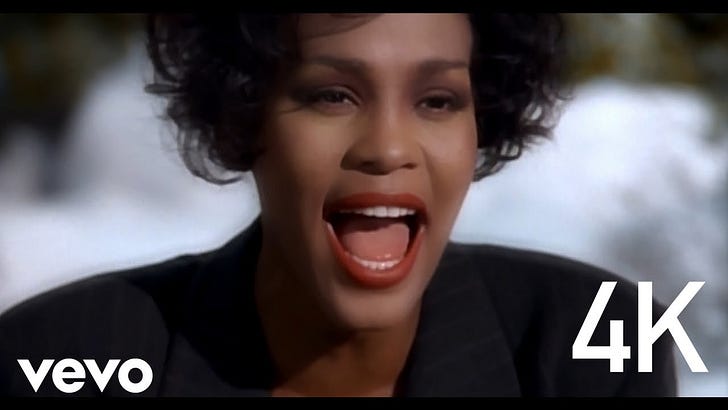
When I was eight, I believed that if I could sing like Whitney Houston, I could save the world. (In my twenties, that fantasy shifted to Adele.) I’d press record on my little cassette player and belt “And I Will Always Love You” with all the power my tiny lungs could muster. I sounded like a cat dying in a wind tunnel.
I imagined my voice echoing across mountaintops—disarming soldiers, easing childbirth, making criminals drop their weapons mid-heist. Voice, even then, felt like sorcery. The more I tried to sound like Whitney, the more powerful I imagined I’d become.
Now, decades later, I still believe in voice…just not in quite the same way. That reminder came back to me recently at a concert.
A few nights ago, I went to see Blue Rodeo. Watching Jim Cuddy and his band take the stage, I felt it again: that reverence for a voice. His isn’t showy or technically flashy, but it’s alive. It fills the room, the air, the space between people. It’s warm, weathered, generous; a melodic cry that rearranges your molecules.
When they played “Lost Together,” I felt tears slide down my cheeks as memories flickered like film behind my eyelids.
“Strange and beautiful are the stars tonight” —Blue Rodeo, Lost Together
As I drifted off in my seat (it was past ten; forgive my grandma hours), I thought: What makes a voice resonate like that? Why does one creative expression go deep while another barely echoes?
The question followed me home. I started thinking not just metaphorically but literally: What is resonance made of?
The human voice is shaped by breath and anatomy—lungs, vocal cords, lips, and tongue. Sound vibrates in the open chambers of the body: the chest and throat. Those vibrations give a voice its texture and individuality.
It’s biology, yes, but also biography. The sound you make carries the life you’ve lived.
Even when two people hit the same note, the resonance is different. Voice is deeply personal. It’s shaped by experience, rhythm, and taste. No two voices can ever truly be the same.
Think about your favourite actors. For me, Jessica Chastain comes to mind; her beauty, her sadness, that uncanny gift for tears. I once heard her say in a podcast (one I’ve never been able to find again) that she could cry forever. The line stayed with me, especially after I learned about her sister’s death. Diane Keaton’s anxious on-screen presence was central to her charm. She made her awkwardness and neurotic wit relatable. When I read her autobiography and discovered her lifelong battle with an eating disorder, her on-screen energy made perfect sense. Rest in peace, Diane. Thank you for sharing your heart so bravely.
Our quirks, histories, and traumas shape how we move through our art. They shape our voices. As writers, actors, and creators of any kind, we’re asked to bare our souls. I keep asking myself: how much of me am I willing to reveal through art?
Sometimes the answer depends on the project. Some work simply asks us to show up. But often, creating something truly resonant means confronting who we are. And just like our physical voices, creative resonance can be strained, blocked, or hidden.
When the Voice Tightens
When fear grips us, the voice shrinks to fit the space we feel safe in…
The channel between the inner and outer world jams. I know this feeling well. I’d wanted to act long before my career ever began, but it wasn’t until university, filming horror shorts, that I finally gave that desire a voice. Apparently, screaming at blood-curdling pitch is one way to free it.
As a preteen, I was shy, perfectionistic, and carried a soft lisp. I joked I had a fat tongue. My dad would say, “Enunciate your words, Ashley!” The harder I tried, the worse it got. My voice tightened; my words caught somewhere between effort and embarrassment.
Early on, I gravitated toward quieter art forms: dancing and writing (silent but full of feeling). Then, little by little, I stumbled into another kind of voice, one that felt both safe and a little daring: humour. If I made myself the butt of the joke, I could beat others to it and still win approval. Many of us creatives learned that early. I loved Bridget Jones’s Diary because she humiliated herself constantly but was still the hero. I’m drawn to lovable idiots.
As a kid who moved several times and had to rebuild friendships, humour became my armour. If I was funny, I was unthreatening. I loved how humour lifted people and diffused awkwardness.
One afternoon, joking with new friends in a new town, I shouted at one of them, “I will bear your children!” Chaos and laughter erupted until my mom yelled from the next room, “Ashley! You will certainly not!”
Mortified, I realized maybe there were limits to how my voice should sound. It was a small moment, but it marked the start of a lifelong exploration of what I could say…and how.
Making Your Own Creative Work
In 2019, my husband and I made a short film we wrote and produced ourselves. I played the lead and had never felt freer. No one corrected my dialect. I wasn’t trying to “sound right.” I was playing a character I’d helped create, speaking words I’d written. My natural voice—quirks, accent, rhythm and all—finally came through.
We filmed in the land of the midnight sun in Canada’s North, my hometown. I was juggling too many hats: lead actor, writer, producer, driver. Rise n’ Shine is a 22-minute film. You can watch it here.
I was one horrible cup of Folgers’ coffee away from snapping. But in one quiet take, I thought: oh, this is what it feels like to sound like myself.
And guess what? I was still word-perfect. But this time I wasn’t tense. I wasn’t performing precision; I was simply present and open. That’s what resonance requires: openness. I was also too busy to give a single flying f&k about my performance.
That experience got me thinking more deeply about what makes certain creative voices truly resonate, staying with you long after you’ve closed the book or left the theatre. Paul Thomas Anderson, Nora Ephron, and James Baldwin don’t sound like anyone else. They sound like themselves turned up loud. They trust their instincts, their flaws, and their perspective… even when it’s messy or inappropriate.
I just watched P.T. Anderson’s newest film, One Battle After Another, and left the theatre feeling electrified. There’s always a sly commentary on sexuality in his work. Instead of omitting or toning it down, he finds ways to satirize it. One of the opening scenes is a tense, absurd gun standoff between Colonel Lockjaw (Sean Penn), a grotesque, buzz-cut military caricature and Perfidia Beverly Hills (Teyana Taylor), an activist who kidnaps the colonel. In the middle of the chaos, he becomes smitten with her. She plays into it, teasing him until the scene veers into (almost slapstick) comedy.
(I won’t spoil it. It’s hilarious and groundbreaking, all at once.)
I remember thinking, what must it feel like to write a scene like that and say, yes, that stays in the movie?
It’s making me think that maybe the real work is just to open the channel… to get out of our own way. Resonance happens when we quiet the hum of doubt and fear, letting it fade into background noise instead of DJ-ing the show. The energy we create through art travels on our personal frequency, and if that frequency is judgment, we block our own brilliance before it ever has a chance to emerge. (I made a short video about this on Instagram if you want to check it out.)
Resonance isn’t about loudness; it’s about depth. Every creative person has “their thing”…their particular soundtrack in the world.
But even when we find that resonance, there’s still one more threat: the quiet, sneaky kind that lives inside our own heads.
The Trap of Comparison
In my last Substack essay, I ran a poll asking, “What’s the first unhelpful thought that shows up when you try to write (or make anything)?”
The top two answers were:
• “Other people are doing it better”: (41%)• “It won’t be good enough”: (24%)
These thoughts shrink confidence and block your voice before it leaves your throat.
I’ve lived this. I wanted to act from the moment I saw my first Elvis movie at six, but I didn’t start until university. For years, I believed acting was for other people—louder, flashier, real performers. That belief stole years of creative life from me.
Even now, comparison sneaks in. I recently audited a friend’s acting class full of lovely twenty-somethings. When I admitted I’d been acting for sixteen years, I immediately wanted to say I meant sixteen weeks. That’s how sneaky those thoughts are: they peck at your confidence.
But I’ve learned that when I compare myself to others, I become my own gatekeeper. I reject myself before the world ever gets the chance to see or hear me.
It’s become my mission to stop f&king doing it (and maybe help others too).
Someone on Substack recently told me she’d stopped writing because she wasn’t getting views. I get that. Sometimes I think I “should” quit acting, too. It would make sense. But I don’t. Because when you know you have something singular to offer, you keep going.
Sometimes we’re just in the quiet stretch of the journey… the desert before the audience arrives. That’s where resonance is born.
And if your voice feels tight right now, remember: it’s not broken. It’s just under pressure. Take the pressure off. Get WEIRD again. Laugh TOO loud. Use the wrong word. Tell the story that makes you nervous.
If you’re still in the quiet season of your journey, keep going anyway. The audience will come.
You’ve made it this far.
You’ve already proven you have a voice worth using.
A Little Gift for Your Voice
Mantra for Attuning My Voice (and calming the overthinker who rattles in my mind)
I am open. I am present. My instrument is relaxed. My voice is enough. My kindness, humour, and taste are enough. I can be heard. I can be misunderstood. Either way, I’m guided. Those who need me will find me. The lesson I seek is already seeking me. I trust my writing because it always knows where to take me.
Question for the comments:What part of your voice are you ready to free next—on the page or in your life?
Coming Soon: The Most Powerful Guided Visualization to Free Your Voice
Since becoming a certified hypnotherapist in 2023, I’ve been exploring ways to help writers and creatives connect with their subconscious voice: the one that knows what to say before we do.
I’m creating a pay-what-you-want relaxation and visualization recording designed to help you soften, breathe, and let your true creative voice flow freely.
It’s almost ready…stay tuned.If this speaks to you, drop a comment or DM me.