I want to share a brain nugget I’ve been rolling around this week—though honestly, it feels more like batting around one of those Oopee balls from Kentucky Fried Chicken family meals in the 90s. Do you remember those? Those water-weighted plastic beach balls that flailed through the air and made that ridiculous boing sound.
My brother and I used to chase one around Rotary Park in Whitehorse with absolute abandon. It was thrilling, hilarious and unpredictable. Kind of like the way I’m thinking about identity these days.
Here’s the quote that set me in motion:
(Also, I posted this as a video on Instagram and Tiktok—follow me there if you want daily inspo in this vibe!)
“You’re always you, and that doesn’t change, and you’re always changing, and there’s nothing you can do about it.”— Maggie Nelson, The Argonauts
I’m not familiar with Maggie Nelson’s work (yet), but this line alone made me grab The Argonauts from the library. It now sits on my shelf beside the other “to-be-read beauties” I’ve collected. Side note: Anyone else have un-read book guilt? The perpetual guilt of all the books I want to read and will not ever read. It’s real.
What I love about this line is how it captures the paradox of being human. There’s a you-ness that never shifts: something essential and core, but also a constant evolution unfolding at the same time.
And it turns out, this paradox isn’t merely poetic. It’s also biological.
The Science of Our Ever-Changing Bodies
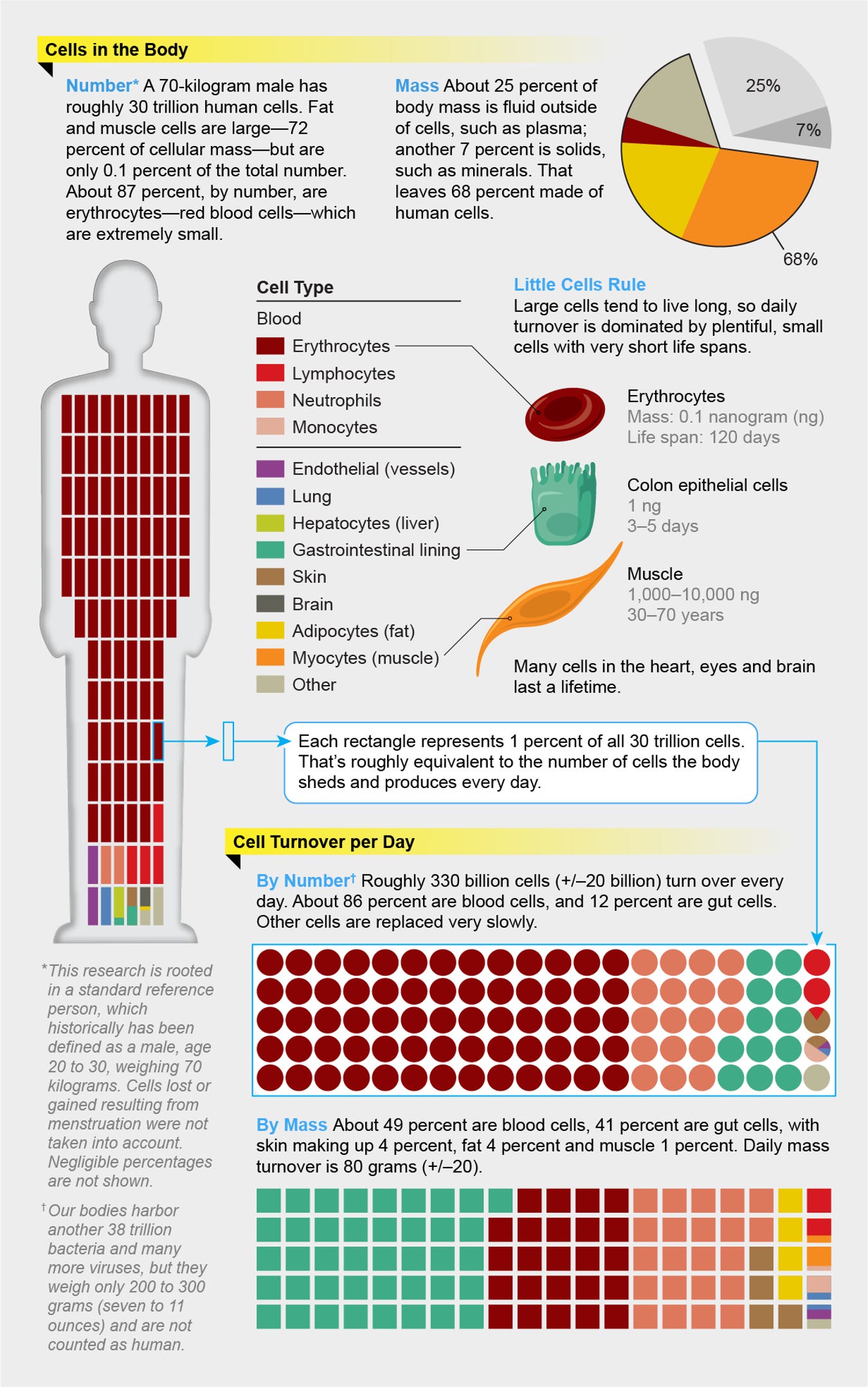
Our bodies are in a state of perpetual change. And I don’t mean metaphorically: I mean at a cellular level.
Every day, we replace about 330 billion cells, which amounts to roughly 1% of our body’s total cell count. Over the course of 80 to 100 days, that means we've essentially regenerated our entire cellular makeup. In other words, you’re not just emotionally evolving: you are physically a different person every few months.
Different cells turn over at different rates:
* Red blood cells: every 120 days
* Skin cells: every 2 to 3 weeks
* Colon cells: every 3 to 5 days
* Skeletal muscle cells: can take up to 15 years
* Neurons in the cerebral cortex: some last a lifetime
So yes, we are always changing. Whether we feel it or not.
Reflecting on Change
Knowing how much we change physically makes me think even more about the changes we can’t see. The emotional shifts. The mental rewiring. The ways our identities reshape over time. We are living, breathing, regenerating beings with a core essence that somehow still feels stable amidst all the incredible changes we experience.
When I shared this quote with a friend this weekend, they told me, “I don’t like to dwell on the past.” And I get that. For some, looking back feels like a trap. But I’ve always been the opposite.
I’ve kept a journal since 1993, when my parents first told us they were separating. I was just a kid then. My brother and I were trying to make sense of a world that suddenly didn’t feel stable. That journal became my lifeline. I wrote down everything: first crushes, first kisses, poetry, cigarettes, dreams, breakups, strange cravings, late-night questions about God and purpose. My journal has become a lifelong excavation project. Substack is an extension of that.
“Like an archaeologist of my own life, I’ve spent years wandering through a private museum of artifacts.”
Like an archaeologist of my own life, I’ve spent years wandering through a private museum of artifacts. Trying to answer:
Who was I?What was I trying to say?And how did I become this version of me?
To me, this kind of self-reflection isn’t indulgent or dramatic. It’s necessary. It’s how I’ve learned.
Just like traveling to another country can give you perspective on your own culture, self-reflection gives you perspective on your own story. It’s internal travel. Soul mapping.
I moved to a town with a pre-dominant Tlingit First Nations culture when I was 11, and it shaped so much of how I see the world. In that culture, connection to the land and ancestry isn’t symbolic—it’s sacred. That upbringing taught me to pay attention to the natural rhythms, both around me and within me. It became the backbone against which I’ve compared every culture I’ve lived in since, including the one I live in now in West Vancouver. Reflection, is listening to where you come from and where you went.
Think about what happens when you travel: You might witness a slower, more communal way of life. You might see joy in simplicity or discover that your pursuit of more has left you disconnected. Or maybe, you return home and realize it has more to offer than you gave it credit for. I experienced both of these sensations when I traveled through Central America in 2023. I wrote about it in the essay “The Year I Slept in 38 Beds.”
However, the point I’m trying to make here is: that kind of perspective shift doesn’t happen just happen through physical travel. It can also come from traveling inward, through time. Lately, I’ve been thinking about my ancestors. This might be a slight side tangent, but it’s been sitting with me: in order for you to be born, 4,096 of your ancestors had to survive- just 12 generations back. If even one of them hadn’t made it, you wouldn’t be here reading this. That kind of math is profound. It makes you pause and reminds you that you’re not just one person—you’re a continuation of thousands.
“To me, this kind of self-reflection isn’t indulgent or dramatic. It’s necessary. It’s how I’ve learned.”
Self-reflection is like that. We use memory to collect insights. We revisit old conversations, journal entries, and yes, even our cringey teenage selves: not to judge, but to learn.
Perspective gives us wisdom. And wisdom changes everything: our relationships, our work, our creativity, our ability to love and be loved.
A Writing Prompt for You
If this speaks to you, try this:
* Write about a version of yourself that no longer exists but left an fingerprint
* Then write about the part of you that never changed
* Imagine those two selves meeting on a bench
What would they talk about?What would they forgive?What would they thank each other for?
Tag me if you write something. I’d love to read it.
Wrapping it up…
That Maggie Nelson line messes with me in the best way.
Because it’s true, isn’t it?
There’s a part of you that stays the same. That core self. That stubborn and tender spirit. Yet, there are also versions of you who’ve moved on. Disappeared. Evolved.
I did this prompt, myself, and was surprised at the self (?) and selves I’ve outgrown…some lovingly, some by necessity.
And yet... they all left a mark.
I’ve kept this picture of myself as a kid as a screensaver on my phone for the last six months or so. It reminds me of the part that hasn’t changed. The goofy, kind child who saw the good in all people. The one with a lightness in her being. I don’t want to forget her.
Recently, someone caught a glimpse of the photo on my phone, and asked how old my daughter was. LOL. I just smiled. Because I am my own child. And I’m still taking care of her.
Question for the comments: What imprint has your past self left on who you are today? Where do you still feel their fingerprints?
With love and evolution,Ashley