Pedagogy Everywhere
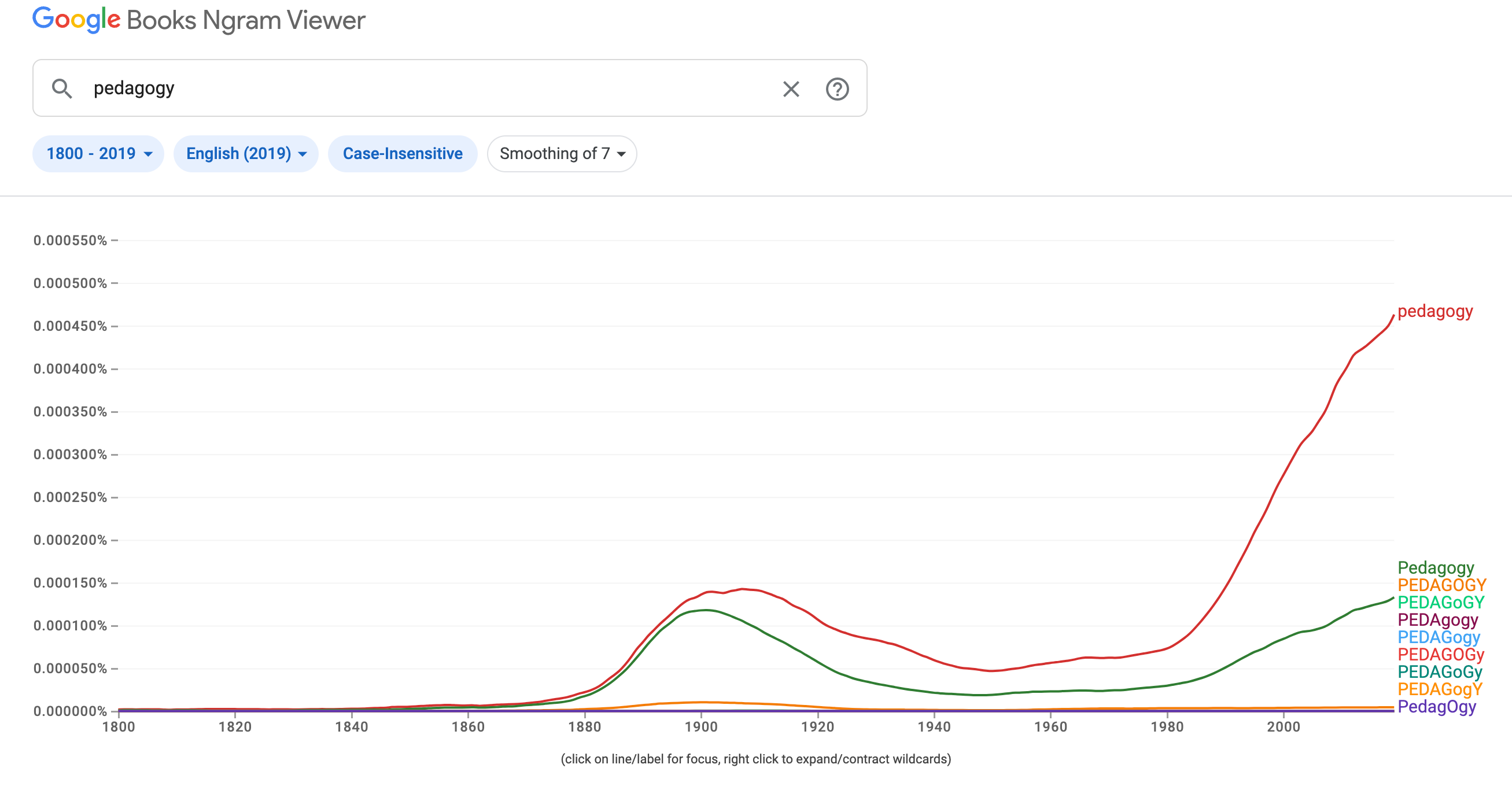
Gee I hear the word “pedagogy” a lot. I hear it pronounced in a myriad of ways too. Woah - I just googled it. It’s not just me:
According to Google, there are at least ten pronunciations of pedagogy loose in the wild as we speak. This explains why it’s high on my list I call “Say This Word Second™” just below, diaspora and hegemony. As you might have gleaned, I use pedagogy, but I quite enjoy when Americans use “ped-a-goe-jee” and “peed-a-goe-gee” must surely be the most hardcore.
Back to Google: it seems the pronunciation problem didn’t exist until the bump in usage around the turn of the 20th century which coincides with the rise in compulsory school-based education, in what Hargreaves et al would call the “Anglophone Nations”. Then it seems to fall out of fashion, maybe mirroring the demise of progressive education in the post-war period, then takes off like a unicorn startup in the 80s, just as the Global Education Reform Movement (GERM) emerges - hmmm… interesting…
Everyone’s a Pedagogue!
So, all of a sudden, everyone’s a pedagogue, but until recently, I’ve felt like the guy in the Canadian Club ad, I don’t really know what “pedagogy” means and I have this sneaking suspicion that I’m not alone. In this post I’ll share my journey to understand pedagogy and what happens next.
Given that there’s no consensus on the pronunciation, what are the chances of broad agreement on what pedagogy actually is? And, how might our own (conscious or unconscious) definition determine or maybe limit our actions as pedagogues? Well, in their chapter from 1999 called “Pedagogy: What do we know? Watkins and Mortimer start with the heading “pedagogy”, [ready for it?] “a contested term” (p. 1). Looks like we might need to do some philosophising…
But What is Pedagogy?
Let’s start with a “disambiguation”. According to the Stanford Encyclopedia of Philosophy, “ambiguity has excited philosophers for a very, very long time”, at least since Aristotle. It excites me too and it’s a vitally important tool for Gig Based Learners as critical thinkers. Disambiguation is the process of interrogating words to try to remove the ambiguity in their meaning, or to distinguish between different meanings of words to “clear up confusion”. As a starting point, philosophers often use etymology to uncover the origin of a word and how its meaning has “changed over the course of history”.
Back to Watkins and Mortimer, they say that:
“Pedagogy”, [is] derived from French and Latin adaptations of the Greek [παισ, παιδ (boy) + αγωγοσ (leader)], literally means a man having oversight of a child, or an attendant leading a boy to school. This meaning is now obsolete. (1999, p. 1)
So, adapting for modern usage - Pedagogy - to lead a child. Is that meaning obsolete? How many current classroom teachers see teaching as “leading children”? Is it possible this notion persists and possibly limits possibilities in our classroom?
Next, Pedagogy as “the science of teaching” vs Pedagogy as “the art of teaching” sets up a classic Deweyan either-or and it’s problematic since “such definition depends on the reader’s conceptions of ‘teaching’” (p. 2) - wait a second, there are conceptions of teaching? Yes there are, more on that in a future post. This “Science and Art” notion has been around since that first hump in our google graph and persists along with a tweak in the 1990s that suggested that pedagogy might be actually be a “craft”.
But, so far, it’s all about the “teacher”. Haven’t we forgotten someone? Watkins and Mortimer remind us that these definitions of pedagogy are really just “didactics” or the transfer of information from teacher to student. But what about the student? Which brings us to recent developments and the OECD.
The OECD and Pedagogy
A 2018 paper produced by the OECD suggests that “a good starting point in conceptualising pedagogy is Loughran’s definition” (p. 36) from 2013 which takes pedagogies as “ways of looking at the interactions of teaching and learning in the real time of classroom practice”. Therefore:
Pedagogy is thus both knowledge (ways of looking at) and action (the decision-making and designs shaping the interactions of teaching and learning in classroom practice). [D]ecisions about instruction are informed by knowledge about the relations of teaching and learning [and] these repertoires for designing learning environments and practice build on previous instruction and [in] a dynamic model connecting knowledge and action. (p. 36)
Yes!
Pedagogy as Craft combining Teaching and Learning as Science and as Art
Bringing this all together, Pollard (2010) suggested pedagogy is simultaneously a form of science, craft, and art where “science is the knowledge and art is in the practice” (Paniagua, 2018, p. 37). Now we’re getting somewhere. Bring it together for us Paniagua:
Pedagogy as science refers to how forms of instruction are made explicit, coherent and generalisable through the learning sciences. Pedagogy as art refers to how teachers implement pedagogical approaches, strategies and tools intuitively and creatively, through contextualised personal responses and capacities. The interaction between these two ends comes together in the notion of ‘craft’, as a mastery of a repertoire of skills and practices - knowledge about practice and putting knowledge into practice. Pedagogy as craft stands in the interface between the learning sciences and idiosyncratic, contextualised teacher classroom practices; it encapsulates scientific knowledge in application and intuitive practice, informing professional judgements about approaches to teaching.
Source: Adapted by Paniagua, (2018) from Pollard, A. (ed.) (2010), Professionalism as Pedagogy: A Contemporary Opportunity: A Commentary by TLRP and GTCE, TLRP, London.
And this next part is a bombshell:
Craft, then, lies in the dynamic intersection of science and art (dark blue zone), but is wider with boundaries as indicated by the dashed line. Craft includes scientific knowledge that is not yet fully validated as implementation into practice or is still permeating teaching practices; it also incorporates practices that are well-established but with only limited scientific evidence about their impact.
See why this is such a bombshell? Pedagogy as the “dynamic intersection of science and art” gives us agency to “implement pedagogical approaches, strategies and tools intuitively and creatively, through contextualised personal responses and capacities”. It’s still all about the teacher but that’s OK for now because we have agency to include the student in decisions about their learning - that’s a pedagogical practice. So, there’s my call to action: to improve the quality of my “professional judgements about approaches to teaching” by increasing my “knowledge and understanding of learning sciences” and integrate them into my “idiosyncratic, contextualised teacher classroom practices”.
Introducing Bradagogy
Neologisms have also excited philosophers for a very, very long time. A philosopher creates a neologism “as a shorthand for a complex construct or to distinguish a single denotation--and shed the connotations--of an existing word. Neologisms also serve to facilitate the spread a philosopher's work. So, I think a neologism is warranted here. I’ve established that pedagogy is a complex construct, it’s also become heavily laden with unhelpful connotations that need to be shed, and I could use some help to spread my work. So, I hereby coin:
Bradagogy - the dynamic intersection of Brad (musician-teacher-learner) and Pedagogy (the craft of teaching and learning)
Source: Adapted from Paniagua, (2018) which was adapted from Pollard, A. (ed.) (2010), Paniagua, A., & Istance, D. (2018). Teachers as designers of learning environments: The importance of innovative pedagogies. OECD. https://doi.org/10.1787/9789264085374-en
Bradagogy is my unique Dialogic Critically Reflective Practice (DRCP) of classroom music education which is activated through Gig Based Learning in …