Welcome to GTM Vault, trusted by GTM leaders building the future of revenue.
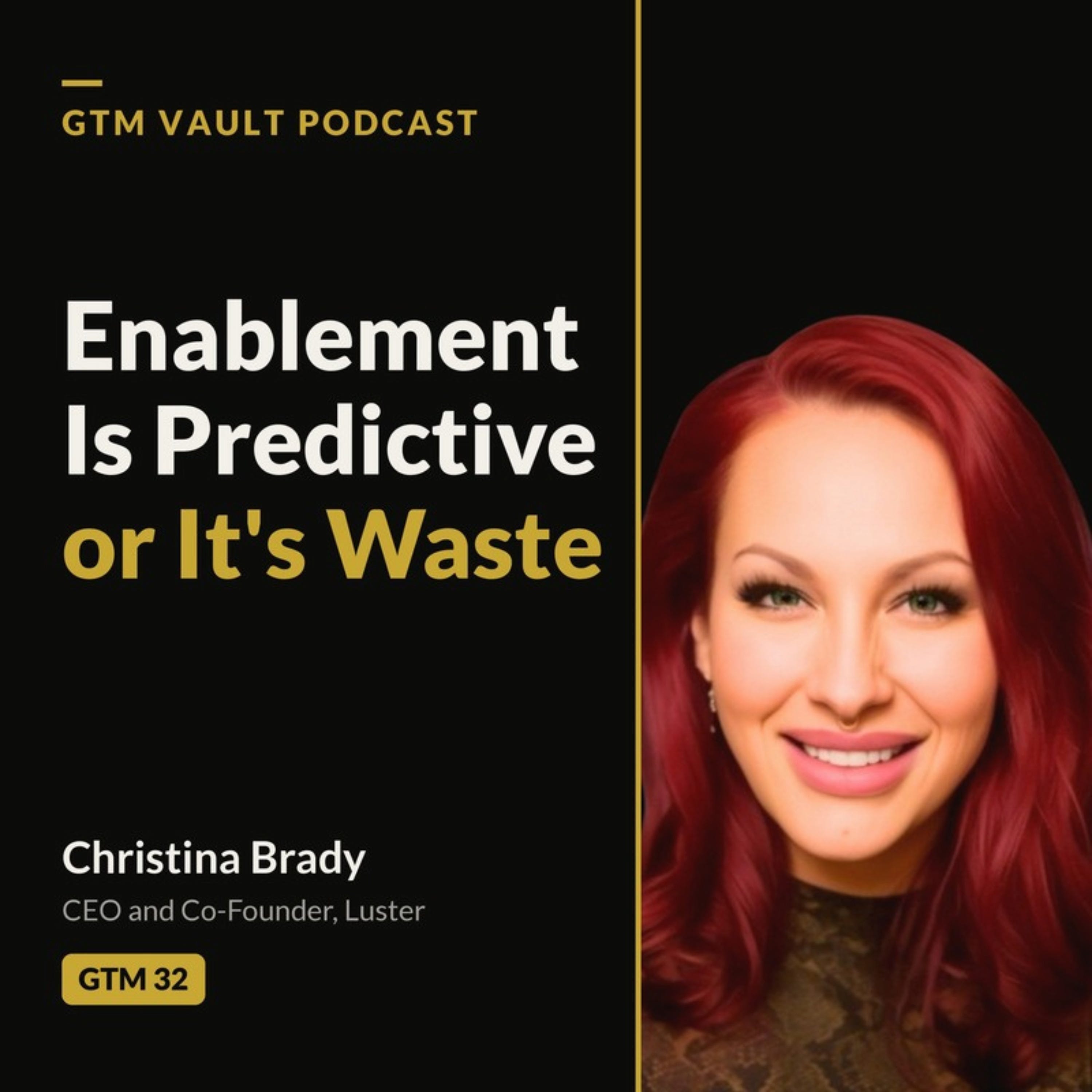
This week’s guest is Christina Brady, CEO and co-founder of Luster – a next-generation GTM enablement platform. With nearly two decades in SaaS sales leadership (from roles at Groupon, Glassdoor, and Spekit) and a deep commitment to people-first growth, Christina is now leading a movement in GTM: Predictive Enablement – using AI plus real-time data to reveal where reps are poised to falter, and intervene before revenue leaks.
Inside this episode:
* Why traditional enablement still fails the best GTM teams – the “what do you think you need” trap and one-size-fits-all training.
* The anatomy of predictive enablement: Diagnose → Predict → Prescribe – integrating call-data, calendar insights, content usage, and skill-maps.
* How AI becomes a human-centric accelerator – you want the human in the lead, AI in the system.
* Early wins: e.g., 50% faster ramp, big upticks in ACV, reduction in mistakes before they impact deals. Read the announcement →
* Culture, growth and the GTM engine: Christina’s move from operator to founder, and how she scales an AI-native GTM system without losing her people.
This episode is for founders, CROs, RevOps and GTM operators who are scaling revenue teams and want alignment across Marketing, Sales & CS – where readiness, data and cadence outpace brute force.
Listen & subscribe now across:YouTube // Apple // Spotify
This episode in the Library: the written playbook, the stack and the full transcript, free and open. Open it at pro.gtmvault.co.
Highlights
* From noise to signal: Use real data (calls, calendar, content usage) to identify which rep is at risk of a revenue-impacting mistake.
* Don’t train first – diagnose first. Build a proficiency map before you build training.
* AI isn’t the mandate – it’s the amplifier: Use AI to surface insights and free humans for high-value work.
* From reactive to proactive: Imagine knowing this week’s leaks before they leak.
* Culture fused with tech: Scaling GTM means systems, cadence, and human creativity aligned.
Frameworks & Playbooks from the Episode
* Proficiency Map Blueprint – Qualitative + quantitative skills per role/tenure → enables bespoke readiness.
* Diagnostic → Predictive → Prescriptive Engine – Data inputs (CRM, content, calendar) feed predictions → trigger role play/coaching.
* AI-Amplified Enablement Stack – Human strategic roles + AI for insight/administration = scalable GTM engine.
* Culture-Tech Union – Talent strategy, trust, feedback loops + systems and cadence to deliver sustainable GTM growth.
Referenced Tools & Concepts
Luster (Predictive Enablement), role-play simulations, skill maps, call-calendar-content data integration.
Recommended Books
Radical Candor – Kim ScottWho Moved My Cheese – Spencer Johnson
Takeaways for your revenue engine
* Stop assuming reps know their gaps and treat the team the same. Build a readiness graph for each rep.
* Align Marketing, Sales & CS through a shared data layer: same metrics, same hypotheses, same cadence.
* Audit your enablement stack: How many tools do you have that train? How many that diagnose?
* Treat enablement as a system, not a department: It should cover hiring → onboarding → execution → ongoing readiness.
We discuss
03:34 – The gap in traditional enablement
05:50 – Defining Predictive Enablement
08:33 – Role of point-solutions vs readiness systems
10:20 – Signals: CRM, calendar, content, call data
15:11 – AI hype vs real value in enablement
17:01 – Designing human-AI collaboration
20:25 – Advice for revenue leaders modernizing enablement
22:00 – Founder mindset, culture & GTM engine
24:32 – Org design, category design & future of roles
27:57 – Mind-shift for leaders adopting predictive systems
29:47 – AI’s impact on sales, enablement & revenue leadership
30:55 – The world of GTM in 2030
38:06 – Rapid-Fire segment: metrics, lessons, roles
What you should do this week
* Pick one role in your GTM org (e.g., SDR or AE) and map the three key skills that drive performance in that role.
* Pull in one data stream you’re currently not using for readiness (e.g., calendar + persona on call, content consumption, rep self-assessment) and plan to integrate it.
* Run a mini-experiment: select two reps with similar quota coverage – run one through a readiness map + tailored intervention and compare outcomes in 4–6 weeks.
Why this matters for scaling
As you scale GTM operations, growth comes when you reduce the leaks: rep attrition, bad hires, missed ramp metrics, unpredictable revenue. The fix: move from “train everybody” to “ready each person”. Christina’s work at Luster shows how you shift from firefighting to foresight – and that is where growth becomes repeatable, not random.
Predictive systems turn intuition into data – and data into repeatable revenue. That’s the GTM Vault advantage.
Connect
Follow Christina Brady: LinkedIn // Luster
Follow Rick Koleta: LinkedIn // RiteGTM
Catch up on all GTM Vault episodes →
Thanks for being part of the GTM Vault community. If this episode made you rethink how enablement integrates with your revenue engine – share it, apply one small step this week and let’s build GTM systems that scale with clarity, alignment and conviction.
Full transcript, searchable to the timestamp: pro.gtmvault.co/episodes/gtm-32.