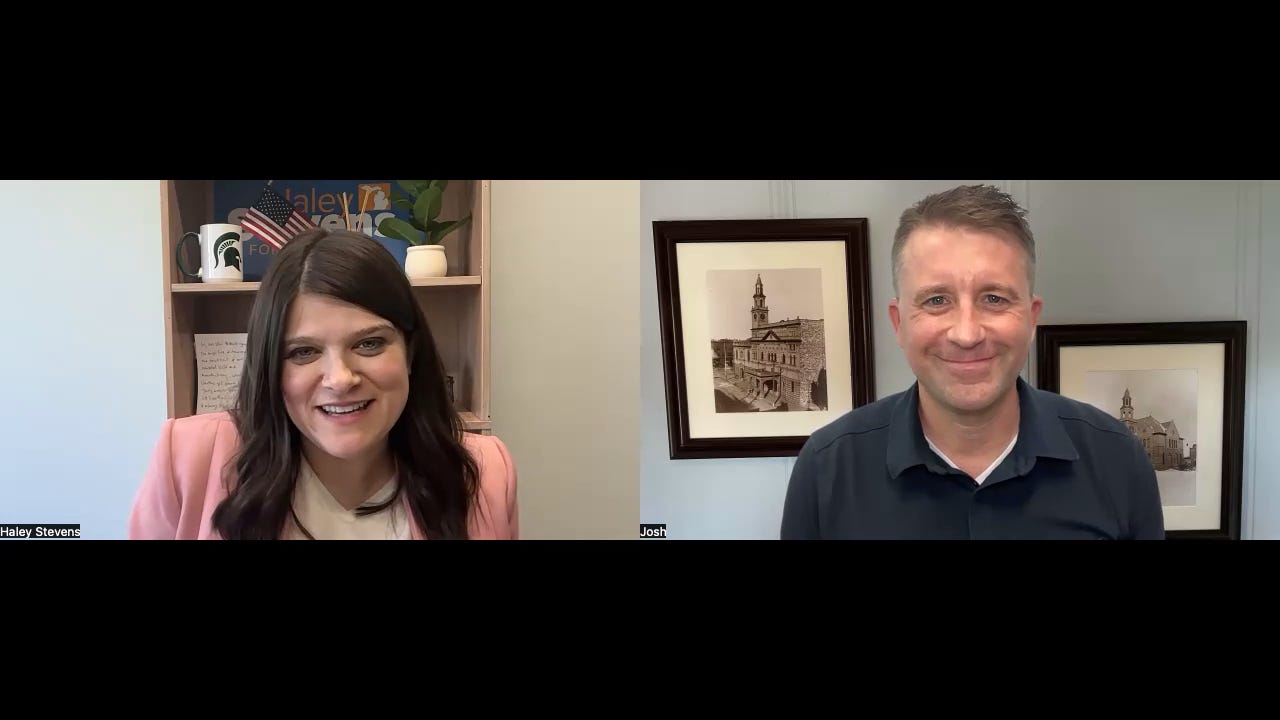
Late last year, and early into this year, I began sitting down with a number of congressional candidates and candidates for governor in battleground races across the country. I wanted to talk to them about their campaigns, but also—because of our focus here at The Forum— how they saw policy issues related to kids and families.
And especially schools—pre-K through higher education.
So this week I’m particularly happy to sit down with Congresswoman Haley Stevens from Michigan’s 11th District, who serves on the House Education and Workforce Committee.
Haley was first elected to the U.S. House in 2018 at the age of 35, and won tough re-election races in 2020, 2022, and 2024. Before running for office, she had a variety of roles in policy and political staff positions—most notably serving as Chief-of-Staff to Steven Rattner for President Obama’s Auto Rescue Task Force.
Haley Stevens is now running against Abdul El-Sayed and State Senator Mallory McMorrow in a hotly contested primary for the Democratic nomination for the U.S. Senate. She’s been endorsed by a number of unions, several fellow members of Congress, former Governor Jennifer Granholm, and the state’s legendary former Senator Debbie Stabenow.
We were supposed to talk last week, but we had to reschedule for the House Education Committee meeting that featured U.S. Education Secretary Linda McMahon. During the hearing, Haley Stevens grilled McMahon on a variety of issues, especially the growing teacher shortage in Michigan and beyond.
Here’s Our Conversation
JOSH: I’m happy today to have Congresswoman Haley Stevens from Michigan’s 11th District on talk about a couple of different things here. Congresswoman Stevens is running for the Senate right now, but also serves in the House Education Committee. So we’re going to talk a little bit about all of that. What’s going on, Haley Stevens?
HALEY: Hey, it’s great to be talking with you. I’m glad to be doing this. Obviously, it’s a pretty serious time out there right now. It’s a time of uncertainty and a lot of that and all of it, frankly, is coming down from Donald Trump’s chaos and abuses of power.
JOSH: Before we get to your current campaign, tell us a bit about your background. I’m interested in what you did both before getting to Congress and even before that--what was your first job out of college?
HALEY: Well, look, I was born here in Michigan—in Southeast Michigan. My dad was actually born in the city of Detroit, grew up in Detroit till he was about 10 years old, and moved to Warren.
My parents, when I was growing up, had a small business. It was a landscaping business. My dad was also a public school teacher, though, too. So I just grew up around really hardworking parents who wanted to give us the best, you know, late- 20th century life that they could.
I grew up just seeing all that and that kind of motivated my approach to public service and how I started getting involved in, you know, government and political campaigns. It was just about working really hard.
But you did ask about one of my first jobs, I think it was out of college, but I had a really, really good first job when I was in high school. I worked at Blockbuster Video. I didn’t last too long. It was like a late summer job, but I went through their training program. That Blockbuster video is long gone now.
JOSH: I actually really wanted a job at Blockbuster. They wouldn’t have me. I applied all over to, like, 7 different Blockbusters, so you’re one up on me there.
HALEY: I bet if I looked hard enough, I could probably find one of their old pieces of paraphernalia or something like the card or whatnot for you.
But look, I would say this. I graduated college right before the Great Recession hit. And when the Great Recession hit, that obviously whacked the place that we call home here in Michigan hardest. So the question for me became, how can I help Michigan?
You know, I thought about going and working at a car dealership, but I had also been working on the Obama campaign, and was kind of right there as he was getting ready to transition into office, and I heard that they were going to do something with the auto industry.
And so I put up my hand, you know, just kind of right place, right time. Steve Ratner was going to be tapped for that, and Steve needed a chief of staff. I’m pretty sure my thick Midwestern accent just convinced him that I would do a great job.
And I was the person from Michigan on that team, you know, taking those phone calls, getting everything set up, making the wheels turn. And it was unbelievable. And obviously we made it through that tough time. But man, oh man, was that an example of good federal policy making, meeting the moment for who we are as Michiganders.
Now is not the time in Michigan to be comfortable and to have comfortable leadership. Now is the time to step up and to fight back.—Rep. Haley Stevens
JOSH: You’re leaving a House seat you’d be heavily favored to win in, to run for the Senate. Walk me through that process: tell me one reason why you might have stayed in that House seat, and one reason that really determined that you’d make the Senate run.
HALEY: I will tell you this because I have a feeling that some of your viewers are younger people who are looking forward to a life of making big decisions. One piece of advice I have on that front is when you make a decision, don’t look back. Don’t talk about the alternative, because it doesn’t exist anymore, and you’re just spinning your wheels. And so I’ll say this to what you’re asking me, which is a really great question. I love the work I do for Michigan.
I am so grateful and honored and humbled to be in my fourth term in the United States House of Representatives, you know, fighting for us, being recognized as the most effective Democrat for Michigan in the Congress. The most effective Democrat for science and tech issues, actually, alongside Gary Peters in the Senate.
Not clear what the California folks are doing, but, you know, Gary and I are writing bills and getting them passed. So, you know, that works. When I ran for Congress, I flipped a seat. And very similarly to when I worked on the auto rescue, I saw Michigan needing something and I wanted to run at it.
So I held Michigan’s 11th district in 2018 and 2020. The district now is redrawn. It is a different district. And you’re right, it tends to be, you know, more of what they call a safer seat for Democrats.
And I love the work that I do on the Science committee and on the Education Committee, which I know we’re going to talk about. But last year, when a fully paralyzed veteran reached out to me through a mutual friend asking if he was still going to get his benefit check because he saw Elon Musk prancing around a stage with a chainsaw—that really broke me and it just jarred me.
And I thought, you know, now is not the time in Michigan to be comfortable and to have comfortable leadership. Now is the time to step up and to fight back.
And I can tell you that I am doing more today, you know, serving in the House of Representatives, running for a statewide role to serve Michigan in the United States Senate and to offer ideas and solutions to some of these challenges that we are facing.
Mike Rogers [the GOP nominee], who, you know, I know you’re familiar with him, but he’s made it really clear what his priorities are. And I… I’m writing a love letter to Michigan. Mike Rogers, he wants to rubber stamp Donald Trump. I’m out here saying I want to work to lower your costs. Mike Rogers is saying, hey, let’s keep the Gordie Howe Bridge permanently closed, like, and go along with these erratic tariffs at every turn. I mean, give me a break.
This isn’t working for Michigan and our manufacturing sector is paying a price.
And as someone who is in a big race that’s still going to be playing out, and there’s a lot of different polls, you know, given the day of the week that it is, but every single poll shows the same thing.
Which is that I am in the best and strongest position to go and beat Mike R…