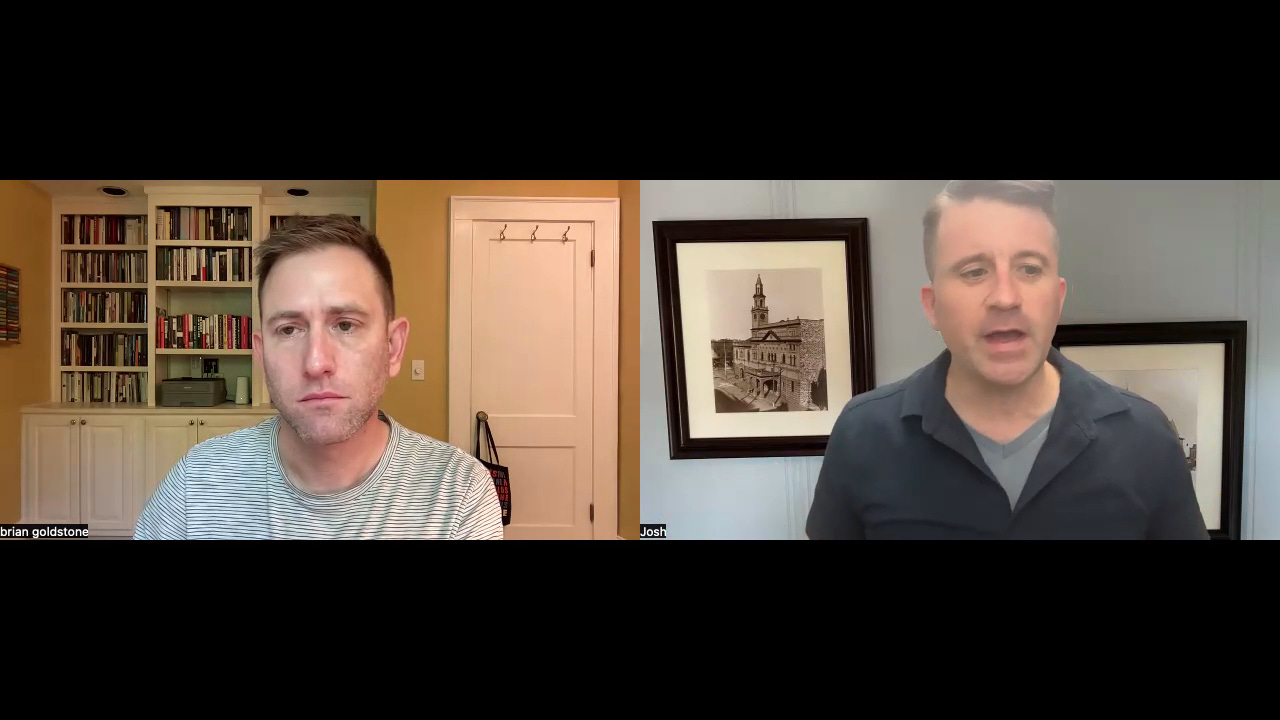
This week’s conversation is with the author and journalist Brian Goldstone, whose book There is No Place for Us: Working and Homeless in Americawas first released last year and is now out in paperback.
There is No Place for Us was one of the best-reviewed nonfiction books of the past year, and landed in the top ten lists for both The New York Times and The Atlantic. The book tells the story of five families in the Atlanta area, struggling to make ends meet, hold down jobs, and remain in stable housing—all while raising children, navigating health care, and dealing with other life challenges.
Goldstone’s book is a clarion call to rethink and respond to the real conditions underlying homelessness: that in the wealthiest nation on the planet, working hard and playing by the rules doesn’t even guarantee some people a place to live.
As a policy expert, I first got interested in homelessness through writing and studying the link between where children live and where they go to school. A decade ago, I wrote a well-received academic paper arguing that the same tools—and the same data—economists and other policy analysts use to study big-think questions in education could be brought to bear to study homeless students.
That was just one small piece of a much larger conversation about a much larger problem, and—hard as it is—I was thrilled to be able to sit down with Brian Goldstone to talk through it together.
A Conversation with Brian Goldstone
Brian Goldstone, so glad that you could join us here. Serious topic, important topic, but happy to dig in with it with you. Tell me a bit about your background and, for folks who haven’t read the book, how your own experience brought you into a place where you take this project on and tell this story to a wide audience.
It's really great to be with you.
Before I became a journalist, I actually studied anthropology. I have a PhD in cultural anthropology from Duke, and I thought that I would be in academia for the rest of my career. I had a postdoc for about 3 or 4 years at Columbia after finishing my PhD. And as the years went on, I kind of became disillusioned with academia for different reasons, and without turning this into a therapy session, I just decided that I wanted to take the plunge into writing for kind of a wider public.
I was also teaching at Sing Sing Prison during that last year at Columbia, and that was a really transformative experience for me. It just showed me that pedagogy, the teaching and learning, could take so many different forms outside of the university, per se. I had been wanting to do this kind of long-form narrative, non-fiction and journalism for years, and anthropology was already kind of a natural fit with this kind of work.
And I began to bring it into my work as a journalist. I began writing for places like Harper’s Magazine, the California Sunday Magazine, and The New Republic. And I reported on a really wide range of subjects: everything from psychiatry and Pentecostalism in West Africa, to Israel’s secretive campaign to deport Eritrean and Sudanese asylum seekers, to the plight of chronic pain sufferers during the opioid crisis.
I had also been wanting to write something closer to home. I had recently moved to Atlanta with my family from New York. And the way I came to this particular book and this particular topic is actually through my wife. She’s a nurse practitioner, and she was working in a community health center in Atlanta called MercyCare. We share a car, so every day we would kind of debrief our days, and she started to tell me about this trend she was noticing among her patients, where people were working full-time hours at places like Amazon warehouses, or Walmart, or McDonald’s, or driving for Uber and Lyft.
And what they all had in common is they didn’t have a home. They were sleeping in their cars, or in the overcrowded apartments of others, or were in these extended stay hotels. One guy was even working on film sets for Atlanta’s burgeoning film industry, and was then sleeping in an encampment.
So she told me about that, I was pretty stunned. Like many people, I sort of harbored this assumption that work was an exit from homelessness, not an accompaniment to it.
That led me to write a New Republic story reported over about 7 months on one family in Atlanta. I think the key argument of that piece—which was that we are as a country seeing a dramatic rise in the working homeless—that phrase, “working homeless,” really struck a nerve with people. I realized at the end of that piece that I had only scratched the surface, and I ended up expanding it to five families in Atlanta, and I reported this book over close to 6 years.
“I tried to show very clearly in the book that families are not falling, they’re not just stumbling into homelessness, they’re being pushed into homelessness.”—Brian Goldstone
Language is important. There’s a big push in some progressive policy circles to use “housing insecure” instead of “homeless,” both because the details are different but also because “homeless” kind of carries a different kind of cultural baggage or meaning. I want to ask in a minute about housing insecurity as a definition, but can we unpack that word homeless for a minute. How do you think about these basic descriptors and the meaning of language when we talk about social conditions?
I really appreciate that question. There is both an implicit and at times explicit argument about language in this book. For instance, it drives me nuts when there are newspaper headlines that talk about such and such number of people, you know, falling into homelessness this year.
I tried to show very clearly in the book that not only in the families that I follow, but the millions of people like them are not falling, they’re not just stumbling into homelessness, they’re being pushed into homelessness.
So even the shift in language there, the disciplining of my own speech around not talking about, like, the “invisible homeless” in this abstract way, but a kind of manufactured invisibility. These are people whose lives have been rendered invisible.
Showing that as an active production and not just this passive state has been important for me. As far as the word homeless goes versus, like, housing insecure: there’s other words like unhoused, houseless, that some advocates prefer. I try to not, take a hard line on any of that. I want to have a humility and just be like: if there are people who would prefer one term over another. I have no problem with that.
On principle it’s important to remember that the word homeless itself was a kind of innovation that we used to have words like vagrant, or hobo, or other words like tramps, that were used to describe people who didn’t have stable shelter. Homeless was seen as a more humane and even more moral advance on that.
I do think I would push back against substituting housing insecure for homeless, because—I mean, I get the impulse—but it’s important, I think, for us to retain the brutal fact that there are people in the wealthiest nation on the planet who don’t have homes. It’s not just that they’re at risk of losing their homes, it’s not that they’re at risk of losing a roof overhead. They don’t have a stable home. They don’t have stable shelter, and I think that’s a really important distinction.
Housing insecure suggests that they could lose it, that they’re on the precipice, and indeed a big argument in the book is that there’s this entire world of homelessness that we’re not seeing. That there’s an entire world of homelessness that is not only written out of the story that we as a nation tell ourselves about homelessness, but is made up of people whose lives, whose experiences literally don’t count. Like, they’re written out of the official statistics.
One way that those official statistics account for these people’s experiences is saying, well, they’re precariously housed. These folks in extended stay hotels, these folks doubled up, they’re just precariously housed.
And I disagr…