Yesterday, my kids (6 & 9) have decided to spend their precious screen time in front of silly AI-generated dancing animal - i.e. slop. The day before, I asked Gemini to find some references to back up a serious article, and it found perfect quotes, that fitted exactly my purpose, from people I follow and appreciate. The only issue is they were all fake - slop again.
This is not great parenting, or research (I’m working on both), but the point is slop is everywhere.
And maybe it’s fine for entertainment, we will get tired of it, just like we did with the Ghibli profile pictures. But in high stakes, complex environments “slop” will be an ongoing challenge.
As I relaunch this podcast as Unsloppable: how human intelligence wins in enterprise sales, I’d like to offer a definition of what it’s about and why it matters.
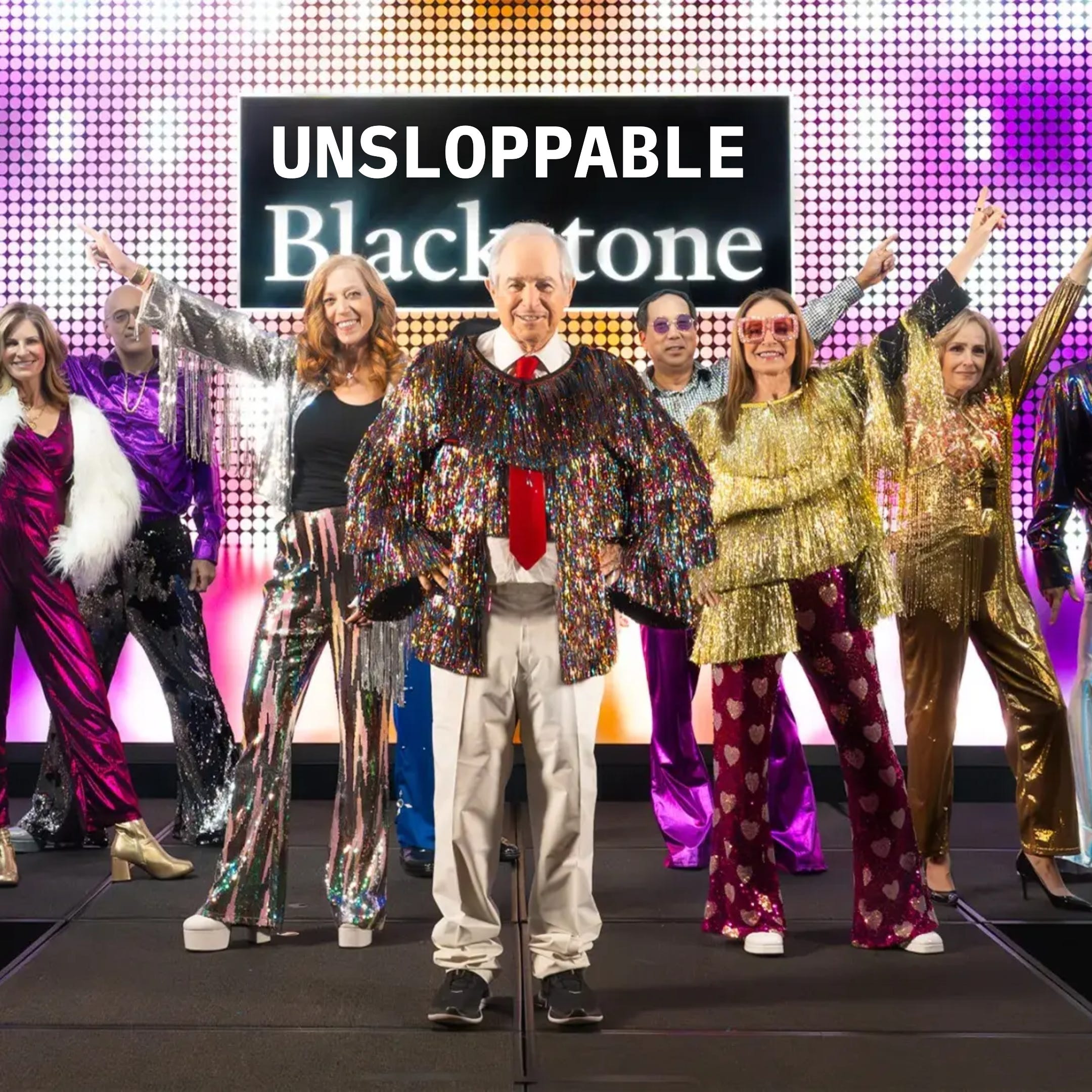
The audio episode itself is about Blackstone, a firm I wrote about previously. They are getting more love from institutional investors with content that stands out and provide an example of what unsloppable can look like, but below are some thoughts about the term itself.
Why Unsloppable?
The term was first heard from TBPN, who offer their own definition:
Becoming Unsloppable means two things. First, your business actually has to derive its economic power from a moat that is Unsloppable, and second, you need to clearly communicate that to shareholders. Right now, if the market thinks you’re just a bunch of lines of code, you’re cooked.
That’s a software-focused definition, it comes from an episode on the SaaSpocalypse, and it’s restrictive. I feel the meaning of the term is still up for grabs, and I will suggest my own definition from a B2B perspective in complex industries like finance, law, cybersecurity, etc.
The unofficial definition of slop refers to: low-effort, low-quality digital content generated by artificial intelligence.
Three elements there: effort, quality & source.
By that definition unsloppable could mean: something that requires effort, is of high quality and generated by human intelligence.
All of those are true, but they are hard to pin down.
What does quality content mean? Is it informative, entertaining, or does it have to be both? And may be it doesn’t require a lot of effort because you’re very good at it?
That last part feels problematic as well. I mentioned before that we still need to reckon with the usefulness of LLMs. I don’t think there’s much content that is untouched by Language Models anymore. I used to Google stuff to fact check, and Grammarly to spell check, now LLMs are part of my workflow.
Below is a definition, for people selling complex solutions to enterprise clients.
Unsloppable for enterprise
Unsloppable, for enterprise sales, has three sides, each represent its own challenge, and bringing in more questions. The podcast will aim at providing answers (I don’t think we will run out of episode material any time soon).
1: Visibility
The default is that your buyers are drowning in content, and the loudest content wins. This trend existed before LLMs; the volume is now categorically different and an existential threat when your industry is boring complex.
Your thought leadership is unlikely to go viral and if it did, it would probably become a compliance issue.
Being unsloppable is about managing to stay visible by using your expertise. But how do you transform it to grab people’s attention?
2: Trust
David Maister’s classic Trust Equation, where Trust = (Credibility + Reliability + Intimacy) / Self-Orientation is a good starting point.
There are 4 elements but Credibility used to be the foundation. I can talk about X because I’m an expert in X.
AI has democratized the appearance of expertise. Today, anyone can write about aerospace manufacturing compliance and look credible at surface-level. When synthetic authority is virtually unlimited, buyers develop an intense skepticism toward all written content.
Can your credibility still stand out? Or do you need to leverage Reliability and Intimacy? Or perhaps you need to bring Self-Orientation close to zero. But self-orientation is how you close the deal.
3: Relationship-building
I’ve mentioned that 83% of the B2B customer journey takes place outside the sales pipeline. That was 2025 data, it’s getting longer. The use of LLMs means buyers may become even more independent, increasingly pre-qualifying and pre-disqualifying vendors entirely through content, before any human contact. The window where a commercial can build relationship through conversation is shrinking. The risk is that it closes the door before the commercial gets a meeting at all.
Yet, enterprise deal will still need human-to-human interaction.
How do you still build a rapport with champions or the buying committee in this new environment? How much can you only rely on events/physical meetings? And how to sustain that connection throughout a long process and be present when there’s finally a trigger for a deal?
Future guests
I already have a few stellar guests lined up across, fintech, cyber, defense. If you are in sales, marketing, bus dev, growth in complex industry, and would like to share your thought leadership, drop me a line george@orama.tv.
I will also do a few solo episodes, like this one.
The Blackstone example
This first episode of the podcast shows what it looks like in practice. A breakdown of how Blackstone — the largest alternative asset manager — uses video to make its executives feel familiar to institutional buyers long before the first meeting. Jon Gray (COO & President) filming with kids in the office on Q1 results day is the quintessential way of sharing expertise, personality and shared values.
Martin Brand (Head of Blackstone Capital Partner) answering institutional-investor questions between two meetings and grabbing a sandwich a from portfolio company that’s just filed for IPO. All of it engineered to ensure that when Blackstone stays on a pension fund’s shortlist, and features as a known peer while the competition arrives as strangers.
Sources and relevant links
Subscribe to the newsletter and get podcast updates in your inbox:
This episode was produced by Orama - thought leadership videos :
https://orama.tv/
Blackstone videos mentioned in the episode:
* Q1 results: https://youtube.com/shorts/yyySn8vILCA?si=-KDUnhX8bQ4fwphE
* Between 2 meetings: https://youtube.com/shorts/uh3joLX9EnM?si=u7gh6IYSDbToTD5A
* Blackstone Holiday video
About George Aliferis:
George Aliferis is the founder of Orama. He spent over a decade in institutional finance before moving into media to build the bridge he couldn't find: content that makes complex solutions visible and engaging.
Linkedin profile: https://www.linkedin.com/in/george-aliferis/
About the Unsloppable podcast:
The show about enterprise sales in serious industries. Each episode, George Aliferis talks to commercial and marketing leaders in regulated, high-stakes markets about what actually moves complex deals — where thought leadership earns its place, and how they're holding the line against the flood of AI-generated content drowning everyone else out.
Unsloppable: how human intelligence wins.
About Orama:
We build thought leadership video assets for those selling complex solutions to enterprise buyers: human content for institutional solutions.
https://orama.tv/
Timestamps
00:00 Blackstone is Unsloppable
01:12 Q1, the billionaire president, and some kids
03:19 The Blackstone filming setup
04:47 Making executives video-ready
06:55 Between two meetings
08:17 How Blackstone stays Unsloppable
10:30 Takeaways for Enterprise Sales