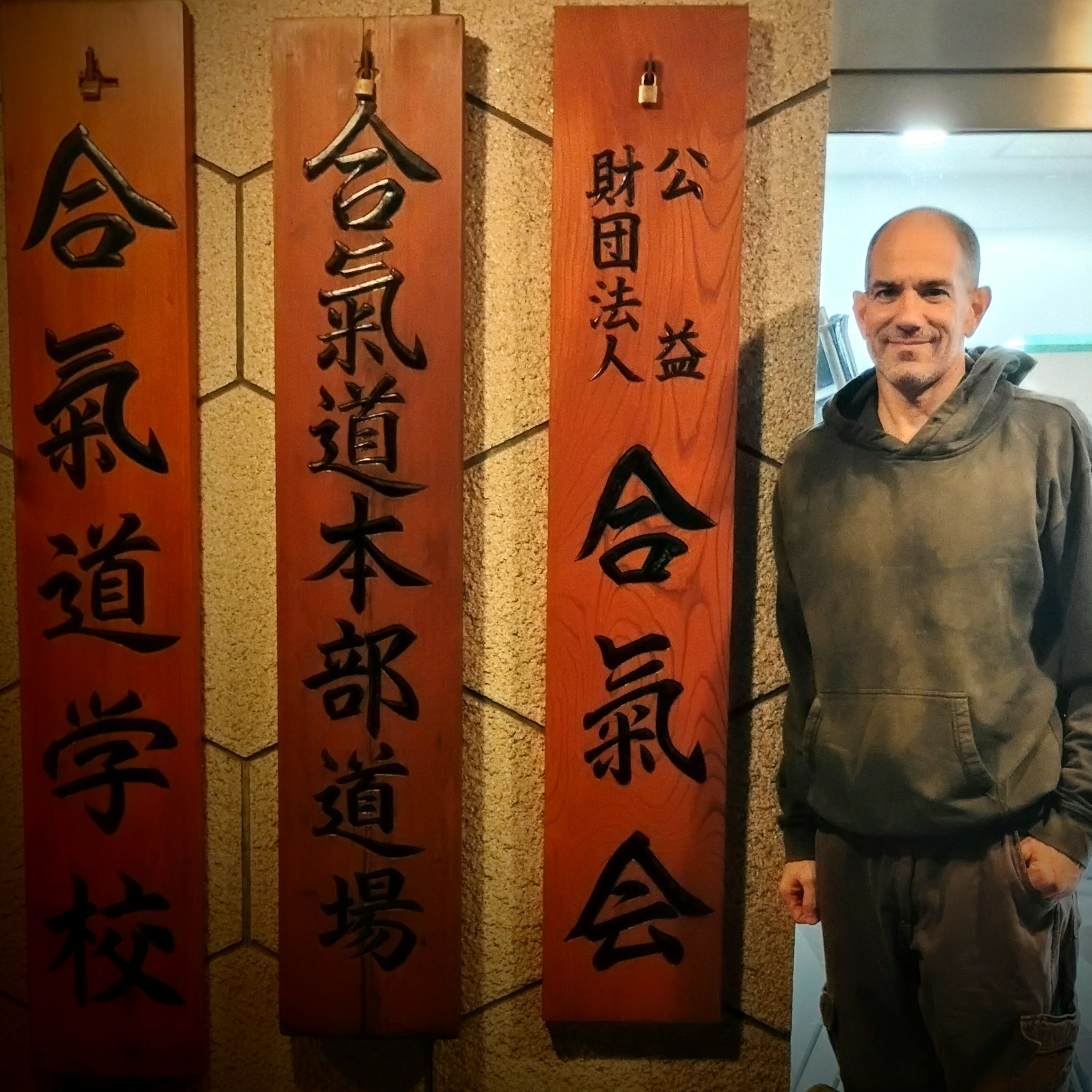
Kevin Cunningham is the first Bond Street Dojo member (besides myself, of course) to be featured on this podcast. He holds a truly special place in the history of our dojo, and I’m eager to share our recent conversation.
I hope you will be as encouraged by it as I was.
Kevin’s insights are invaluable, providing a candid window into the rich traditions, the camaraderie, and the transformative experiences that have defined the dojo for so many.
His dedication and consistent presence offer an unparalleled and deeply personal perspective on Bond Street's evolution and enduring legacy.
For over two decades, he’s actively contributed to shaping the dojo's character and fostering its unique atmosphere, making him an indispensable figure and a steadfast pillar of the community.
His remarkable background story is testament to Aikido's real-world application, starting from incredibly challenging circumstances.
Kevin's introduction to Aikido (1973 in Austin, Texas) was far from conventional. He was working in high-security mental hospitals with violent psychotic individuals, a demanding environment that immediately put Aikido principles to the test.
He recounts a transformative experience where he was required to work one-on-one with a severely disturbed 15-year-old, tied to him by a belt for 12 hours a day, functioning as the patient's "impulse control."
This direct, daily application accelerated his understanding of ki flow and how to use energy from the heart. His expertise in non-violent self-defense and conflict resolution led him to become an instructor for the Texas mental health system, where he routinely used Aikido principles, including disarming individuals of weapons, when no other options were available. His personal experience vividly demonstrates how Aikido works in “real life.”
Kevin's connection to Bond Street Dojo is deeply rooted. In Bond Street, he found a welcoming artistic community, the "mythical dojo" he’d sought upon moving to New York. He notes that the Bond Street style was less stiff and more responsive than his previous training, allowing him to integrate both good ki extension and solidity with a more “watery” and responsive approach.
He recounts the privilege of working directly with Saotome Sensei, who taught him the principles of a less defensive and more connected and smooth response to a potential attack.
Kevin is deeply invested in the dojo's future and (like most of us) recognizes the challenges of maintaining membership, particularly in this current milieu of societal atomization.
Despite this, he remains an optimistic voice, actively working towards Bond Street's self-sufficiency model by expanding its offerings as a Budo center. He firmly believes that the dojo's commitment to community building and "cooperation, not competition" represents the Aiki way forward.
Kevin probes the depths of the profound philosophical underpinnings of Aikido. His fascination lies in how "empathy works and musubi functions to change violence into something." For him, musubi—connection—is a "kinesthetic sense" felt even "before contact," enabling an empathetic response to an attacker.
He passionately argues that while any Aikido technique can be a killing technique, its true focus is protection and offering choice, teaching practitioners to stay calm under pressure and analyze situations objectively rather than reacting instinctually. This training has proven invaluable in his professional and personal life.
His brilliant work running 3LD.org, a non-profit arts organization, stands as a testament to this dedication and application of Aikido principles. His ability to remain centered, calm, and objective (particularly during high-pressure negotiations with the MTA) allows him to effectively defend the organization's mission and provide a crucial hub for pure creativity in New York City.
Even in the face of post-COVID funding challenges, Kevin's commitment to cooperative ethics and finding self-sufficient models continues to inspire hope for the future of arts and technology.
(And the dojo)
Enjoy!