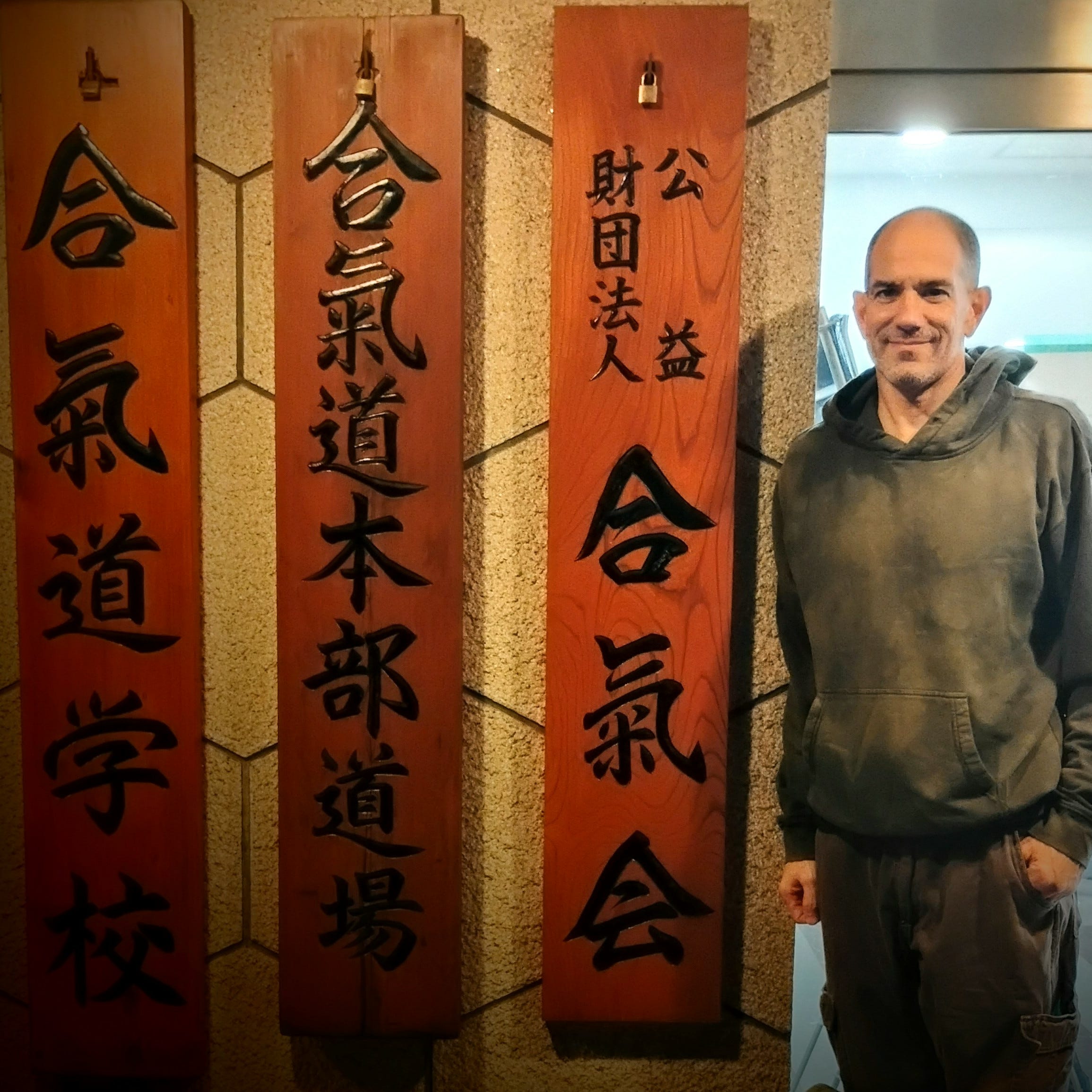
On this episode, I had the pleasure of being joined by a true inspiration and a good friend of mine (from real life), Phil Cappello.
We met when I was an uchi-deshi back in ‘08—and here we are, seventeen years later, as he put it, “Still training, still trying to figure some of this stuff out.”
Phil’s journey is remarkable, an extraordinary story in which the discovery of Aikido provided holistic relief from severe injury trauma and catalyzed his mission to transform how we approach the simple, yet potentially terrifying, act of falling.
At twenty years old, Phil survived an astounding fifty-foot fall off the roof of an apartment building. This life-changing event put him way past the statistical margin of survival; as I learned in this episode, falls over thirty feet are about 50% fatal.
This incident (obviously) instantly transformed his life.
The physical damage was immense: Phil emerged with seventeen broken bones, broken ribs (as in, all of them), a perforated lung, a damaged spleen, and catastrophic injury to his arm, resulting in his humerus, elbow, and shoulder being blown out, leading to paralysis in his elbow and wrist for years.
The medical advice he received was counterintuitive to his nature as a highly active Division 1 lacrosse player: he was told to protect the injury, and cautioned against exercise.
Yet, even the doctors admitted that his athleticism was likely what saved him from contracting pneumonia, highlighting the irony that the active life they were telling him to abandon was the source of his initial survival.
Despite the severity of his injuries, Phil possessed an inherent, deep-seated athletic drive, didn’t want to get pneumonia, and sought a way to maintain his conditioning. Driven by this necessity, he threw himself into rehabilitation, using a background in wrestling to inform his recovery.
In 2003, Phil discovered Aikido. He was quickly disabused of the notion that it was a “soft art” when he saw that much of the practice was acutely devoted to the very physical challenge that now terrified him most: falling.
He was faced with the immediate psychological pressure of grappling with an experience that had nearly killed him, yet he quickly realized that Aikido offered something revolutionary, providing more than a physical redemption arc. Aikido offered a healing modality unmatched by anything else.
Through practicing throws and falls in the dojo, he was able to confront and overcome the (totally) understandable fear of falling that threatened to stifle his natural proclivity for action.
This realization was revelatory: he was able to do what he’d always loved—wrestling and grappling—but in a “totally different” context where violence was not the objective.
Phil’s experience has led him to dedicate his current work to sharing the unique value of Aikido’s distinct ukemi practice with the wider world.
He is now the driving force behind the innovative program he calls “Ukemi: The art of falling.” Check out the website here: https://thefallingexpert.com/
His goal is to translate a core skill of Aikido—the ability to fall safely and rise again—into a system accessible to the general public.
This mission is directly inspired by his own family, noting that for elderly people, falling is a real concern and a worry. Phil realized that most people might not need to know how to perform Ikkyo, but everyone could stand to learn how to more safely engage with the dynamics of a fall.
Phil has adapted the methodology of traditional martial arts masters, such as Jigoro Kano, structuring his curriculum around training a practitioner in forty foundational falls over a period of five years, consciously emulating the highly successful educational model of Judo.
This program serves a wide range of individuals, from senior citizens in need of basic fall prevention to competitive martial artists who want to get more comfortable with the standing phase of grappling.
Ultimately, Phil’s work epitomizes the principle of giving back, stemming from the self-mastery he achieved through dedicated training. He took the profound, life-saving lessons learned on the tatami and formalized them into a vital service, ensuring that the peaceful and protective dimension of the art is accessible to a much larger segment of the population.
This, to me, is the ultimate expression of the spirit of Aikido, turning personal trauma into a universal therapeutic offering—a true art of peace and harmony in action.