I had just left Wavefront. This was early 2002.
I didn't have a plan. Didn't have a product. Hadn't met Kymberlee yet. No introNetworks on the horizon. Not even a whiteboard sketch of what was next.
I was wandering, really. But when your brain runs on systems and visual metaphors, it doesn't exactly sit still. Even when you want it to.
So when I ended up at a wildlife film festival here in Santa Barbara, I wasn't expecting it to become a scene I'd still be thinking about more than two decades later.
That's where I ran into my good friend Mike deGruy, whom I'd met a few years earlier at an organization I co-founded called SCAMP, The South Coast Alliance of Media Professionals.
Seems prescient that now I'm co-founder of another Alliance: Coastal Intelligence, The South Coast AI Collective.
The Brightest Light
Mike was a gem. Cinematographer. Ocean explorer. Wild man with a camera. He'd worked with all the big names, including James Cameron, but he was just Mike to me. Curious. Fast-talking. Brilliant.
Mike was always the brightest light in a room. Nothing stopped him, and his endless optimism and love of life probably became a big part of my energy in tackling what came next.
We'd talk for hours as he explained, from his point of view, what was wrong in his industry. And excitedly, I'd offer ideas for solutions, which we'd riff on together.
Mike didn't see challenges. They were all opportunities.
We all have a Mike in our lives, or we should. Too bad he passed away so soon, but it was doing what he loved, on a shoot with James Cameron.
The Problem That Wouldn't Sit Still
We got to talking about what it's like being out in the wild, trying to film that perfect moment.
An eagle is grabbing a fish. A leopard stalking a gazelle. That kind of thing.
The teams might wait a week for one clean shot. Maybe longer. They'd shoot tremendous amounts of film or video to capture that one perfect interaction between animals. Mike explained this with the kind of detail that only comes from twenty-plus years in the field.
But the real problem, he said, wasn't the camera work.
It was the headquarters.
Picture this: hundreds of crews scattered across the globe. Patagonia. The Amazon. The Serengeti.
Limited communications. No real-time visibility. Remember, this was 2002, no iPhones, barely any internet, and if you were lucky enough to have a cell phone, it was a flip phone.
You might have a half-dozen producers sitting in a conference room in Washington D.C., and someone asks, "How's the Patagonia shoot going?"
And nobody really knew.
It was paper. Phone calls. Gaps.
These teams had variables breeding more variables:
• Delays • Rain• Equipment failures • Political unrest • Budget overruns • People getting sick
Even if they wanted to report back in real time, they couldn't.
And I thought: That's a systems problem. That's my kind of problem.
And that's when it hit me. I could see it. Not just the problem, but the solution. It was right there, floating in my mind like a piece of art that could come alive.
If You Can Dream It...
Because I'm a systems thinker, and I'd been trained at Wavefront to believe that anything was possible, I remember seeing Walt Disney's quote over the entry at Disney Imagineering:
"If you can dream it, we can build it."
That's how I feel about life in general.
So I had this idea: what if you could see everything on a single screen?
A giant digital canvas in the executive producer's office. Something beautiful. Something interactive. Something useful.
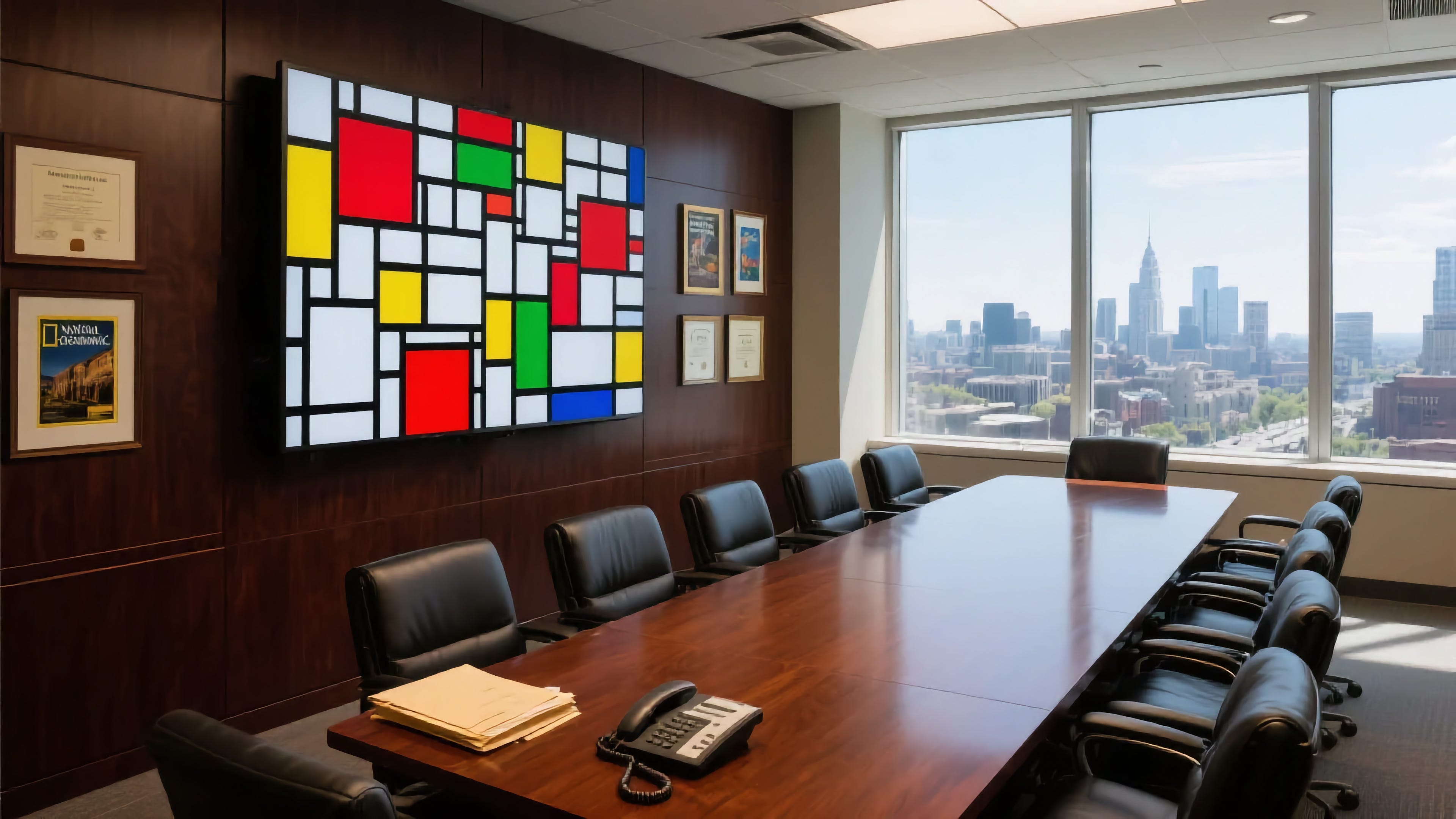
In my mind, it looked like a Mondrian painting. You know, white background, colored squares of different sizes. Red, yellow, green. If you're not familiar with Mondrian's style, there's a hotel on Sunset Boulevard called the Mondrian that had artwork inspired by his approach covering the building.
I was fascinated by how the metaphor of size and color could easily be mapped to real data. Mondrian never actually used green in his early career. I was influenced by his approach, not copying it exactly. What mattered was being able to touch what was actually the top of a long rectangle and interact with it.
The Vision
Each square represented a field team:
• Big square? Big budget • Small square? Smaller operation• Red square? Behind schedule or over budget • Green? Smooth sailing • Yellow? On the edge, maybe in danger • White? Neutral, everything is normal
But here's where it got interesting.
Touch a square, and the whole painting tips sideways like a trapdoor. Suddenly, you're looking at what were really the tops of long rectangles, and you can see the depth, the timeline, what made something red or green.
This was 2002, and I was dreaming of a data-driven dashboard triggered by field reports. I even imagined automating input through a voicemail system, teams could dial in and receive an automated response where they'd key in answers to, say, a dozen questions.
Did you get today's footage? Is everything going okay? How's the weather? Any political issues? Budget concerns?
All of this would be fed into the visualization in real-time.
I called it MONDRIAN. Of course I did.
What Could Go Wrong?
Now, what could go wrong with this fantastic idea?
Well, in 2002, none of these systems talked to one another. And my vision of an interactive backend of databases that could communicate with each other and be triggered by a digital recording made by a voicemail system was clearly a pipe dream.
But I didn't know any better. I was naive about production systems at the global corporate level, and I assumed it would be an easy thing.
It clearly was not.
There was another bigger problem: you couldn't do real-time 3D on a website.
What? Yeah, that's right, you couldn't do 3D in a browser back then. I had just been introduced to Flash, which was capable of doing some incredible animations, but it had yet to do 3D.
But I'd been at Wavefront. I was so used to working with cutting-edge engineers who knew no obstacles. Look at what we'd done there, and what that software, Maya, continues to do today.
The problem was that I no longer had access to those resources.
But here's the thing that still gives me chills when I think about it: what I was trying to build in 2002 was genuinely impossible with the technology that existed at the time.
Real-time 3D in a browser? Didn't exist.Integrated enterprise data systems? Not a chance.Touch interfaces that could manipulate complex visualizations? Science fiction.
I was trying to build a real-time digital dashboard, but we didn't even have a name for that back then.
The audacity of it still amazes me.
Building the Impossible
I reached out to my network and found someone who had been working with Flash. Unfortunately, I forget his name now, terrible of me. However, he was able to take my vision and we created a working prototype that was data-driven to a certain extent.
It wasn't working exactly, but it looked like it was working.
And when you're doing a prototype, that's all it has to do: work well enough to communicate an idea.
I was exploring the idea of a touchscreen user experience, which was very new at the time. We had actually developed a similar system for General Motors with our team in the Toronto office. Bill Buxton, our chief scientist, has spent his enti…