This was the first time I’d ever had a full day alone with Dax, my youngest grandson. First time having dinner with just Mason and Lincoln, no one else around. First time Lee Daley and I had uninterrupted hours together in years, maybe ever.
It all happened in one week. All of it felt rare. All of it made me realize something I’d been missing: everyone texts, but not everyone breathes the same air.
Wednesday Night at TED AI
The conference had just wrapped, and there was a great after-party. I walked around the room and noticed something striking: most people had come as individuals, sitting, lounging, staring at their phones.
At a conference about AI and human connection, everyone was looking at screens.
I spent several minutes looking for someone who wasn’t on their phone. It took a while. Eventually, I found a volunteer who was doing the same thing—looking for someone whose face wasn’t buried in a device. We spent 20 minutes talking about TED and TEDx, and her dream of someday speaking on the TED stage.
Here I am being an elder again, at an after-party, because I looked up.
Physical presence isn’t just rare—it’s actively avoided, even when we’re in the same room. And I’d just spent a week discovering exactly how valuable it is.
Through Another Lens is a reader-supported publication. To receive new posts and support my work, consider becoming a free or paid subscriber.
The Day Dax Got Hooked
Every eight weeks, Kymberlee and I drive down to Santa Monica, and this time I said we should pick up Dax on the way. I had two options for how to spend the day: Santa Monica Pier with its rides, games, and cotton candy—standard 12-year-old fare—or the Museum of Jurassic Technology in Culver City.
I saw the word “Jurassic” and thought it was perfect for a kid who wants to be a paleontologist.
The Museum of Jurassic Technology is run by a foundation honoring a Russian immigrant couple who’ve since passed, and they collected—or were given, or inherited —the documentation is deliberately vague—the strangest objects you’ve ever seen. They let eight people in every 15 minutes, no cameras allowed, which meant we had to remember everything.
The first thing we saw stopped us cold, then the second, then the third, each more compelling than the last. There were miniature carvings inside the eye of a needle, sonic experiences that blended as you moved through the room, a study of mathematics in Islamic architecture where you sit inside a tiled alcove that feels like being inside a mosque.
Five minutes in, we both started laughing when we realized there weren’t any dinosaurs at all. When I pointed this out, Dax said that it was fine because what we were looking at was way more interesting.
We took our time through the rest of the museum, calling each other over whenever something caught our attention—Renaissance instruments, 1800s aerospace theories, staircases built into the walls that were scale models of famous architectural staircases. At the top was a tea garden with fabric draped over the roof for shade, morning doves cooing, a pair of lovebirds in an aviary, and everyone speaking quietly.
“I feel at home here,” Dax told me.
Not because the museum had what he expected, but because we were there together, sharing attention, calling each other over to see things, building a shared experience that couldn’t be texted or FaceTimed or captured later. We had to be present for it.
Making Memories Without Cameras
Since we couldn’t take photos in the museum, we had to rely on memory alone. On the drive back, we talked through everything we’d seen—what was curious, what was strange, what made us laugh. I recorded our conversation on my iPhone and later fed it into EVERYWHERE™, my orchestrated intelligence system. Claude extracted the conversation into song lyrics, and when I asked Dax what kind of music he liked, I learned that, at 12, he already had a rich musical tapestry.
The one that connected with me was classic rock, though he also writes sea shanties. I told Suno.ai to blend classic rock and sea shanties, and five minutes later, we had a song.
The opening verse captured the day perfectly: “Started at Shake Shack, yeah we went to town / Burger, bacon, cheese fries, golden brown / But we didn’t have a shake at Shake Shack, no way / Saving room for all the things we’d see today.”
The bridge pulled in details from our entire adventure, including a line about “imprisoned animals” from the petting zoo at The Grove that we’d both noticed felt wrong. EVERYWHERE caught that tension in just two words, capturing a moment of shared observation that happened because we were physically together, both noticing the same thing, both feeling uncomfortable about it.
A week later, Dax is still talking about the day and still playing the song. That’s the metric I care about—if he’s still talking about it a week later, it means the memory stuck. We replaced the photo album with a soundtrack, and it turned out to be more powerful than any picture could have been. But the soundtrack only exists because we were there together.
Go Duck Yourself
Monday afternoon, I flew up from Santa Barbara, checked into my hotel, and that evening, Mason and Lincoln picked me up in Lincoln’s new Tesla coupe. It’s a fantastic car for a 16-year-old—politics of the brand aside, they practically gave it to him. I settled into the front seat, looked around at the impressive ride, and immediately asked, “So, how many girlfriends do you have?” He said one, though it wouldn’t have surprised me if he’d said three.
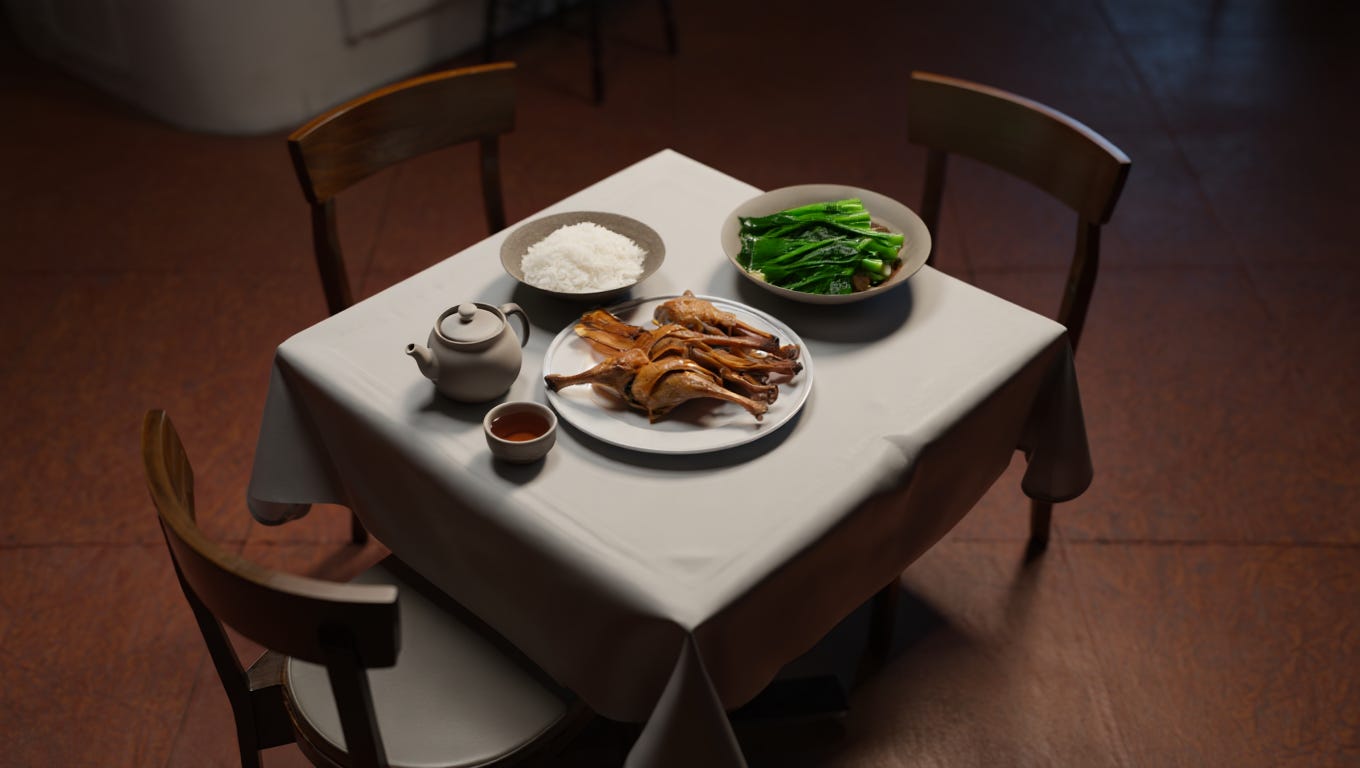
Two years ago, we did our first food quest together, spending most of a day finding the best loaded fries in the city—it was spectacular. This time, I wanted to find the best Peking duck, making this our second quest and building toward what I hope becomes an authentic tradition. Not a texting tradition or a FaceTime tradition—an actual showing-up-together tradition.
I found it at a place called Go Duck Yourself, a restaurant in South San Francisco run by two brothers whose family had been in Chinatown for decades until their rent got jacked up. They moved, changed the name, and kept cooking. It’s a ten-table place tucked in a cool neighborhood, and when we walked in, I knew we were in the right place.
The woman who greeted us looked like she ran the place, so I asked if she was the owner. “I’m the wife of one of the brothers,” she said. I told her we wouldn’t need menus and that she knew her menu better than I did, so we’d love to start with duck and then have her bring us whatever she thought we should have. She smiled and brought out a perfectly carved duck with crispy skin and tender meat, then followed it with barbecued pork belly, salted pork, greens, rice, sauces, and bao. Everything was spectacular.
Mason leaned back in his chair at one point and said, “That’s what my dad used to do—walk in and just order like that.” I asked him where he thought his dad learned it, and we all laughed.
You can’t text that moment. You can’t FaceTime the recognition on his face. You can’t email the way Lincoln looked at his brother when he said it. Those things only happen when you’re physically together.
Then I asked them what I always ask when we have time together: What do you love? What do you want to do? What’s the dream?
Mason told me he runs a shrimp boat after his classes at Cal Maritime, working with a buddy trolling for brown shrimp that fishermen use as bait. He loves being on the water, loves working with his hands, and at 19, he wants to own a shipyard someday. Lincoln’s dream is less defined but more immediate—he’s living it right now, DJing parties, making people move, reading the room, and picking what comes next. He takes it seriously, and it’s clear he’s not just pressing play.
They’re brothers, completely different from each other but tight as hell.
At one point, I looked them both in the eye—one at a time, making sure the connection landed—and said, “I’m choosing to be an elder in your life. That means I’m in your corner for the rest of my life. You understand that?”
They nodded.
I wanted to be a grandfather since I was 12 because I didn’t have that kind of presence in my own life, so now I’m building it for them. But here’s what I didn’t fully understand until this week: being an elder isn’t something you can do remotely. It requires eye contact. It requires sitting across the table. It requires being in the same room when you say the words that matter.
I didn’t know Mason runs a shrimp boat until he told me over Peking duck.
The Systems Thinker Who Came to San Francisco
Tuesday morning, I was sitting next to Lee Daley at the Herbst Theater for the first day of TED AI. I met Lee at TED 20 years ago in Monterey, and he’s been a good friend ever since. He’s British, currently lives in NYC after moving from Malibu a few years ago—good timing, since his old neighborhood burned to the ground in the early 2025 Palisades Fire.
Back when we first met, he fell in love with introNetworks, our networking software developed for TED in 2003. Years later, he called to tell me he was ready to build a global system connecting 18,000 employees across 70 countries. He called it “The Neural Network,” and we both smiled every time someone at TED AI said those words over the next two days. He was ahead of his time.
Lee had flown in from New York the night before, and while we were both there for the content—speakers at the state of the art of AI, panels on technical and business tracks—if we’re being honest, we came primarily to see each other.
During a Q&A session on the business track, Lee stood up to ask a question. He’s the former Chief Strategy Officer at McCann Erickson, one of the largest ad agencies in the world, and his question was characteristically direct: “The ad business is dead; they just don’t know it yet.” His concern was that CEOs at multinational companies won’t adopt AI on a personal level, and transformation isn’t a task you can delegate. You have to get your hands dirty with it, even if you’re using it to make your shopping list. People swarmed him afterward, which surprised him but didn’t surprise me at all. That’s on-brand Lee—controversial with strong opinions, saying things people won’t say out loud.
The next morning over breakfast, we talked about what’s changed. Both of us have always been systems thinkers, people with big ideas who give them away freely. Lee spent his career as Chief Strategy Officer, having brilliant ideas for bringing brands to life, then handing them to creative directors to execute because that was just how the model worked.
“I always needed other people to get my ideas across the finish line,” he told me.
“Not anymore,” I said, and we both sat with that for a moment.
We talked about context engineering, building relationships with AI systems that understand how you think, and about manifesting ideas in minutes instead of months. Ten years ago, Lee needed 18,000 employees to manifest his neural network vision. Today, he needs a laptop and a morning.
But here’s what struck me most about our conversation: it wasn’t about AI at all. It was about two friends in their 60s and 70s, both still building, both still dreaming, having the deeply personal conversation that only happens face-to-face.
The Uber Ride
Wednesday afternoon, when TED AI wrapped, Lee had managed to sneak in a downtown meeting that ended just in time for me to pick him up. We shared an Uber to the airport.
The conversation in that car wasn’t about systems thinking, AI, or transformation. It was about life, about aging, about what matters when you’re in your 60s and 70s and still building. It was the kind of conversation you can’t schedule, can’t plan, can’t have over Zoom.
Twenty years of friendship, both of us building in AI, both understanding what the other is trying to do without having to explain it. And time together this rare, this focused, this uninterrupted doesn’t happen often.
We both admitted that this was the primary reason we came to San Francisco. Not for the speakers, the panels, or the state-of-the-art demos.
For each other.
To breathe the same air.
I flew home Wednesday night and landed in Santa Barbara close to midnight. Thursday morning, I was at Cottage Hospital for hip replacement surgery. On my way out afterward, I joked with the nurses that I had come in as an old hippie and was leaving as a new one. They laughed at the dad joke, and the recovery gave me the quiet time I needed to think about what that week had meant.
What’s Actually Abandoned
My grandsons and I stay connected across the miles between Santa Barbara and their homes through all the digital channels—texting about school, emailing about dreams, and FaceTime calls to check in. We do all the things that keep us tethered.
But I didn’t know Mason runs a shrimp boat until he told me over Peking duck.
We don’t hug through screens. Don’t make eye contact agreements through email. Don’t discover what actually matters by texting about it afterward.
Physical time is the most abandoned commodity we have, and I saw the evidence everywhere that week at the TED AI after-party, where everyone was looking at screens instead of each other. In the rarity of having a full day alone with Dax—first time, and he’s 12. In the significance of one dinner with just Mason and Lincoln, no one else is around. In the recognition that Lee and I came to San Francisco primarily to see each other, not for the conference.
Everyone’s racing toward infinite digital connection while actual presence sits there, undervalued and overlooked.
The arbitrage opportunity isn’t in attention economy tricks, growth hacks, or engagement metrics.
It’s in showing up.
It’s in looking someone in the eye when you say, “I’m in your corner for the rest of my life.”
It’s in calling your grandson over to see something curious in a museum and watching his face light up.
It’s in sitting in the back of an Uber with a friend you’ve known for 20 years, having the conversation you can’t have any other way.
Running Out of Time
I’m 72. Lee’s in his 60s. My grandsons are 12, 16, and 19.
None of us has unlimited time for this.
Dax won’t always want to spend a Saturday with his grandfather at a museum. Mason and Lincoln will build their own lives, their own families, their own obligations. Lee and I will have fewer years ahead of us than behind us.
The window for physical presence is closing for all of us, and we’re spending it staring at screens.
I thought about something from 10 years ago, when I got to tour Disney Imagineering in Burbank —one of the hardest tickets on the planet. Walking out, I saw a quote above the door from Walt Disney: “If you can dream it, we can build it.”
That line came back to me, thinking about Dax in that courtyard at the Museum of Jurassic Technology, looking down at the Moroccan-style fountain and asking, “Can I live here?” It was pure dreaming with no filter, just possibility. But the dreaming only happened because we were there together.
I thought about Mason’s recognition across the dinner table, ”That’s what my dad used to do,” and how that moment of intergenerational connection only exists because we showed up.
I thought about Lee and me, finally having the uninterrupted time we’ve needed for years, and realizing we came to San Francisco primarily for that.
Physical presence is the most abandoned market of all, and we’re running out of time to reclaim it.
The Real Wealth
At 72, I’m building AI systems that let me manifest ideas in hours instead of months. My grandsons are 12, 16, and 19, building their own paths—museums and boats and music and dreams.
We stay connected through texts, emails, and FaceTime. All the digital channels that make modern family life possible across miles, schedules, and different lives.
But the wealth isn’t in the connectivity.
The wealth is in the moments when we breathe the same air.
When Dax says “I feel at home here” in a tea garden at the top of a strange museum, and I’m there to hear it.
When Mason recognizes his father in me across a table at Go Duck Yourself, and I’m there to see it.
When I look Lincoln and Mason in the eye and tell them I’m in their corner for the rest of my life, and they’re there to receive it.
When Lee and I sit in the back of an Uber heading to the airport, having the conversation that 20 years of friendship has built toward, and we’re both there for it.
You can’t text that. You can’t FaceTime it. You can’t capture it later.
You have to show up.
If you’re building something that requires physical presence in a digital world, I want to hear about it. Please reply to this ‘stack and tell me how you’re showing up.
Thanks for reading Through Another Lens! This post is public so feel free to share it.
P.S. - How This Essay Got Made
You just read 3,200 words that started as an hour-long conversation with Claude about my grandsons, TED AI, and a hip replacement—no outline, no structure, just conversation. EVERYWHERE™, my orchestrated intelligence platform, turned that conversation into this essay. Sara Williams assembled the team, Natasha Volkov identified what the essay was actually about (even when I wasn’t sure), Jordan Lane maintained voice authenticity, Isabella Quinn applied editorial standards, Betterish scored every iteration, and Dr. Elena Vasquez caught AI patterns before they crept in.
But here’s the thing: the essay only exists because I spent physical time with Dax, Mason, Lincoln, and Lee. The AI helped me process, shape, and make it readable. But it can’t create the moments that matter. Those only happen when you show up.
If you are interested in how EVERYWHERE works and would like to discuss bringing it into your organization, send me a note at mark@marksylvester.com or leave a comment here on Substack.