This story is also a podcast. Press play on the audio player to listen, or keep reading. Same story either way.
The foot. That’s what stopped me.
I was at a friend’s pancake gathering in Santa Barbara, talking to a commercial photographer who shoots products for athletic brands. Cycling shoes, athletic gear, shots with athletes and products. He described a typical shoot: a professional rider, a bicycle, controlled light, a thousand frames, and then hours of editing to find the handful that actually work. I asked what separates the ones that work from the ones that don’t. He said the angle of the foot matters enormously. So does the light, obviously. But the foot. I would never have thought about the foot.
He has spent years developing an eye for things the rest of us don’t know to notice. And he was worried that AI was going to make that expertise irrelevant. I understood the worry. I also thought it was the wrong question.
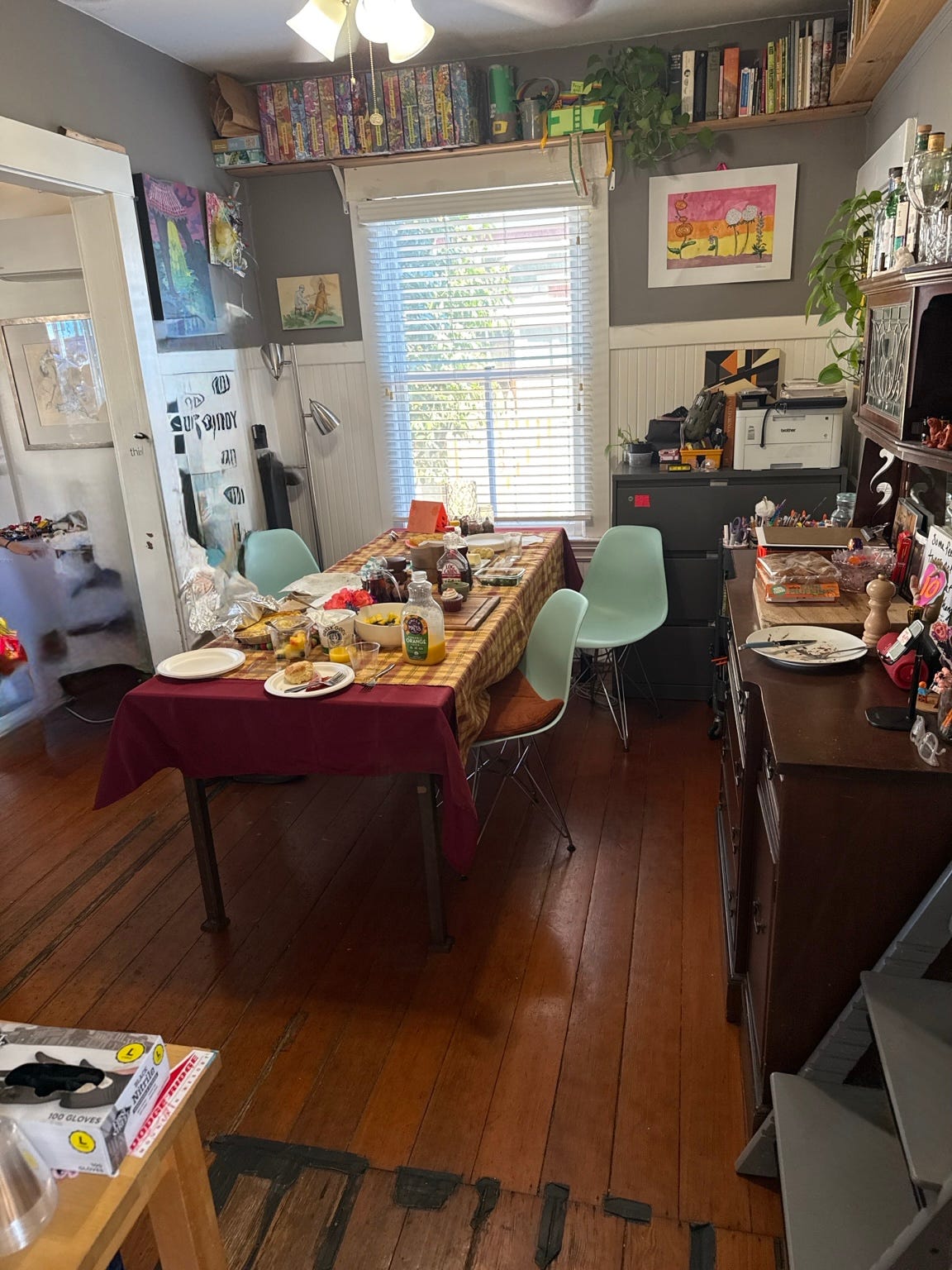
What if he showed an AI a hundred photographs, identified the ones he loved, rejected the ones he didn’t, and explained why? Could he teach it enough about his own standards to help surface the strongest candidates from the next thousand frames? We hadn’t tested it. It was a question. But while we were talking, I tried something simpler. I took out my phone, aimed it casually into the adjoining room, snapped a photograph without composing it, and typed seven words: Tell me something I don’t know about this picture.
Through Another Lens is a reader-supported publication. To receive new posts and support my work, consider becoming a free or paid subscriber.
What the AI Said
The response surprised both of us. The AI suggested the room was trying to be five rooms at once: a dining room, an office, a library, an art gallery, and possibly a music room. It pointed to the printer and filing cabinet, the books overhead, the paintings, the breakfast dishes, and what looked like a keyboard. Then it offered a reading I loved: this is a room designed to be used. That was an inference from visible clues. But neither of us had been sitting there thinking about it, and the photographer’s expression shifted. You could almost see him recalibrating.
He asked whether I’d trained the AI to do that. I hadn’t. All I’d done was ask a more interesting question.
The Experiment, Repeated
I’ve been doing this for a while now, in different settings, with different photographs. After an improv show, my scene partner Harnoor and I were sitting in a restaurant in Ventura. He’s fifty years younger than I am, and we love playing together. I took a picture of him smiling over a bowl of noodles, chopsticks in one hand, spoon in the other, red restaurant lighting behind him.
We handed the picture to AI and asked what it could tell us. It started noticing things: clues about the food, the restaurant, the atmosphere, details we hadn’t consciously registered when I pressed the shutter. Two people sitting over dinner, genuinely surprised by an ordinary photograph. The questions we could ask of it had changed.
Since then I’ve run this experiment in hotel lobbies, in front of audiences, and standing in airport lines. I don’t try to compose the shot. Sometimes the randomness is the point. I’ve done this hundreds of times with people’s own photographs, because a picture that’s yours lands harder. I’ve been an amateur magician since I was eighteen, and a trick works when the audience picks the card. In the Denver airport, I asked a man near me if he had AI on his phone. He did. I asked him to open his photo library, scroll backward without looking too carefully, and stop on a picture. Then he shared it with his own AI. Everything stayed on his phone. He landed on a photograph of his newborn daughter. His AI suggested she might be eight to ten weeks old, commented on her gaze, offered a possible explanation for whom she was looking at. Those were inferences. The photograph couldn’t prove any of it. But the man got teary-eyed. He hadn’t looked at those baby pictures in a long time, and there he was, in an airport, unexpectedly back inside a moment he loved.
The Ceiling Nobody Looked At
The third experiment started with Sigrid Wright at the Community Environmental Council in downtown Santa Barbara. Sigrid sent me photographs of the exposed wooden beams in the ceiling of their building. She was curious about the wood: what kind it was, when it might have been milled, what the cut marks could tell us about its history. AI proposed Douglas fir, pointed to saw marks and old hardware, and suggested the wood might have come from the Pacific Northwest, milled before 1939. When we checked, the Community Environmental Council’s own published account confirmed one thing: original Douglas-fir rafters dating to the 1930s. That’s where the verification stopped. The pre-1939 frame, the Portland origins, the handmade bolts, none of it found footing. The decade is real. Everything built on top of it isn’t.
So was the experiment a success? Yes. It gave us specific things to investigate. The questions got sharper. The research got more focused. We learned something about a building people walk through every day without once looking at the ceiling.
Seeing and Noticing
Here’s what I keep coming back to.
Every room, photograph, and ceiling you pass is a document you haven’t read. The gap between seeing and noticing closes with a better question.
The kitchen you’ve walked into ten thousand times, the entrance to your office, an old family photograph sitting in a folder you haven’t opened in years: your eyes collected the information. You just never asked it anything.
The gap between seeing and noticing closes with a better question. The question was always available. We just had to ask it.
If you want to try this yourself, choose one: your kitchen, an old photograph from your camera roll, a plant in your garden, the entrance to your business, or the place where you work. Take a picture, or find one you’ve already taken. Ask your AI: Tell me something I don’t know about this picture. Then ask: What clues led you to that conclusion? Then ask: If that’s true, what else might be true? Check the answers. Challenge the assumptions. The AI will be wrong sometimes, maybe often. That’s not a flaw in the experiment. The wrong answer that sends you to the right source is still doing its job.
I’d genuinely like to see what you find. Leave out private details, get permission before posting pictures of other people, and share the most surprising thing the question surfaced.
I was already in the car when it hit me. The foot.
A thousand frames from one shoot. A hundred he loves, with his reasons. Feed a hundred keepers to an agent and it could start measuring what his eye does without trying. Maybe the foot sits at fourteen to seventeen degrees. Maybe the light comes in from the front left. Maybe it’s something neither of us would have guessed. I don’t know yet. I never asked him.
So I’m asking here. Photographer at the pancake gathering, bring me a hundred.
The photographer at the pancake gathering left with a different question than the one he arrived with. That’s the whole first move.
Show notes
In this episode
* A commercial photographer, a thousand frames, and the angle of the foot
* Seven words typed under a snapshot of a room
* A newborn’s photo in the Denver airport, shared with the owner’s own AI
* Ceiling beams at the Community Environmental Council and what checked out
* One exercise: ask your own photograph a question
Learn more
People
* Sigrid Wright, CEO of the Community Environmental Council, who sent the photographs of the ceiling beams.
* Harnoor, my improv scene partner, fifty years younger than I am, and the smiling face over the bowl of noodles in Ventura.
Places
* Community Environmental Council, the Santa Barbara nonprofit whose building has the exposed ceiling beams.
* Denver International Airport, where a man shared a photo of his newborn daughter with his own AI.
* Santa Barbara, the city of the pancake gathering and the ceiling.
* Ventura, the Cali…