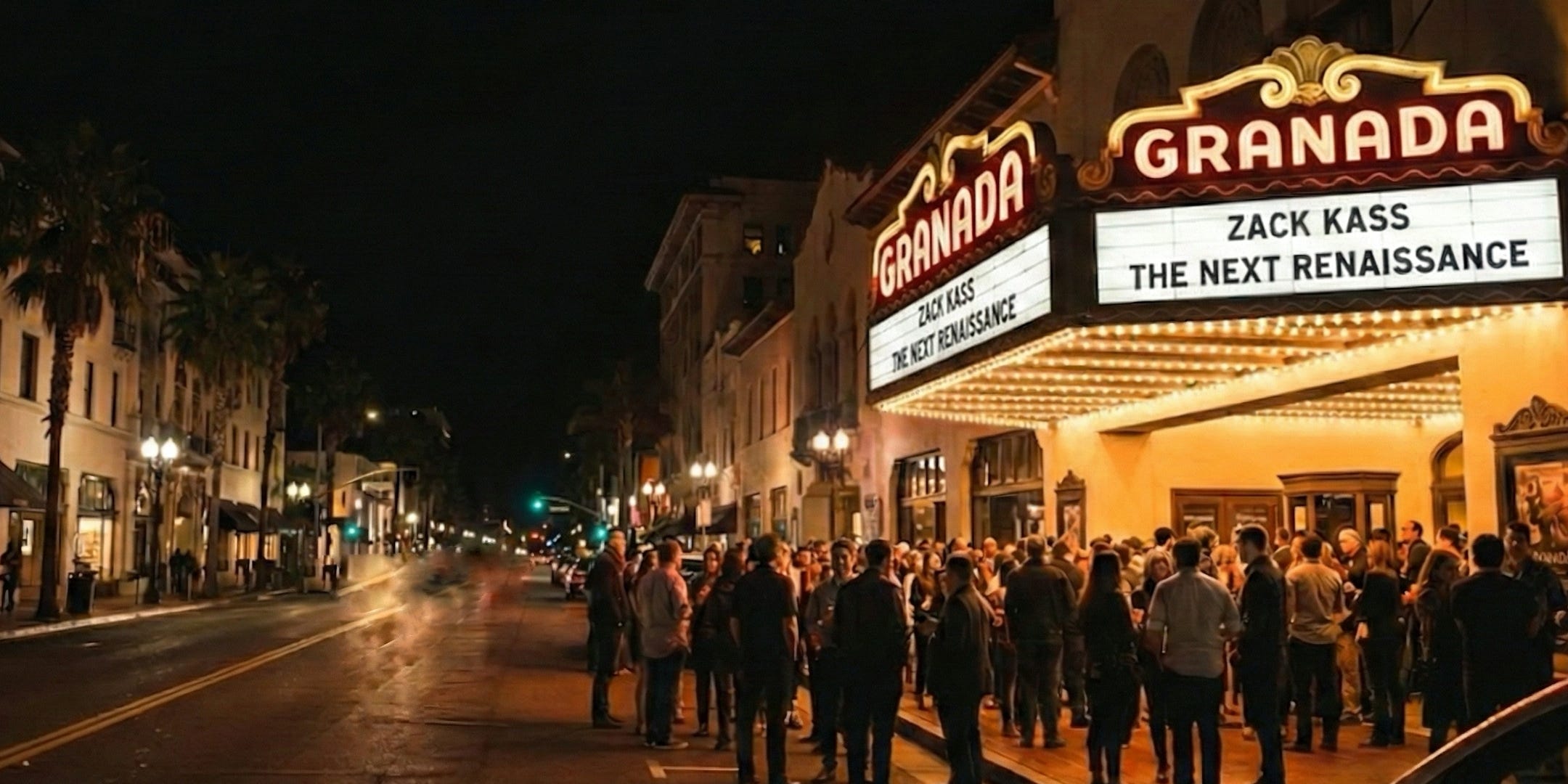
Tuesday Night. The Granada Theatre.
Fifteen hundred people. Sold out. The kind of crowd that doesn’t gather for entertainment — they gather because something’s happening.
Zack Kass took the stage. Sixteen years in AI. Former OpenAI. Three hundred thousand people have been in his audience over the last five years. He’s seen what’s coming. He wrote the book on it —literally. The Next Renaissance. It came out last week.
He chose Santa Barbara for this moment.
In the lobby beforehand, people kept finding me. “Of course you’re here, Mark.” One after another. “Who else would we expect?” I didn’t know whether to laugh or take notes.
Then Zack said it.
“We have such a special opportunity to build the Florence of the next Renaissance.”
He wasn’t being poetic. He was being precise.
What Made Florence, Florence
When he said it, I felt it before I understood it. The hair on my arms. The sense of standing in exactly the right place at exactly the right time. But I didn’t really know what Florence had done to earn that title.
So I went looking.
Florence in the 1400s had about sixty thousand people. Smaller than Santa Barbara County today. But it became the center of the Western world’s greatest cultural explosion.
Trade routes converged there. Florentine merchants imported English wool, combined it with Asian dyes, and sold high-quality textiles across Europe. Then they invented modern banking. The city got wealthy not from natural resources but from being the place where commerce and ideas intersected.
Then the Black Death hit. Half the population died. The economy contracted. And something strange happened: the wealthy couldn’t find traditional investments anymore. So they put their money into culture. Art. Architecture. Scholarship. Patronage wasn’t charity. It was what you did with capital when the old playbook stopped working.
But wealth alone doesn’t make a renaissance. Florence developed something called civic humanism. The core idea: citizens have a duty to participate in public life and contribute to the common good. Individual achievement was celebrated, but always connected to making the city better. This wasn’t a top-down policy. It was a cultural expectation.
And when Constantinople fell in 1453, Greek scholars fled west, carrying classical texts. Plato, Aristotle, and ancient science. Florence welcomed them. The collision of old wisdom and new wealth created something neither could have produced alone.
The city didn’t announce it was the center of the Renaissance. It just was. People came because things were happening there.
Right Place. Right Time.
I moved to Santa Barbara in 1972. Young man. Young family. Didn’t know what I was walking into.
Somewhere along the way, Peter McDougall grabbed me by the shoulders. He was president of Santa Barbara City College at the time. This was 1999. I’d just received the Executive of the Year award from the South Coast Business and Technology Awards for my work at Wavefront. He didn’t congratulate me. He explained something.
Stewardship. What it means to live here. The generations of people who have stepped up to keep Santa Barbara a special place. Not because they were asked nicely. Because it’s what citizens do.
My friend Noah Ben Shea was a member of the Center for the Study of Democratic Institutions, which called Santa Barbara home for decades. That history matters. There are footprints to follow.
When Zack said “Florence,” I thought about all of that. The precedent. The expectation. The question of whether we’re living up to it.
And I thought about what’s actually here now.
Google’s Quantum AI campus sits near UCSB. The Willow chip, the breakthrough everyone wrote about last month, was designed and built in Goleta. Amazon’s downtown office is where they built the next generation of Alexa. These aren’t satellite offices. These are where the work happens.
UCSB is a research engine. Westmont has a Center for Technology, Creativity and Moral Imagination, and they’re asking the moral questions most tech companies skip. Santa Barbara City College is ranked the number one community college in the United States. Pacifica and Fielding add graduate programs in psychology and human development. This is a center for study.
The intellectual capital is here because people came to learn and then stayed. Over decades. The density built up quietly.
And here’s a number I didn’t expect: Santa Barbara County has the second-highest concentration of nonprofits per capita in California. In South County, there’s one nonprofit for every 349 people.
That’s not an accident. That’s generations of people saying yes when asked to serve.
Florence had civic humanism. We have something similar. We just don’t have a name for it yet.
What Zack Asked Us to Do
Toward the end of his talk, Zack got practical. Four things. Four ways to prepare for what’s coming.
I’ve been thinking about each one through the lens of Florence, and through the lens of someone who’s been here a long time.
One. Anchor Your Mission, Vision, and Values.
Zack’s point: The infinitely adaptable friend is the worst. Everyone’s least favorite person is the one who changes their opinions based on who they’re talking to. In a world that moves fast, anchor to what you believe. Be unwavering in your mission. Be adaptable in your methods.
“You weren’t born to do a thing,” he said. “You were born to accomplish a thing.”
The Florence parallel: The Medici didn’t change their core commitment to making the city great. They changed how they invested. Banking innovation, then patronage, then politics. The means shifted constantly. The anchor held for generations.
My take: This is what we call the Trust Stack.
Organizations move at trust speed. Technology moves at light speed. That gap is where most AI implementations fail, and seventy to ninety-five percent of them do fail. Not because the technology doesn’t work. Because nobody established trust first. They skipped straight to the tools.
I’ve been making something out of nothing for fifty years. The kitchen. Computer graphics. AI orchestration. The medium keeps changing. The drive never has.
If you don’t know what you’re anchored to, AI will just make you faster at drifting.
Two. Learn How to Learn.
Zack’s point: Your ability to learn the next thing matters more than your ability to do the current thing. Study something you love so you can taste mastery. That feeling transfers to everything else.
“Your ability to learn,” he said, “will define so much of your success in a way that none of prior generations did.”
The Florence parallel: When the Greek scholars arrived carrying Plato and Aristotle, Florence didn’t just collect texts. They built academies. Cosimo de’ Medici founded the Platonic Academy. The city became a learning machine, not a knowledge warehouse.
My take: Santa Barbara has this. The academic density is real. The pipeline of people who come to study and then stay.
But learning how to learn isn’t just for students anymore. It’s for everyone.
I’m seventy-two. I’ve spent the past year building a system of AI agents that collaborate. I call it orchestrated intelligence. Not because I understood it when I started. Because I was willing to figure it out.
Problems are recipes. You break them down. You learn the ingredients. You iterate.
The question now isn’t what do you know? The question is: can you figure out the next thing? If you can’t, AI will eat your lunch. If you can, AI becomes your kitchen.
Three. Go Outside.
Zack’s point: Santa Barbara is the best place on Earth. If you can’t be bothered to go outside here, what chance does anyone have? Participate in the physical economy. Shop downtown. Be part of the community.
“If you want to be part of the solution,” he said, “live it.”
The Florence parallel: The Florentines didn’t just fund art. They built piazzas, cathedrals, and public spaces. The Palazzo Vecchio. The Duomo. The physical city was the canvas. Wealth was poured into places where people could gather.
My take: Civic humanism in action. Not just with money. With time. With presence.
Zack’s right: go outside, shop downtown, participate. But I’d add something. Show up to the things that don’t scale. TEDx. The nonprofit boards. The salons. The library talks. The conversations where you don’t know what the outcome will be.
The digital world doesn’t replace the physical one. It’s supposed to free us up to be more present in it.
Four. Be Human.
Zack’s point: Real estate agents used to be chosen for market knowledge. Now they’re chosen because people like spending weekends with them. Wealth advisors aren’t picked for financial alpha anymore. They’re picked because they pick up the phone. Human qualities are now the product, not the feature.
The Florence parallel: The Medici weren’t just bankers. They were present. Cosimo walked the streets. Lorenzo held court with artists and poets. The patronage wasn’t transactional. It was relational.
My take: This is what Zack’s father taught him.
Doc Kass sat in the front row on last Tuesday night. His son told the story of the patient who realized the machine was now determining her treatment, but the doctor’s courage and compassion were irreplaceable. “The bedside manner,” she said, “is no longer a feature. It’s the product.”
That changed Zack’s life. It clarified everything.
If we can’t win by being the smartest person in the room, and we can’t because the machines have that now, what’s left?
Curiosity. Empathy. Courage. Wisdom. The willingness to pick up the phone.
That’s not soft. That’s the whole game now.
How a Renaissance Gets Built
Florence didn’t separate the money from the mission. The Medici and the merchant families weren’t donating to culture as an afterthought. Patronage was a strategy. It built relationships. It cemented positions. It created legacies. The financial engine and the civic purpose moved together.
If Santa Barbara is going to be what Zack says it can be, we need the same thing.
What does that look like today?
It looks like the Better Business Bureau is sponsoring AI events. It looks like education leaders are stepping up to host a summit on AI across public and private schools, with a full scope. It looks like nonprofits are sending their teams through training that starts with trust, not tools.
It looks like free events at the library called “AI for Everyone” where the whole community can learn together. It looks like think tanks are forming around specific sectors, such as education, healthcare, and venture capital, so the conversations go deep rather than staying shallow.
It looks like all of us are paying attention to what’s already happening and amplifying it instead of competing with it. The AI and Art event that the Brill Foundation sponsored. The work his appening at UCSB and Westmont. The startups are emerging from the university.
And eventually, by the end of this year, if we do it right, it looks like an annual State of AI in Santa Barbara report. A public record. Measurement. Proof that this isn’t talk.
Santa Barbara has had an economic forecast for decades. The AI transformation deserves the same rigor.
The Occasion
So what does it mean to rise to it?
Santa Barbara takes a leadership role in the AI transformation of everything we do. How it helps us at work. How it helps us at home. How we educate. How we deliver healthcare. How we run cities, government, and county services. How we care for each other.
We become the example of a community that integrated these new technologies to improve the quality of life for its citizens. Not because we announced it. Because we actually did it.
We work with the county. We work with the city. We work with the state. We show what’s possible when a community chooses to be thoughtful rather than reactive.
And then people notice. They look over and say, “What are they doing in Santa Barbara?”
That’s how Florence did it. They didn’t claim to be the center of the Renaissance. They just built things. Funded things. Gathered people. Created conditions. And the world came to them.
Right Place. Right Time. Right People.
Tuesday night, walking through the Granada lobby, person after person said the same thing.
“Of course you’re here, Mark.”
Of course.
I’ve been here for fifty-three years. I’ve watched this place evolve. I’ve been given the stewardship talk. I’ve tried to live it. Sometimes well, sometimes not.
And now Zack Kass stands on stage and says Santa Barbara can be the Florence of the next Renaissance.
I believe him.
Not because it sounds good. Because the ingredients are here. The intellectual capital. The civic infrastructure. The nonprofit density. The academic pipeline. Tech companies are developing frontier technology here in Santa Barbara.
And citizens who show up. Generation after generation.
The question isn’t whether it’s possible.
The question is whether we’ll do it.
Mark Sylvester is a co-founder of Coastal Intelligence, Santa Barbara’s AI think tank and consultancy. He has lived in Santa Barbara since 1972.