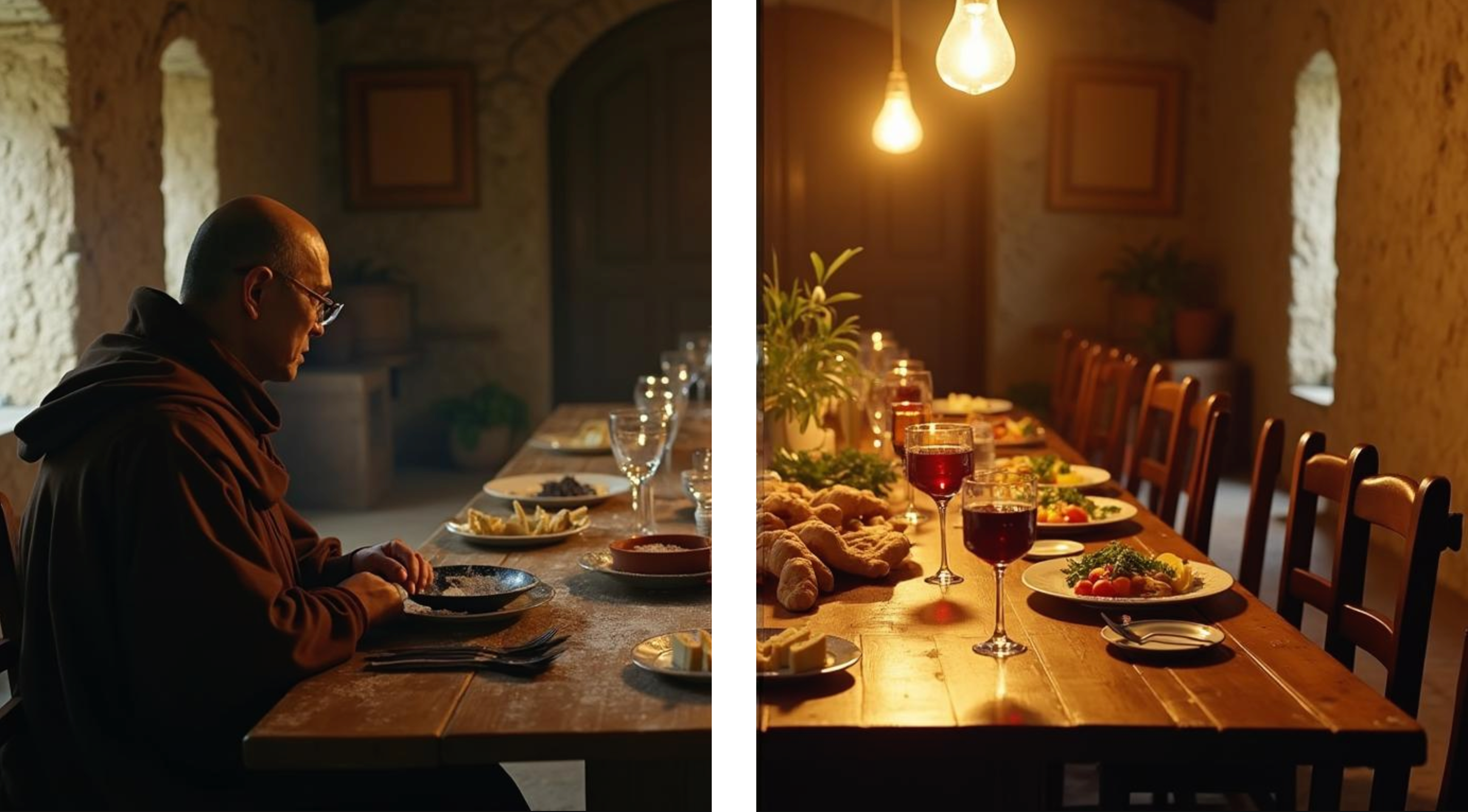
ASH ON FOOD, WINE IN THE CELLAR
It’s September 1975. I’m 28 years old. I’m the chef at the Jesuit Novitiate in Montecito - this beautiful property tucked into the foothills where young men spend two years figuring out if they want to become Jesuit priests. A novitiate, if you’re not familiar with the term, is the first step. It’s where you test the calling. Some guys come straight out of college. Others show up at 40, walking away from entire careers to see if this is what they’re meant to do.
At any given time, we’d have a dozen novices living on the property. Sometimes we’d cook for just them. Sometimes we’d host events for 600 people. You never knew. What you did know: This was a 100% scratch kitchen. Farm to Table, before that was even a thing. We made everything. Bread. Soup. Sauces. Pastries. We butchered our own meat. We had a garden where we grew herbs and flowers for the tables. When I started, I trained for a year under Chef Veane, who was very proud of this. Literally everything from scratch.
It was my last professional chef job. Five years before I started Wavefront. And it was the best one.
So this new sous chef shows up. I don’t remember his name. He’d worked at a monastery up in Big Sur - the silent monks, the ash-on-food place. He told me stories about how harsh it was up there. They’d sprinkle ash on the food because there should be no pleasure in their life. The Jesuits had a different philosophy entirely. For them, food was one of the few pleasures they were allowed. They loved to eat. They had a winery up in Santa Cruz. We had an excellent wine cellar. The whole approach was different. Food wasn’t something to endure. It was something to celebrate.
Through Another Lens is a reader-supported publication. To receive new posts and support my work, consider becoming a free or paid subscriber.
JUST LIKE THAT
His first day on the job. Saturday night. We’re working through service together. I’m showing him the ropes. Everything’s going fine. By the end of the night, the novices have been fed. The kitchen’s clean. Everything’s put away. And I notice the floor needs mopping.
I go to the mop closet. Fill the bucket with hot water and soap. Grab the mop. Walk back out. Hand it to him.
He looks at me. “What’s this?”
“It’s a mop.”
“I don’t mop floors.”
I wait.
“I’m a chef,” he says, almost like he’s correcting me. Like I’ve misunderstood something fundamental about hierarchy.
“Well,” I say, “you also don’t work here anymore. Come by Monday morning. Pick up your check.”
He stares at me. “Just like that?”
“Yep. Just like that.”
CEOS WITH DISH TOWELS
I mopped the floor myself. Mind you, this was 50 years ago. No iPod. No phone. There were no podcasts to entertain me while I was working. Just the quiet hum of the refrigerators and the sound of water on tile. I loved that quiet. I mopped. I locked up. I went home. I knew I’d have to hire someone new on Monday. The novices were great about helping - five or six of them would work each shift, doing everything from scullery to peeling potatoes. It wasn’t going to be a hardship.
But I also knew something else: I have absolutely no room for people who are afraid of work.
This isn’t the only time this pattern’s shown up. About fifteen years ago, I ran a Gentleman’s Dining Club here in Santa Barbara. Eight CEOs. We’d meet once a month on a Saturday at someone’s beautiful home in Hope Ranch. I’d create a 15-page little book with whatever cuisine we were exploring - the history of the dishes, the techniques, everything. My concept: Five dishes, five ingredients, five steps. Easy to remember. Totally worked.
Here’s how it went: We’d hit the farmers’ market in the morning. Shop for everything. Start cooking around 2:00 PM - all the prep, making desserts, everything from scratch. Wives and significant others would arrive at 6:00. I taught the guys how to plate and serve. And when dinner was done? We cleaned up. All of us. CEOs washing dishes. Mopping floors. I didn’t bring in help for cleanup.
If they’re going to do this at home, entertain, host, and cook for people they care about, they need to understand the whole picture. The work doesn’t end when the guests say thank you. Kymberlee, my wife, finally said: “Hey. These guys are paying a lot of money for this experience. You shouldn’t make them wash dishes.” We had a discussion. I told her what I just told you. She said, “Yeah, I hear that. And you’ve made your point. Now let’s bring in Maria, our housekeeper at the time, and she can handle the cleanup.”
I admitted, ‘Yeah, it was nice having someone else do that part.’ But I’d made my point.
MAKE SURE IT’S COMPLETE
I have a trait. I don’t know if there’s a formal word for it, but I call it being a completist. Someone who’s incessant about completing things. For me, “done” means: Trash is emptied. The kitchen’s clean. Floors are mopped. Everything’s put away. You walk out the door so that when you come in the next day, it’s a new day. A clean slate. That’s how I approach everything.
I’m not obsessive about it. I just can’t leave something until it’s done. Unless it’s a multi-day project, and then you leave it in a state where you can pick it up exactly where you stopped. I don’t know if it’s how I was raised. I don’t remember where I picked it up. I just know it’s deeply true about me. And I’m starting to understand why.
Maybe it comes from being a systems thinker. When you’re cooking for 600 people - or even 12 - and you’re doing a bunch of things at the same time, you need room. You need it clean. You clean as you go.
I can remember when I was the head chef at Westmont College. George Greyson had left, and I had to do a seated, plated prime rib dinner for 2,500 people. We had to move everything in vans from the main kitchen to wherever we’d set up the temporary kitchen - I don’t remember if it was the gymnasium or somewhere else on campus. It was a long time ago. Tight timeline. Lots of pieces. And we forgot something. Ice scoops.
Sounds stupid and simple. But we needed them for the water pitchers. A lot of them. And not having them threw the whole timing off. I was 22 years old. Exactly fifty years ago. And I remember thinking, very distinctly: You have to think of everything.
When you’re putting together something complex - an event, a service, a software project - what are all the pieces you’re going to need? And whatever you have to do to keep track of those things - do that. If you have a great memory, great. I used to. Now I need checklists. If you need checklists, great. Just make sure they’re comprehensive. Make sure they’re complete. That may be where the word comes from.
HE THOUGHT IT WAS STATUS. I KNEW IT WAS SYSTEMS.
Here’s what I didn’t understand when I fired that cook: His problem wasn’t ego. It wasn’t that he thought mopping was beneath him - though that’s what it looked like. His problem was that he didn’t understand systems.
He thought “I’m a chef” was an identity statement. A status marker. Something that exempted him from certain tasks. I understood “I’m a chef” differently: I’m responsible for this kitchen being ready for tomorrow. That’s the job. That’s what the role actually means.
Most people think career advancement is about escaping the menial work. You get promoted, so you don’t have to mop anymore. Success means delegation. Growth means you’re finally above the grunt work. But completists understand something different: The work isn’t done until the system is ready for the next cycle. And the person who pays for incomplete systems? Usually you.
That cook wanted to be a chef. But he was avoiding the work that would have made him one - understanding that the job doesn’t finish when the food goes out. It finishes when the kitchen is ready for the next day. The CEOs at the Gentleman’s Dining Club wanted the experience of hosting elegant dinners. However, some of them initially avoided the work that comes with it - the cleanup, the completeness, and the reality that hospitality isn’t just about the performance. I forgot the ice scoops at 22. I was avoiding the tedious checklist work. And it cost me invaluable time. I never forgot that lesson.
THE ICE SCOOP YOU FORGOT
Last night I heard comedian Jimmy Carr say something that landed hard:
“The life you want is on the other side of the work you are avoiding.”
That’s it. That’s the whole thing. The cook wanted to be a chef. But the life he wanted - mastery, respect, the ability to run a kitchen - was on the other side of understanding that mopping the floor isn’t grunt work. It’s systems work. It’s the curriculum.
I saw a sign years ago at the CrossFit gym Kymberlee used to attend that said, “In a year, you’ll wish you’d started today.” It stuck with me. Right now, what’s the work you’re avoiding? It could be AI upskilling. It could be finally learning to delegate properly. It could be having a difficult conversation with your business partner. It could be shipping the thing instead of perfecting it forever. It could be an admission that you need help with your finances. It could be going back to basics in your craft after years of coasting.
Whatever it is, you know what it is. And you have a compelling story about why you’re not doing it yet. It’s overwhelming. You don’t have time. You’re waiting for the right moment. That’s not your job anymore. You’ve moved past that. Someone else will handle it. It’ll sort itself out.
In a year, you’ll wish you’d started today.
I see it everywhere. Smart people. Capable people. People who’ve built careers on learning new things. And they’re all saying some version of the same thing that cook said: “I don’t do that.” Same avoidance. Same outcome. They think they’re protecting their status - their identity, their brand, their expertise. But what they’re actually doing is refusing to understand the system that will define their next chapter. And in a year - maybe less - they’re going to be standing in a space that everyone else knows how to navigate, holding tools they don’t know how to use, wondering why they got left behind.
WHO YOU DON’T BECOME
Here’s what nobody tells you about avoided work: It’s not about the work itself. It’s about what the work teaches you. Mopping the floor teaches you to see the kitchen as a system. To understand that “done” means ready for the next person. To think about completeness, not just completion. Learning the thing you’re avoiding teaches you to see your work as a system. To understand what matters and what doesn’t. To think about leverage, not just effort.
The people who avoid the work also avoid becoming the person who can handle the complexity. That’s the real cost. Not the mop. Not the AI prompt. Not the difficult conversation. The cost is who you don’t become.
I’m 72 now. I haven’t worked in a professional kitchen in decades. But I still mop. Not literally - though honestly, I do that too. I still finish things. I still think in systems. I still understand that incomplete work creates downstream chaos, and the person who usually has to deal with that chaos is me.
That cook probably became a fine chef somewhere. I hope he did. But I wonder if he ever learned what I learned that Saturday night in 1975:
The work you’re avoiding isn’t the problem. The work you’re avoiding is what builds you.
WHICH WORK ARE YOU AVOIDING?
So here’s my question for you: What’s the work you’re avoiding right now? What’s the thing you know you should be doing - learning, building, practicing, completing - but you keep putting it off because it feels overwhelming or tedious or beneath you?
Because here’s what I know after fifty years:
The life you want is on the other side of that work.
And in a year, you’ll wish you’d started today.
That’s always true. The only question is: Which work are you avoiding?
Through Another Lens - A Sunday StoryNovember 9, 2025
Thanks for reading Through Another Lens! This post is public, so feel free to share it.