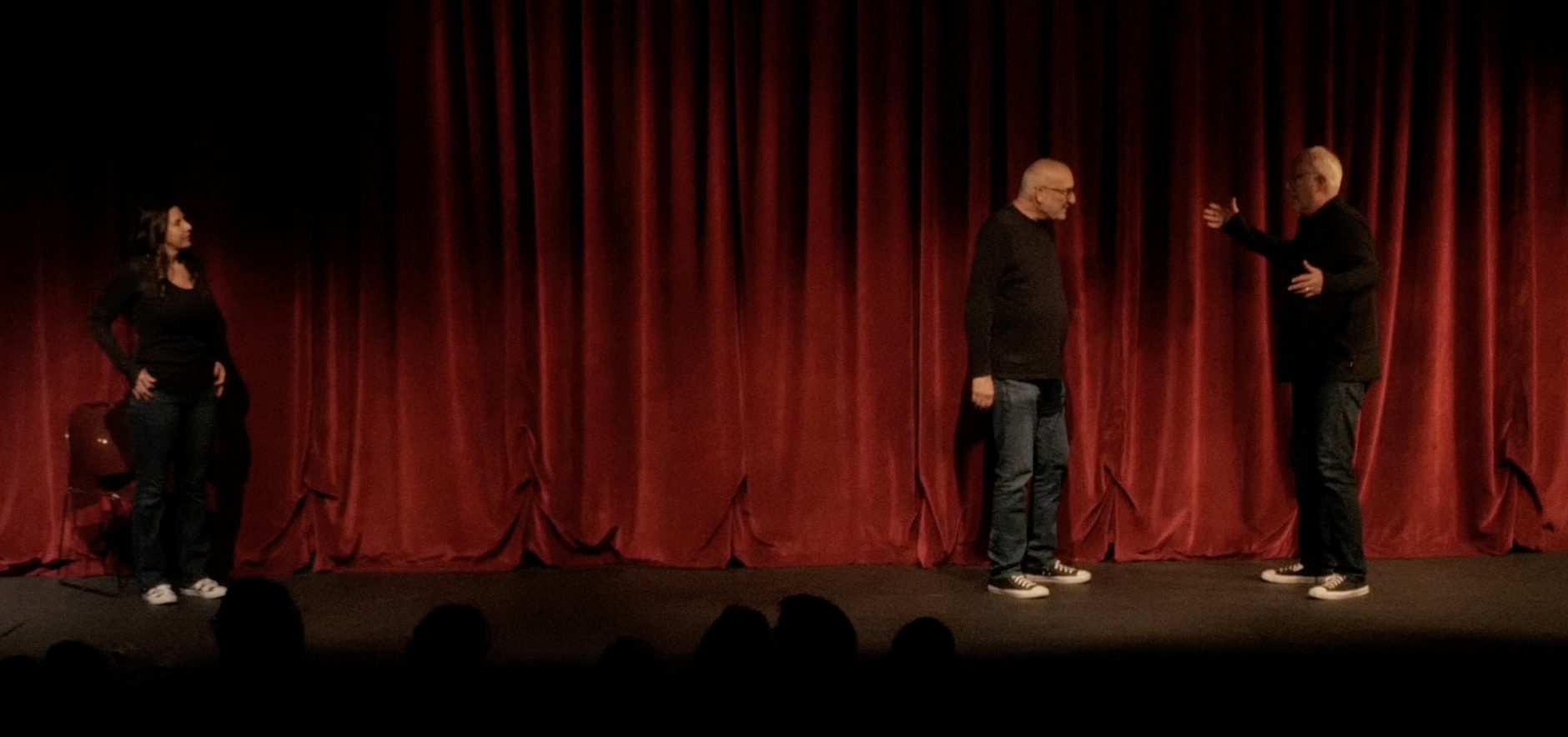
The thing about growing up on Lenny Bruce and George Carlin is that they taught you that comedy’s job was to rub our noses in hypocrisy. Smart comics. They held up mirrors to society and made us laugh at what we saw, even when it was uncomfortable.
Especially when it was uncomfortable.
I thought I understood what that meant until I found myself producing an improv troupe at 70, standing in front of a circle of students ranging from their twenties to their seventies, all wanting the same thing.
I was about to learn exactly how dangerous that becomes when every moment could be recorded forever, and when the difference between being edgy and cutting too deep can determine whether you heal or harm.
Tuesday Night Magic
“What do you hope to get out of class tonight?”
“Laughs. Just get out of my head.”
“Stop overthinking everything.”
“Permission to be silly.”
That’s what Kymberlee asks them at the beginning of class every Tuesday night. She follows that up by telling them, “This is a safe space. Take big swings. We have each other’s backs.” We work with our house team, the Embarrassment of Pandas.
And we do have each other’s backs. In that little room, with no audience except ourselves, people discover they can be funny. They find voices they didn’t know they had. They play characters that surprise them. Sometimes they cross lines—usually with what we old-timers call “blue humor,” though I bet half these kids don’t even know that term.
It feels like magic. Like we’re giving people exactly what they came for.
But here’s what I didn’t anticipate: being told repeatedly by our coach to “not think” in a world where thinking has become mandatory for survival.
Don’t Think, Just Trust
Kymberlee and I have been training for ten years here in Santa Barbara. We’ve built something real – our troupe performs monthly at the Alcazar Theatre in Carpinteria, and we’ve been going down to JEST Improv in Ventura for Friday jams for a couple of years now. We’ve done festivals, other venues. We take the comedy seriously.
This year, we brought in Navaris Darson from The Groundlings to work with our core group of five or six players. Thursday nights, we rehearse hard. Navaris brings that professional LA training – the kind that emphasizes fearless commitment, taking big swings, and making bold choices without hesitation. “Don’t think,” he tells us, over and over. “Trust your instincts. Commit fully to the choice.”
It’s a conscious effort to turn off your brain. And sometimes, when I’m so in the moment, I’m already committed to the choice when my rational mind kicks in – usually because of a laugh from the audience or my teammates that’s encouraging me to keep going.
What has been interesting to me over the years is the quality of intelligence that we see in people who come to class on Tuesday nights. Currently, we have a researcher at our hospital, a mechanical engineer, a vibe-coder, a Disney-adult, our former sitcom writer, a young mother of four who has just gotten her second degree and knows complex math like she knows “Yes, And” - an aspiring actress, a playwright, and a fashion designer. A wide mix that seems to be forever shifting.
These brilliant people come seeking the same thing everyone seeks in comedy: permission to be spontaneous, to surprise themselves, to connect through laughter.
Through Another Lens is a reader-supported publication. To receive new posts and support my work, consider becoming a free or paid subscriber.
Fast and Funny Until...
See, we don’t just teach. We perform. We call what we do “fast and funny”—outlandish, physical humor that presses hard on the hilarity of the human condition. Simple, random things you wouldn’t think are funny. Like a talking water bottle in the break room.
And here’s the thing about live improv comedy that people don’t understand: it’s a real-time negotiation between performer and audience. You try something. They laugh. You double down. They laugh harder. You keep going until...
Until what?
That’s when I started thinking about the phrase “cutting edge.” It has a specific meaning, right? Sharp, innovative, pushing boundaries. And then there’s “edgy comedy” - provocative, risky, boundary-pushing.
But here’s what hit me: you want comedy that’s edgy but doesn’t cut.
Comedy that’s sharp enough to matter, but not so sharp it wounds the relationship you have with your audience.
The Impossible Balance
That’s the impossible balance we’re trying to strike every time we step on stage. Be authentic enough to surprise people, bold enough to make them think, edgy enough to break through their defenses - but not so sharp that we cut the very connection that makes comedy work.
Because once you cut that relationship, once you damage the trust between performer and audience, the healing power of laughter disappears.
The South Coast improv scene has grown over the past decade. SB Improv and Carpinteria Improv anchor two theaters. We’re part of building something that matters. But every show now feels like walking a tightrope where one wrong step could damage not just your own reputation, but the whole community you’ve helped create.
One night, I was doing a character - some opinionated old guy from a red state - and I could feel myself getting close to that edge. The character felt authentic, the audience was engaged, but there was this moment where I realized I was approaching territory that could go either way.
I could feel Kymberlee watching, gauging whether I was being edgy or about to cut too deep.
The New World Order
That’s the thing about live performance - you’re always making split-second decisions about how far to push, how authentic to be, how much risk is worth taking. And now we have to make those decisions knowing that someone in the audience could be filming for fun, capturing a moment that was never supposed to live in infamy.
We reminded ourselves afterward: not knowing if there’s a recording or not means we have to assume there’s always a camera somewhere. That’s the new world order.
And that’s exactly what we’re talking about with comedy, isn’t it? The unexpected moment that breaks through our defenses. But what happens when we make the unexpected too dangerous to risk?
One of our troupe members is a former sitcom writer from the 70s and 80s. He’s adapted beautifully to improv – no longer trying to script everyone’s lines, just being himself on stage. But he gets the bigger picture in ways I’m still figuring out. He was just saying that students are relying on AI now, and whatever happens in that debate, for us, on stage, no robot is going to make us funny.
Then he laughed. “Problem is, we’re making spontaneity dangerous just when we need it most.”
Always Being Watched
The assumption we have to make is that we’re always being watched, always potentially documented. That changes everything about how you perform - how edgy you’re willing to be, how close to that cutting line you’re willing to get.
I’m guessing that writers rooms in the big late-night comedy shows are having this conversation right now. Yes, we CAN say anything we want - however, it feels like poking the bear right now. Look what just happened to Kimmel - suspended for a week, major station groups refusing to air his show, government officials threatening broadcast licenses. And that creates an atmosphere not conducive to lightness and mirth.
There’s definitely a part of us that wants to fight back - however, the consequences are very real and immediate these days. With doxxing and other harassment, it makes staying within the lines that much more urgent. And probably lessens the looseness needed to truly be in the moment.
That must have been what it was like in the McCarthy era when Hollywood was in the administration’s sights. People are cowed now, just like they were then. Artists caught between integrity and survival.
Which brings us back to what Michael Meade said about needing the unexpected during these transformative times. We need comedy to help us process what we can’t otherwise handle. But…