Written 4/3/2026.
Let’s get something straight.
Ethics training for insurance agents didn’t happen because the industry suddenly cared more about doing the right thing.
It happened because the system kept producing the wrong results.
What actually went wrong
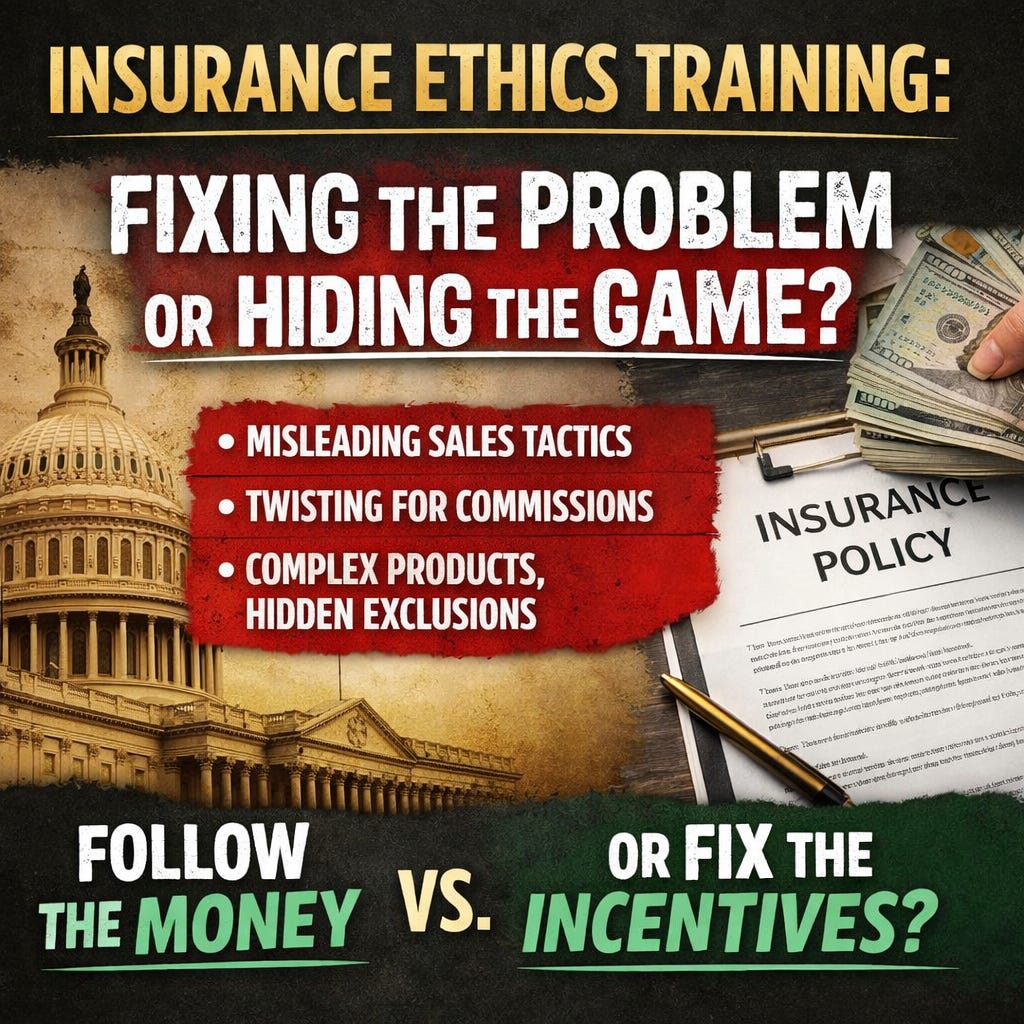
For years, regulators saw the same patterns:
* Agents overstating what policies covered
* Replacing policies just to generate new commissions
* Products so complex that the average person couldn’t realistically understand them
So the response became… ethics training.
But that assumes the problem was a lack of understanding.
It wasn’t.
The real problem
The system pays for behavior.
And people follow the money.
If you pay someone more to sell something new than to maintain what’s already in place, what do you expect to happen?
The system wasn’t broken.
It was working exactly as designed.
Then we made it worse
Insurance products didn’t get simpler—they got more complicated.
Variable life.Annuities with caps, triggers, and riders.
At some point, this stopped being about “explaining things better.”
The complexity itself created space for manipulation.
Why ethics training exists
After lawsuits, media attention, and regulatory pressure, something had to be done.
So ethics training became mandatory.
Not to make agents ethical.
To create accountability.
It does three things:
* Defines a minimum standard of behavior
* Gives regulators something to enforce
* Protects carriers and states legally
If something goes wrong, the answer is simple:
“You were trained. You knew better.”
What it actually accomplishes
Let’s be honest.
Ethics training does not eliminate bad behavior.
It filters out the most obvious violations.
That’s it.
Because the underlying system hasn’t changed:
* Commissions still drive decisions
* Products are more complex than ever
* Consumers are still at a disadvantage
So what would actually fix it?
You have to change the incentives.
Not the training.
If doing the right thing is harder, slower, or less profitable… most people won’t do it consistently.
A real-world example
When I help someone with individual health insurance outside of open enrollment, I might get paid $20 per month.
Many of these policies only last a few months.
That means I might earn $60 total.
For one to two hours of work.
That doesn’t work economically.
And when the math doesn’t work, behavior changes.
The Medicare problem (and unintended consequences)
Agents generally can’t charge fees for Medicare advice.
Sounds consumer-friendly.
Until you look closer.
If someone needs help choosing a Part D drug plan, the compensation is often minimal—sometimes nothing.
So what happens?
Most agents don’t offer that service.
Not because they don’t care.
Because they can’t afford to.
And now seniors are left making complex decisions on their own—often choosing the wrong plan.
In trying to protect consumers from fees, the system actually reduced access to good advice.
What needs to change
If agents could charge transparent fees:
The question shifts from👉 “What pays me?”
to👉 “What’s best for this person?”
That’s a meaningful change.
But here’s the catch
Consumers have to value expertise.
You can’t demand unbiased advice while insisting it should be free.
Because it’s not free.
You’re just paying for it in ways you don’t see—and often in ways that don’t align with your best interest.
Bottom line
Ethics training isn’t the solution.
It’s a patch.
Until incentives change, the outcomes won’t.