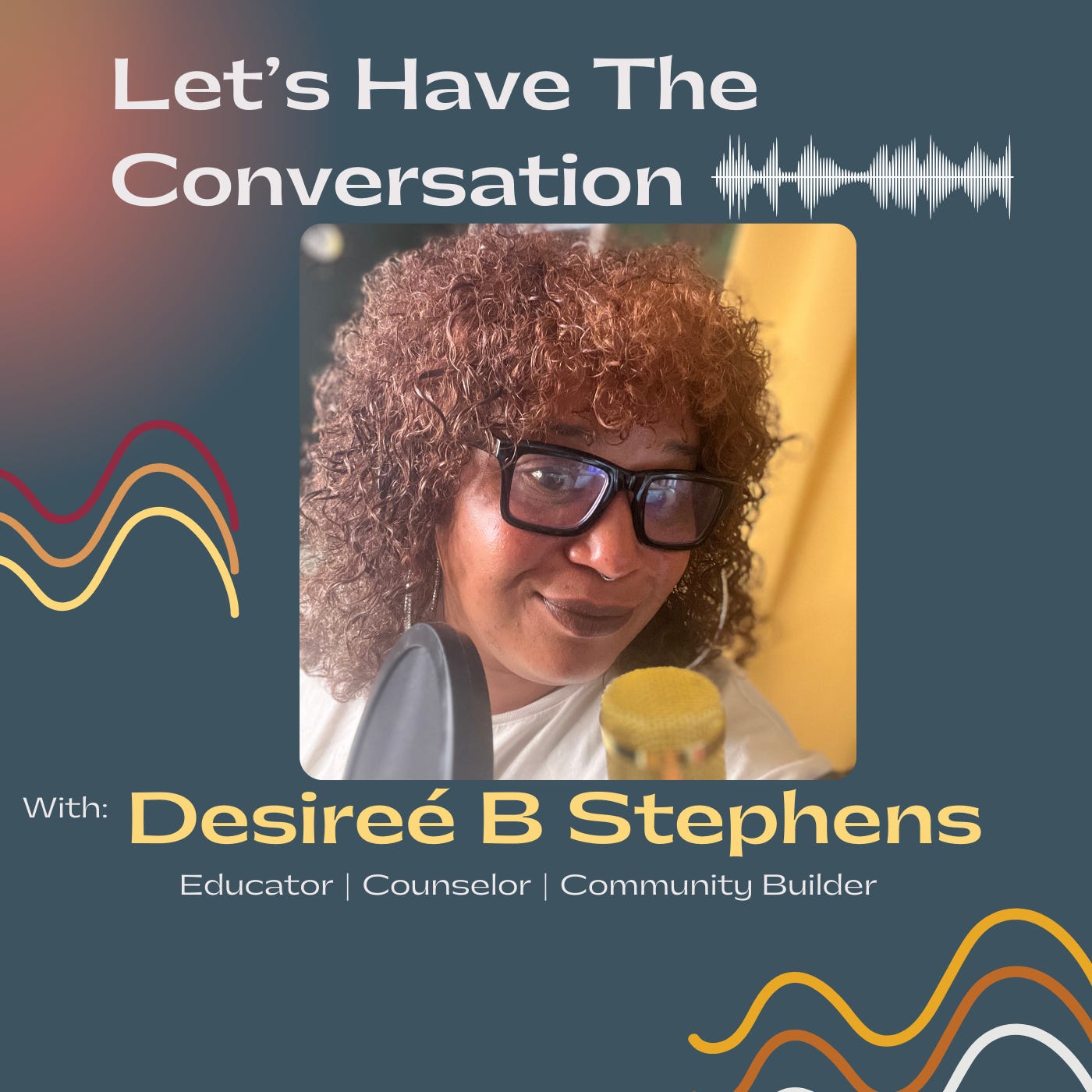
This is a free preview of a paid episode. To hear more, visit desireebstephens.substack.com
Today’s Friday With Friends was a whole sermon on what it means to build a business that doesn’t betray your values.
I sat down with Kay Coughlin , CEO of Facilitator On Fire, who has been behind the scenes helping me stay on task, sort the swirl in my brain into an actual roadmap, and keep Make Shi(f)t Happen growing in ways that are aligned with liberation, not grind culture.
Kay works with justice-minded leaders – for-profit and non-profit – who are trying to build organizations that center social and ecological justice. She does it with equity pricing, deep compassion, and a refusal to feed supremacy culture while doing “good work.”
This conversation was a love letter to everyone trying to build something real in the middle of late-stage capitalism without losing your soul, your health, or your community.
How We Got Here: “What the hell, why not?”
Kay and I met on Substack. She reached out and basically said, “This is what I do. I think I can help.”
Both of us have that “what the hell, why not?” energy.We’ve both taken big leaps, taken risks, and decided we’d rather try and get a little bruised than stay stuck and safe.
What made this collaboration work is that Kay didn’t come in trying to “fix” me or tame me. She came in saying:
* You are not too much.
* Your pace, your brain, your rage, your tenderness – all of that belongs.
* Let’s build structure around you, not against you.
That alone is a radical stance in a culture that tells us to contort ourselves to fit the spreadsheet.
Kindness, Compassion, and Calling People In
One of the things that kept coming up in our conversation is how Kay holds people.
She moves with compassion, not “tolerance.”Tolerance is: “I don’t like you but I’ll deal with you.”Compassion is: “I see how you got shaped, and I’m still going to invite you into better.”
In rooms full of acronyms and insider language, Kay notices who looks lost. She’s the one who will:
* Slow down.
* Define the term.
* Bring the conversation back to the humans in the room.
That’s part of “equity over extraction” too.It’s not just about money. It’s about access. It’s about refusing to gatekeep knowledge to feel powerful.
Equity Over Extraction: How Kay Builds Her Business
Kay’s entire model is built on the question:
“How can I remove as many barriers as possible without burning myself to the ground?”
She uses an equity pricing structure so people with less financial access aren’t automatically shut out of support. It’s not charity. It’s alignment.
We also uplifted Kind Cotton – where Kay got the shirt she was wearing.You can find them at Kindcotton.com. For every item purchased, they give away inclusive children’s books to classrooms and kids who need them.
That’s what “equity over extraction” looks like in practice:
* Building give-back into the business model.
* Treating generosity as infrastructure, not an afterthought.
* Accepting that “enough” is a liberation goal, not a failure.
Kay talked about pricing, not as “charge as much as possible” but as:
* Honoring your expertise.
* Staying resourced enough to keep doing the work.
* Making sure people who need the work aren’t structurally locked out.
That’s a social justice business model.
1. The Intersection of Justice and Business
Kay’s entire model challenges the lie that business must be extractive or morally neutral.She builds strategy through a justice lens — asking:
✨ How do we create offerings that don’t replicate the systems we’re trying to dismantle?✨ What does leadership look like when we center people, not productivity?✨ What is the ethical way to scale, grow, and still stay aligned?
Kay shared how she became rooted in this work, why she chose this path, and what keeps her hopeful — especially at a time when so many businesses are abandoning DEIA conversations altogether.
This section of the conversation lays the foundation for what justice-based entrepreneurship looks like in real life — not theory.
2. The Power of Accountability and Structure in Liberation Work
One of the deepest threads in our conversation was liberated accountability — something Kay practices exceptionally well.
It’s not punitive.It’s not shame-based.It’s not “why didn’t you get this done?”
It’s structure without domination.Support without infantilizing.Planning without perfectionism.And accountability without urgency.
Kay has been helping me stay on task in ways that honor:
* my neurodivergence,
* my capacity,
* my season,
* and my liberation-centered values.
This is the kind of accountability that opens up possibility instead of shutting people down.It’s the antidote to the “grind til you break” culture we were raised in.
3. Equity Pricing, Community Care, and Removing Barriers
Kay’s equity pricing structure is one of the most powerful things about her business model.
She doesn’t just believe in accessibility — she builds it in.
She designs her pricing to:
* remove as many barriers as possible,
* keep herself resourced,
* and create a sustainable ecosystem where people can get the support they need without shame.
We also uplifted Kind Cotton — the brand where she gets her shirts.Their model is stunning: for every item purchased, they give away inclusive children’s books to kids and classrooms.That’s what equity looks like in practice.
This part of the conversation became a blueprint for anyone wanting to shift from extractive business practices to community-centered ones.
Connect With Kay + Support Her Work
I want you to be able to find Kay and support her directly:
* Book a session with Kay (Facilitator On Fire):https://facilitator-on-fire.moxieapp.com/public/facilitator-on-fire/client-session
* Connect with Kay on LinkedIn:https://www.linkedin.com/in/jkcoughlin/
* Support Kay’s justice-aligned work on Patreon:https://www.patreon.com/cw/FacilitatorOnFire
* Grab a shirt from Kind Cotton (BOGO inclusive books model):
https://Kindcotton.com Every purchase helps get inclusive books into the hands of kids.
* Read Zawn Villines ’ writing on relationships & justice: Liberating Motherhood
The rest of this conversation is for paid subscribers.
If you felt yourself leaning in, keep going.
If you’re growing something meaningful…If you’re shifting your work to align with liberation…If you’re re-learning structure outside of grind culture…
You’re going to want the rest of this. Become a paid subscriber to access the full conversation, the companion article, all Friday With Friends episodes, and the entire Liberation Education archive.