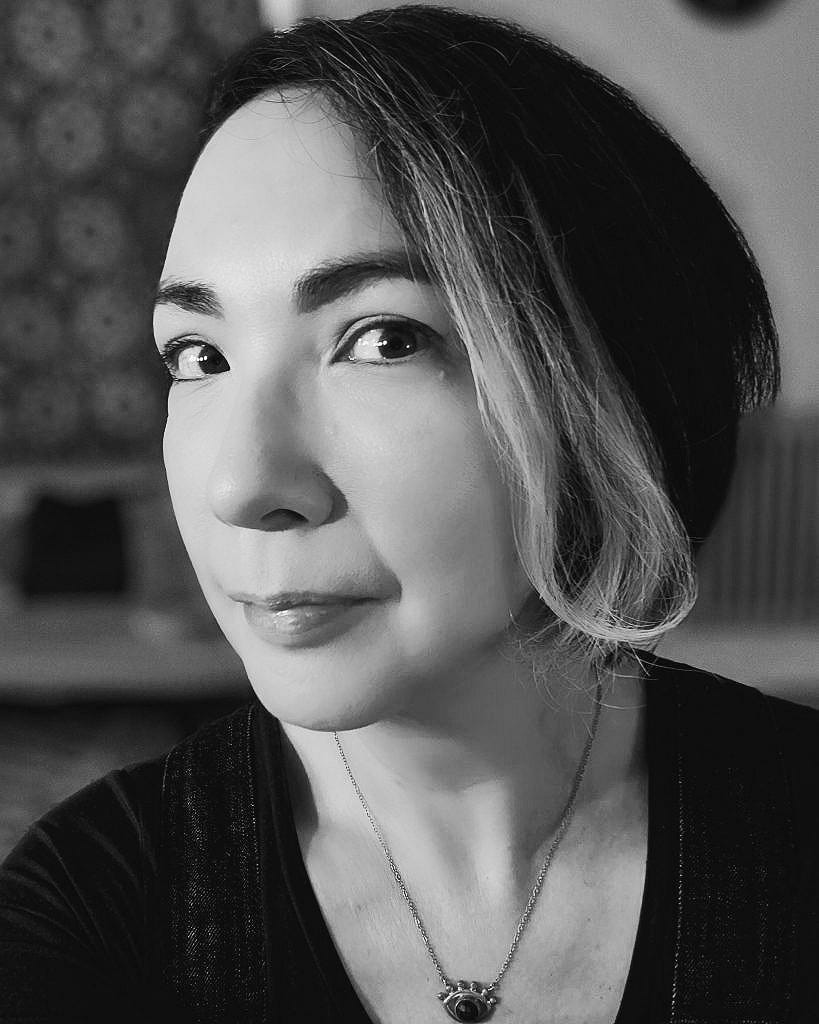
Trying something new this month: a bit of improvising! Most of the content is in the audio version only, with the full author interview and some links below. My submission stats are exclusive for newsletter readers this month (only because I forgot to read them out 🙃). Please let me know your thoughts on this new, improvised format.
📖 Author interview with Wiz Wharton
Wiz Wharton was born in London of Chinese-European heritage and is a prize-winning graduate of the National Film and Television School (NFTS). Her debut novel Ghost Girl, Bananawas published in 2023 and deals with issues of identity, belonging and familial secrets. It was longlisted for the Authors’ Club Best First Novel Award 2024 and shortlisted for the Diverse Book Awards 2024. Adaptation rights have been optioned with Wharton on board as screenwriter and executive producer. In 2023 the Scottish Government Expo Fund named her as one of the 40 Authors Predicted to Set the Literary World Alight. She lives in the Scottish Highlands.
What inspires you?A lot of the obvious stuff, I suppose, like books and art and music, but across the whole spectrum of what I personally regard as creatively successful. I hate the phrase “teachable moment” but I’m often inspired as much by things I don’t particularly enjoy because it’s interesting to consider how I would have done them differently. Whatever the medium, or person, I’m hugely inspired by authenticity in all things because it speaks of fearlessness which is a state I’m constantly trying to get to, both in my writing and in life.
For me, writing is a way of evolving or making sense of the world so I’m obviously inspired by past experiences and past relationships although not in an autofiction way. Rather, it’s the feelings behind those stories that I like to explore. Finding the universal in the specific.
Do you have a writing routine?I’m lucky enough to write full-time now, although when I had an additional job it did oblige me to be more disciplined about the creative stuff so it’s been a learning curve! I always start the day with coffee and admin—writing or replying to emails, following up on invitations or filling out tax spreadsheets—all the things that keep the business side running. Before I was published, I didn’t really think much about this aspect, but it’s become something that solidifies writing as a job to me. Then I’ll turn off the internet and put my phone into do not disturb mode and sit down to whatever I’m working on, whether it’s my current book or a script. I’ll usually read back the previous day’s work and mark any new thoughts I’ve had without editing the pages themselves. I always leave the manuscript at a point where I can immediately dive into the writing itself when I return. Sometimes I’ll have left notes in the margin about what I’m trying to achieve in terms of plot or what a character wants in a scene. Sometimes I’ll have left mid-sentence! I learned this trick a few years ago and it definitely works for me.
People often think writing is just about getting words on the page, but I probably only spend about five or six hours a day on this, ending up at around 3pm, and some days I don’t write at all. The advice to write every day is more of an ideal than a reality for lots of people and like most rules about writing (which when you’re beginning are easy to regard as sacrosanct) it really has no bearing on whether or not you’ll be published. Incredible novels have come out of all sorts of situations.
Unless I’m on a particularly tight deadline, when my usual routine tends to go out of the window, I’ll spend the rest of the day doing things that revolve around writing, so reading and researching or watching films or TV. This feeds the analytic side of my brain and I always do it with a notebook in hand. I also advocate naps. It’s amazing what your mind comes up with when you’re not whipping it into submission!
The other thing I build into my routine is lots of walks with our dog, Wilson. The change of scene and the physical effect of being outdoors does wonders if I’m feeling stuck or need to think about the project in its entirety and what I’m trying to do with it.
My worst writing momentThe dreaded book two syndrome. With my debut I’d had considerable time to write without expectation and Ghost Girl, Banana was in pretty good shape by the time I even thought about submitting to agents. A second book is another prospect entirely because by then you’re already on the publishing carousel with all the other commitments that entails and I definitely felt the pressure. It’s not simply the dread of showing a really bad first draft to someone whose opinion you respect, it’s that debuts also tend to set out your stall as a writer, meaning that readers have expectations of you too. It took me a good year and four failed attempts at a second manuscript before I came to the realization that I—as my first audience—should actually be enjoying what I was writing, without becoming bogged down in whether it would sell or do well. Getting out of my own way was the key to finally landing on the right idea—the one that means something to me and that I would want to read. I definitely panicked myself into thinking I would never write another book, but it’s been a valuable lesson in trusting my gut.
My best writing momentThe best moments (plural) are undoubtedly getting to meet readers. The prize lists are wonderful but they’ll never beat the experience of talking to someone who thinks of your characters as real people and who have invested such time and emotion into their stories. So many have written to me saying that they felt seen by Ghost Girl, Banana and will remember it for a long time to come and that’s the kind of legacy that makes it all worthwhile. That particular novel is very much about coming to terms with being “other” and even growing to a place of empowerment with that knowledge, and from a personal perspective, readers have helped me in that journey too, not only validating me as a writer but as an individual.
What are you reading right now?Dear Dickhead by Virginie Despentes, which I am loving. I tend to gravitate towards books with similar themes to whatever I’m working on at any given moment and Despentes has a lot to say about feminism and sexuality and generational differences which speaks very strongly to what I’m trying to achieve in this second book. I haven’t read an epistolary novel since Where’d You Go, Bernadette and it’s a form I really enjoy when it’s done well, as this is! One of the reasons I’m loving it so much is because Despentes really nails the pathos-through-humor trick. To convey a sense of human fragility without recourse to sentiment or victimhood is very hard to pull off creatively and I’m in awe of her skill.
Book recommendationApart from the Despentes, I’ve read so many good things in the last twelve months, it would be hard to choose just one. I’d happily press into anyone’s hands Ordinary Human Failings by Megan Nolan, or Trespasses by Louise Kennedy.
Where can we find you?I’ve more or less given up on social media, especially since Twitter got taken over by Musk, but I’ve retained my handle @Chomsky1. Maybe I’ll take the mothballs off it if it ever returns to its golden years. I’m slightly more active on Instagram @wizwharton although I have a love-hate relationship with social media, to be honest. It can be both a balm and a time-suck. Just write already!
📚 Recommendations for ravenous readers
* Returning Home with Glory: Chinese Villagers around the Pacific, 1849 to 1949 by Michael Williams
* Sour Heart: Stories by Jenny Zhang
* A Feather on the Breath of God by Sigrid Nunez
* Backstory London’s monthly reading challenge
✏️ Resources for wonderful writers
* The Writers’ Workout Fiction Potluck contest, “About an Egg.” I’m the judge! Up to 5,000 words, due February 20th.
* Mslexia Agent Extravaganza, February 3rd & 4th.
* Reedsy lists, e.g. Best Short Story Book Publishing Companies in UK and Best Short Fiction Independent Publishers in 2025.
👣 Updates on my moseying
I’m now submitting my short story collection, Staring into the Sun, directly to small presses. My next project will be a nonfiction book, the SME Sustainability Handbook, which ties in with my consulting business, Grain Sustainability. I’ll probably self-publish it.
Short story collection submissions to small presses — tracked on Chill Subs 📊⏱️ 1 pending🚫 1 rejected🟰 2 total
Queries to literary agents — tracked on QueryTracker 📊⏱️ 7 waiting for replies on query letter🕰️ 1 waiting for reply on full manuscript🚫 2 rejections after reading query letter😭 1 rejection after reading full manuscript🟰 11 total
Story submissions — tracked on Chill Subs 📊🏆 7 accepted⏱️ 3 pending🙅♀️ 7 withdrawn (accepted elsewhere)🚫 52 rejected🟰 69 total
📙 Where to find my writing
"Things My Dad Told Me" in Tomorrow There Will Be Sun, the Hope Prize anthology published by Simon & Schuster Australia.
“Gold Mountain Diggers” in Issue 10 of Livina Press.
“His Bones” in Transformations, the Oxford Flash Fiction Prize anthology.
US and UK printed books plus ebook links are all available on my website.
Most book links go to my Bookshop.org page, where sales are win-win-win, benefiting the authors, local bookstores, and my own writing—unlike using A-you-know-who!
If you enjoy The Spark, please share it, rate, and review on your favorite podcast platform or go to Substack where you can listen to the podcast and subscribe to the newsletter. I don’t think I actually have any reviews yet, so I’d really appreciate your contribution on Apple Podcasts or Spotify.
Thanks for reading The Spark! Subscribe for free to receive new posts and support my work.