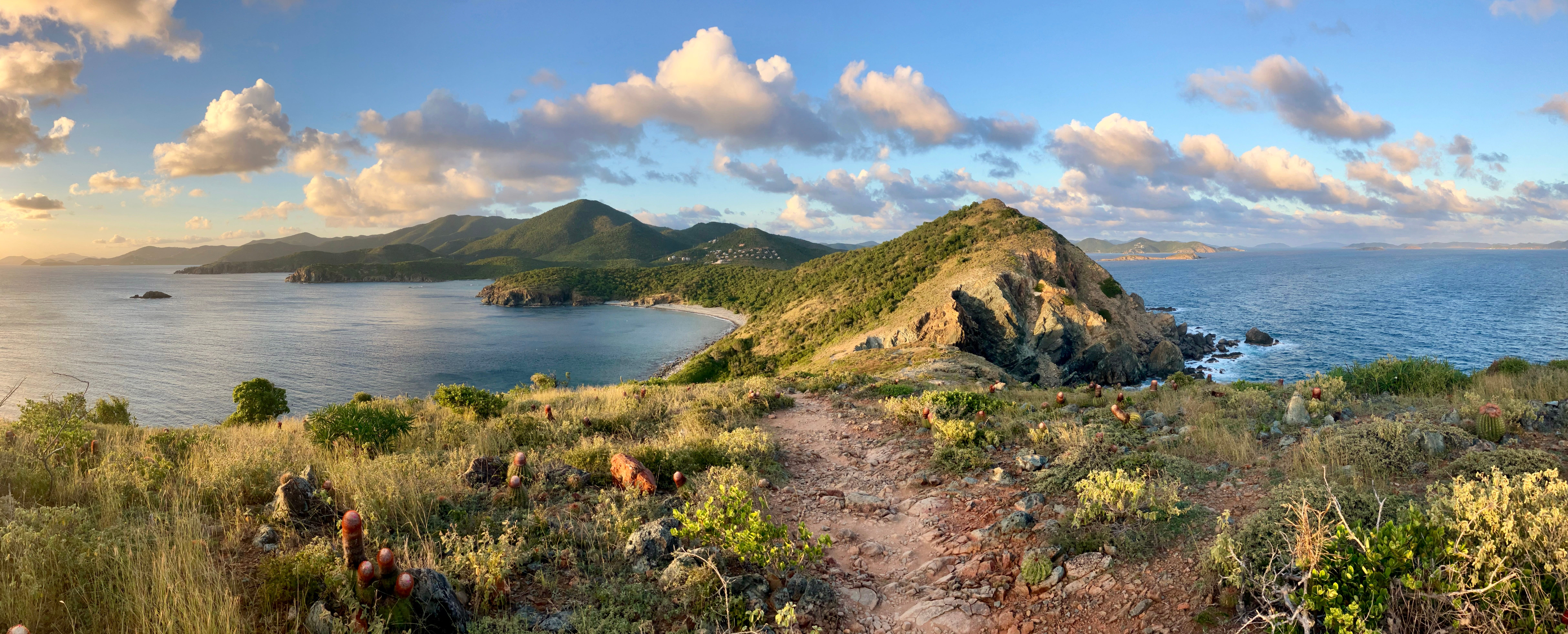
Last week I was on an island in the Caribbean. Some of the trees in the Virgin Islands National Park wink at you when you walk past them. They flex and whisper their age. They tell stories, if you listen, about the ecology of the place and about a whole history of happenings.
Ferns grow on the trees’ trunks and contribute to their whispers. It is a rather elegant arrangement. These ferns are epiphytes—they don’t put roots in the soil like many plants do, but instead they attach themselves to other root-bound plants and gather nutrients direct from the light that filters through the canopy, and from the midday rain.
We were on the island because it’s beautiful, and also to spend a week at the outset of this new year catching some rest and preparing for what’s ahead.
Emma and I got engaged over the holidays. On a rainy day in Boston in late December we gathered all of the house plants in the house and placed them in the living room for company and witness. We lit candles and built an altar with objects and words that told of our promises to each other. I gave her a ring that sparkles with gems that are situated along the band asymmetrically, like stones crossing a shallow riverbed. She gave me a beavertail canoe paddle made from alder, basswood, and walnut, with an oiled grip. It feels like a scepter and an heirloom in my hands.
In witness of fire and life, we flowed around the bend, crossing a threshold into the next chapter of this story that we are authoring together.
One of the witnesses was the staghorn fern—an epiphyte by nature—who lives in my office near the windowsill over my desk.
Last week I spent an afternoon swimming in the waters, among the reefs and over swaths of sea grass. I floated for I-don’t-know-how-long-because-time-melts-in-salt-water gazing at a sea turtle who found me while I was out snorkeling. When she surfaced I surfaced with her, and held her gaze, our heads bobbing together above the water and then below again, above for a deep gulp of air, and then below. She dove down to the grass to feed, and I waited ten or twelve feet above until she was ready for another breath.
And there was a third with us, her remora—one of the suckerfish whose custom it is to accompany other creatures, attaching to their bellies or the backs of their shells, like finned epiphytes of the sea.
Share this with someone who’s got your back.
Which all has me wondering what remora fish I carry with me into my days and into my relations. What are the sometimes pesky, sometimes graceful, always present companions that move with me? What skills, wounds, stories, needs, uncertainties, gifts follow and attach themselves to me wherever I swim?
And what epiphytic instances of life have endured long on the trunk of my soul, drinking from the emotional weather around me?
With all of these hangers-on, it is brave of us to interact with one another. All of us. Any of us. It takes courage to explore the places where one ends and the other begins, to color new worlds with bold ecotones.
An excerpt from an encyclopedia article about community ecology:
No interaction between species fits neatly into the categories of antagonism, commensalism, or mutualism. The interaction depends on the genetic makeup of both species and the age, size, and physical condition of the individuals. Interactions may even depend on the composition of the community in which the interaction takes place.
Healthy ecosystems depend on variety and diversity; on the mixing and weaving of many. That’s why, after our engagement ceremony, Emma and I drove across town where our families had gathered to root for and bless us—and join us—in new formation.
Our worlds meet and we give shape to new ecologies. New patterns of atmosphere emerge with new formations of community. We lock eyes and take big gulps of air together. We tend to each other’s soft bellies. We have each other’s backs. Sometimes we stand tall on our own like trees, and tell the stories of everything happening around us. Sometimes we hold to those stories like thirsty ferns.
Always, in defiance of the categories that we create to make sense of such things, we interact.
How very wild of us. We are brave and beautiful little ecosystems, and continual creation requires us to risk and celebrate proximity.
How very wild, that it implores us to explore our evolutionary instincts to share space; to nurture our particularities in the weather of community.
How very wonderful, that the world depends on us being wild, and on the generative wildness of our many mingling loves.
PS – This post pairs well with Soul Mate by Flora Cash.