Alright—this week’s episode might be outside your comfort zone. But I encourage you to lean in.
My guest is Maria Rodale: writer, publisher, gardener, and lifelong explorer of humanity’s relationship with nature. Maria comes from organic agriculture royalty. Her grandfather popularized the term “Organics,” in the 1940s, and her father launched one of the longest-running side-by-side studies comparing organic and chemical farming—still underway at the Rodale Institute today. Maria herself has spent decades carrying that legacy forward, both as the CEO of the family publishing company, Rodale, Inc. and as a prolific author in her own right of books like The Organic Manifesto, Scratch, and half a dozen Organic Gardening works.
But today’s conversation isn’t really about Maria’s accolades in the regenerative agriculture movement. It’s more about how describes herself on her website:
An explorer in search of the mysteries of the universe.
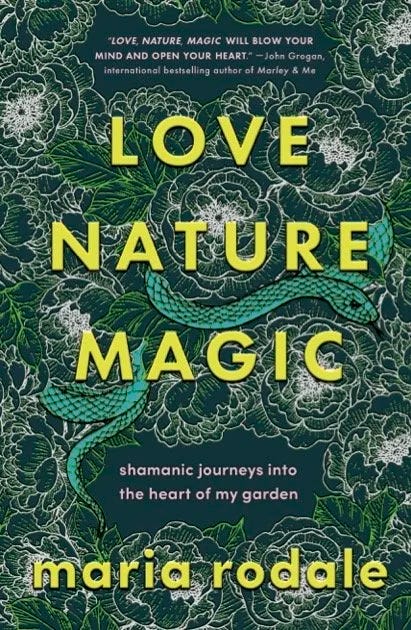
In this podcast, we get down to some cosmic business discussing Maria’s newest book, Love, Nature, Magic, and delving into her personal practice of drum-based shamanistic journeying—a meditative, imaginative way of communicating with the natural world. No drugs. No dogma. Just a drum, an intention, and a willingness to listen.
Yeah, this episode gets a little woo-woo.But I like woo. And if I think there’s something to learn from it, I like sharing other people’s woo.
What I loved most about our conversation is how Maria never preaches. She isn’t asking anyone to believe what she believes. In fact, she probably doesn’t even care if you are curious about her drumming journeys. Instead, what comes across in our conversation—and in her book—is an invitation to reconsider how we relate to the living world.
Not only the cute plants and animals.Not just the life-giving soil.But even the “pests” and “weeds” we're so quick to wage war against in our gardens.
From there, we move seamlessly into the grounded realities she knows so well:
* What “organic” really means, and why it still matters
* Why farmers often feel trapped in industrial systems they didn’t design
* And why reconnecting kids with nature and food may be the most important work of all
A theme that keeps resurfacing is healing—not just of land and ecosystems, but of fear, disconnection, and the stories we tell ourselves about control. Maria makes a compelling case that when we stop treating nature as something to dominate, we become better collaborators. both with the planet and with one another.
This is a conversation that moves between science, policy, culture, and mystery—and somehow makes all of it feel practical, human, and hopeful.
Step outside if you can for this one. Maybe start imagining what you might plant in your garden this spring.
And if you’re feeling adventurous, find a drum, a coffee can to bang on, or an app on your phone. It’s time to expand our palates and our minds, one beat at a time.