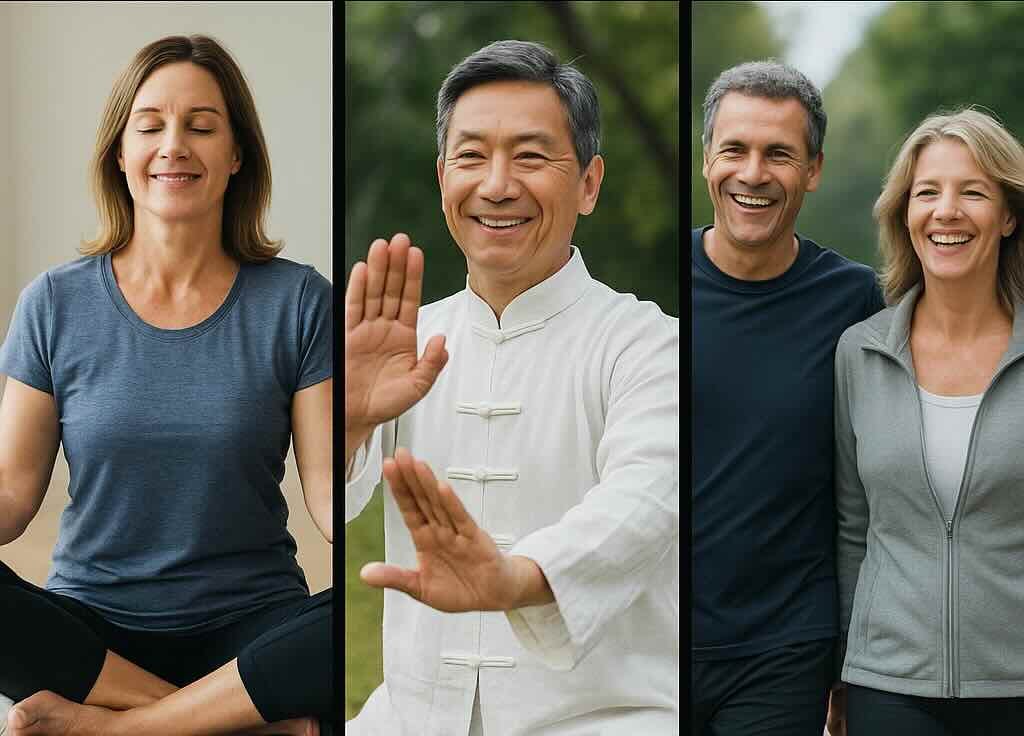
If you’ve ever spent the night staring at your ceiling, mentally rewriting your grocery list, or contemplating life’s deepest questions (“Why did I say that in 2009?”), you’re not alone. Insomnia is a frustrating, exhausting, and surprisingly common problem—one that can affect your health, mood, and productivity.
The good news? You might not need to reach for another sleeping pill or expensive therapy session. A 2025 systematic review and meta-analysis by Bu et al. [1] found that certain types of exercise can be just as effective—if not more—at helping you catch those elusive Z’s. Check out the 20min podcast above or the summary text below.
So, grab your yoga mat or walking shoes, and let’s explore how moving your body can finally help you rest your mind.
* 💤 Why Exercise Helps You Sleep
Traditional treatments like sleeping pills and Cognitive Behavioral Therapy for Insomnia (CBT-I) work, but they’re not always accessible or side-effect free. Exercise, on the other hand, is low-cost, available anywhere, and (bonus!) also good for your heart, mood, and waistline.
Here’s the science-y bit, made simple:
* Yoga helps calm your brain by boosting GABA (a chill-out neurotransmitter) and quieting that overactive amygdala.
* Tai Chi turns down your stress response, supports your body’s natural rhythms, and even encourages long-term improvements.
* Walking or Jogging burns off excess energy, lowers cortisol (your stress hormone), and encourages deeper, melatonin-driven sleep.
Think of exercise as the “sleep reset button” your body has been waiting for.
🥇 The Gold Medal Sleep Exercises
Bu et al.’s meta-analysis compared 13 different interventions across 22 clinical trials. Three workouts stood out as sleep superstars:
* Yoga 🧘♀️
* Can add nearly 2 extra hours to your total sleep time.
* Improves sleep efficiency (less time tossing and turning).
* Best for people who want to extend sleep and feel more rested.
* Tai Chi 🥋
* Gently increases total sleep time and reduces night wakings.
* Provides long-term benefits—think months, even years of better sleep.
* Great if you want something low-impact and sustainable.
* Walking or Jogging 👟
* Dramatically reduces insomnia severity scores.
* Best for those struggling with daytime fatigue and poor focus.
* Perfect if you prefer a straightforward “get up and move” approach.
Other exercise types—like mixed aerobic workouts or strength + cardio combos—also helped, but the Big Three stole the spotlight.
✅ How to Put This Into Practice
Here’s your practical, no-excuses guide to sleeping better through exercise:
* Pick Your Movement
* Love calm, mindful exercise? Try 30 minutes of yoga before dinner.
* Prefer something meditative but low-impact? Opt for 20–30 minutes of Tai Chi, 3–5 times per week.
* Want to sweat a bit? Go for a brisk 30–40 minute walk or light jog most days.
* Timing Is Everything
* Exercise at least 2–3 hours before bedtime to allow your body to cool down.
* Gentle yoga or Tai Chi can be done later since they’re relaxing rather than stimulating.
* Stay Consistent
* Benefits appear after a few weeks and can last months if you stick to it.
* Think of this as a long-term sleep investment—your future well-rested self will thank you.
* Mix and Match
* Rotate between walking and yoga or Tai Chi to keep things interesting.
* If motivation is tough, consider a class or a walking buddy (bonus: social connection also helps sleep).
🏁 The Takeaway
The research is clear: exercise is a powerful, accessible, and side-effect-free solution for insomnia. Yoga helps you stay asleep, Tai Chi helps you stay consistent, and walking or jogging helps you stop feeling like a zombie.
Tru our BreathNowapp which includes video free guides with Yoga, Walking and Qigong (similar to Tai Chi technique) exercises which help to relax, lower blood pressure and pulse and also improve sleep quality. It includes other useful tools like relaxation music, ASMR sounds and sleep stories.
So next time you’re tempted to doom-scroll at 2 a.m., consider this instead: move your body today, and your future self might just sleep like a baby—minus the 3 a.m. crying.
REFERENCE: