Voice-over provided by Eleven Labs or Amazon Polly
Foreword by Gio Marron
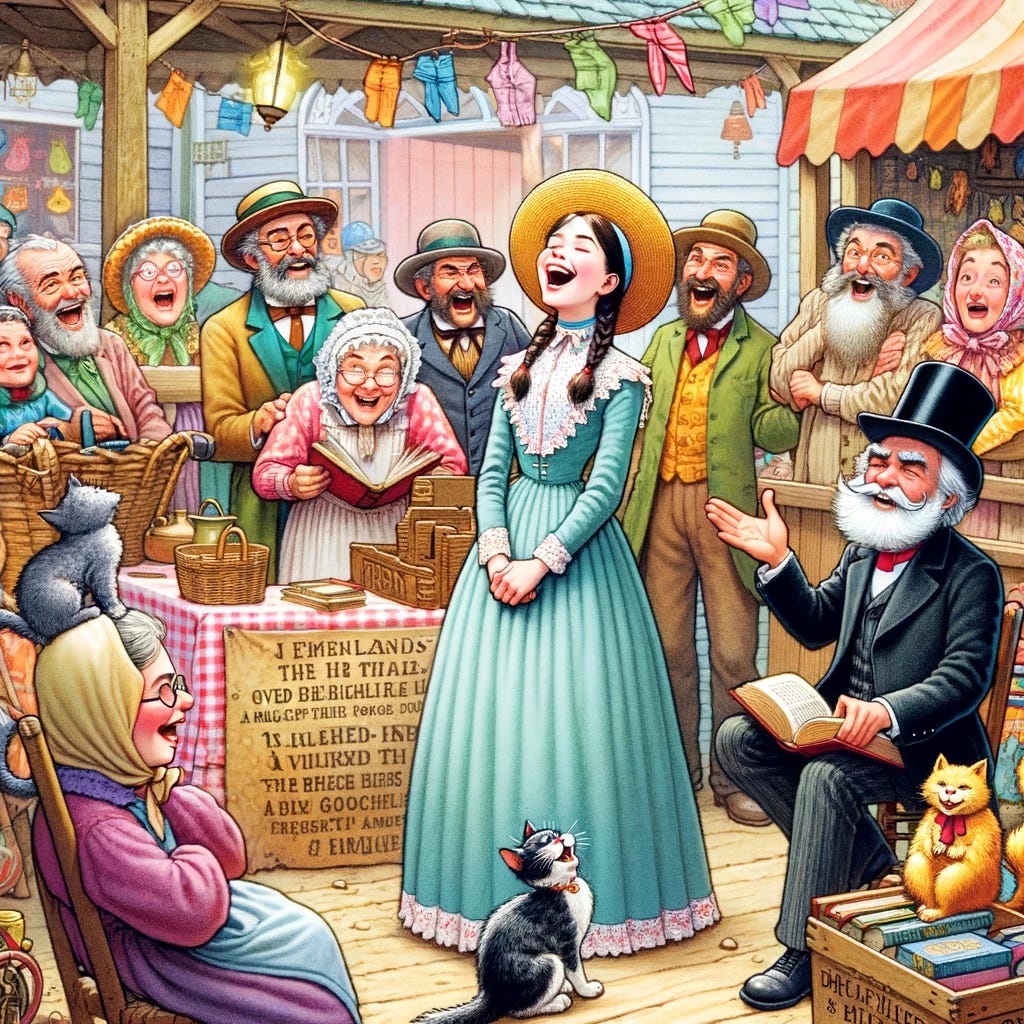
In the quaint and charming world of May McHenry's "Melinda's Humorous Story," readers are invited to explore the layered intricacies of humor and the unintended consequences that can arise from a simple misinterpretation. This delightful concoction of satire and irony plays with the expectations and assumptions of both its characters and its audience, showcasing McHenry's keen observational prowess and her ability to weave complexity into seemingly straightforward narratives.
At the heart of this tale is Melinda, a character who embodies the frustrations and aspirations of anyone who has ever sought to transcend the mundanity of daily life through creative expression. Melinda's journey begins in the depths of despair, a place where her literary ambitions meet the harsh reality of rejection and personal disappointment. In a moment of inspired rebellion against her melancholy, she writes a humorous story, aiming to capture the absurdity of her surroundings and the people within them.
What follows is a masterclass in the mechanics of humor and the often blurry line between satire and sincerity. As Melinda's story—meant to mock and amuse—unexpectedly garners acclaim for its heartfelt and sympathetic portrayal of village life, McHenry invites us to ponder the nature of artistic intent and reception. The editor and her community's misreading of Melinda's work speaks volumes about the power of perspective in shaping our understanding of art.
This foreword serves as your gateway into a narrative that is as much about the small triumphs and pitfalls of village life as it is about the broader theme of how we find and assign value to the creative works we encounter. "Melinda's Humorous Story" is not just a tale of a misunderstood literary endeavor; it is a reflection on the joys, pains, and absurdities of life itself, captured through the prism of McHenry's subtle yet sharp wit.
As you turn the pages [or scroll down the screen], prepare to laugh, reflect, and perhaps even see a bit of yourself in the characters and their misadventures. Welcome to a story that celebrates the complexities of life and the unexpected paths that creativity can lead us down.
Gio Marron
MELINDA'S HUMOROUS STORY
Melinda was dejected. She told herself that she was groping in the vale of despair, that life was a vast, gray, echoing void. She decided that ambition was dead—a case of starvation; that friendship had slipped through too eagerly grasping fingers; that love—ah, love!—
"You'd better take a dose of blue-mass," her aunt suggested when she had sighed seven times dolefully at the tea table.
"Not blue-mass. Any other kind of mass you please, but not blue," Melinda shuddered absently.
No; she was not physically ill; the trouble was deeper—soul sickness, acute, threatening to become chronic, that defied allopathic doses of favorite and other philosophers, that would not yield even to hourly repetition of the formula handed down from her grandmother—"If you can not have what you want, try to want what you have." Yet she could lay her finger on no bleeding heart-wound, on no definite cause. It was true that the deeply analytical, painstakingly interesting historical novel on which she had worked all winter had been sent back from the publishers with a briefly polite note of thanks and regrets; but as she had never expected anything else, that could not depress her. Also, the slump in G.C. Copper stock had forced her to give up her long-planned southern trip and even to forego the consolatory purchase of a spring gown; but she had a mind that could soar above flesh-pot disappointments. Then, the Reverend John Graham;—but what John Graham did or said was nothing—absolutely nothing, to her.
So Melinda clenched her hands and moaned in the same key with the east wind and told the four walls of her room that she could not endure it; she must do something. Then it was, that in a flash of inspiration, it came to her—she would write a humorous story.
The artistic fitness of the idea pleased her. She had always understood that humorists were marked by a deep-dyed melancholy, that the height of unhappiness was a vantage-ground from which to view the joke of existence. She would test the dictum; now, if ever, she would write humorously. The material was at hand, seething and crowding in her mind, in fact—the monumental dullness and complacent narrowness of the villagers, the egoism, the conceit, the bland shepherd-of-his-flock pomposity of John Graham. What more could a humorist desire? Yes; she would write.
Thoughts came quick and fast; words flowed in a fiery stream like lava that glows and rushes and curls and leaps down the mountain, sweeping all obstacles aside. (The figure did not wholly please Melinda, for everybody knows how dull and gray and uninteresting lava is when it cools, but she had no time to bother with another.) She felt the exultation, the joy and uplifting of spirit that is the reward—usually, alas, the sole reward—of the writer in the work of creation.
Then before the lava had time to cool she sent the story to the first magazine on her list with a name beginning with "A." It was her custom to send them that way, though sometimes with a desire to be impartial she commenced at "Z" and went up the list.
At the end of two weeks the wind had ceased blowing from the east. Melinda decided that though life for her must be gray, echoing, void, yet would she make an effort for the joy of others. She would lift herself above the depression that enfolded her even as the buoyant hyacinths were cleaving their dark husks and lifting up the beauty and fragrance of their hearts to solace passers-by. Therefore she ceased parting her hair in the middle and ordered a simple little frock from D——'s—hyacinth blue voile with a lining that should whisper and rustle like the glad winds whisking away last year's leaves.
Then the day came when she strolled carelessly and unexpectantly down the village street to the post-office and there received a letter that bore on the upper left-hand corner of the envelope the name of the magazine first on her list beginning with "A." A chill passed along Melinda's spine. That humorous story—Could this mean?—It was too horrible to contemplate.
She took a short cut through the orchard and as she walked she tore off a corner and peeped into the envelope. Yes, there was a pale-blue slip of paper with serrated edges. She leaned against a Baldwin apple-tree to think.
How true it is that one should be prepared for the unexpected. Melinda had sent out many manuscripts freighted with tingling hopes and eager aspirations and with the postage stamps that insured their prompt return; how was she to know, by what process of reasoning could she infer that this, that had been offered simply from force of habit, would be retained in exchange for an æsthetically tinted check? She anathematized the magazine editor. (That seems the proper thing to do with editors.) She wanted to know what business he had to keep that story after having led her to believe that it was his unbreakable custom to send them back. It was deception, she told the swelling Baldwin buds, base, deep-dyed, subtle deception. After baiting her on with his little, pink, printed rejection slips, he suddenly sprung a wicked trap.
It was some time before Melinda grew calm enough to read the editorial letter. It ran:
"Dear Madam—We are glad to have your tender and delicately sympathetic picture of village life. There is a note of true sentiment and a generous appreciation of homely virtue marking this story for which we desire to add an especial word of praise. Check enclosed.
"Very truly yours,"The Editor of A——."
Melinda sank limply on the bleached, last year's grass at the foot of the tree. "Tender and delicately sympathetic picture"—"Generous appreciation!" She laughed feebly. The editor was pleased to be facetious. Having a fine se…