Voice-over provided by Eleven Labs
Forward By Gio Marron
In the world of Gothic literature, where shadows whisper and the palpable interplay of dread and beauty ensconces the reader, stands "The Fall of the House of Usher" by Edgar Allan Poe. This masterpiece, more than a mere story, is a journey into the depths of the human psyche, exploring the fragile line between sanity and madness, life and death, and the crushing weight of ancestral legacies.
Edgar Allan Poe, a connoisseur of the macabre and the father of the modern detective story, crafts in this narrative a symphony of terror and melancholy, resonating through the ages. The story's setting, a decaying mansion, mirrors the degenerating minds of its inhabitants, the Usher family. Poe's atmospheric genius is not just in creating a mood but in sustaining it, enveloping the reader in a shroud of unease that tightens with each turn of the page.
As a literary craftsman, I am drawn to the way Poe wields language with the precision of a surgeon and a poet's flair. He conjures vivid yet ethereal images, creating a dreamscape where the boundaries between the real and the surreal blur. This tale is not just read; it is experienced. It crawls under your skin, inviting you to ponder the dark corners of your own soul.
"The Fall of the House of Usher" is a tale of isolation, fear, and the profound human connection to place and family. The Usher family, with its complex, almost incestuous bonds, is a study of the power and pitfalls of lineage and legacy. Their ancestral home, a character in its own right, is a testament to the inescapable grip of family history and the burden of carrying on a name that is both a privilege and a curse.
As readers, we navigate the labyrinthine corridors of the Usher mansion alongside the narrator, an outsider drawn into a world of psychological disintegration and eerie phenomena. This narrative perspective is a stroke of genius, allowing us to share his skepticism and eventual horror, making the journey all the more intimate and terrifying.
Poe's exploration of themes such as madness, decay, and the supernatural transcends the story, probing the human condition and our universal fears. In "The Fall of the House of Usher," we are reminded of the fragility of the human mind, the fleeting nature of life, and the inevitability of death.
The story stays with you, haunting your thoughts long after the final page is turned. For new readers, prepare to be enthralled by Poe's timeless narrative. For those returning to its pages, discover anew the dark beauty and enduring mystery of "The Fall of the House of Usher."
~Gio Marron
Son cœur est un luth suspendu;Sitôt qu’on le touche il résonne.
De Béranger.
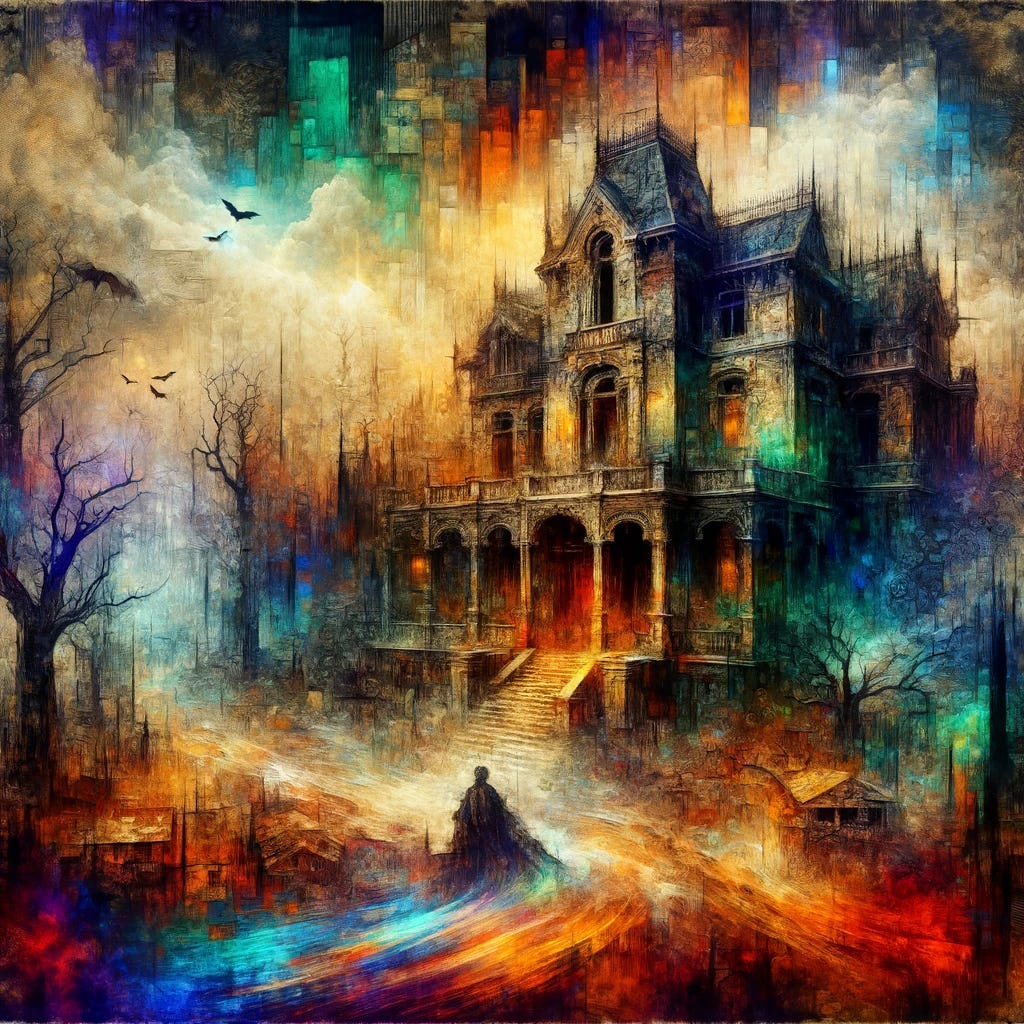
DURING the whole of a dull, dark, and soundless day in the autumn of the year, when the clouds hung oppressively low in the heavens, I had been passing alone, on horseback, through a singularly dreary tract of country, and at length found myself, as the shades of the evening drew on, within view of the melancholy House of Usher. I know not how it was—but, with the first glimpse of the building, a sense of insufferable gloom pervaded my spirit. I say insufferable; for the feeling was unrelieved by any of that half-pleasurable, because poetic, sentiment, with which the mind usually receives even the sternest natural images of the desolate or terrible. I looked upon the scene before me—upon the mere house, and the simple landscape features of the domain—upon the bleak walls—upon the vacant eye-like windows—upon a few rank sedges—and upon a few white trunks of decayed trees—with an utter depression of soul which I can compare to no earthly sensation more properly than to the after-dream of the reveller upon opium—the bitter lapse into every-day life—the hideous dropping off of the veil. There was an iciness, a sinking, a sickening of the heart—an unredeemed dreariness of thought which no goading of the imagination could torture into aught of the sublime. What was it—I paused to think—what was it that so unnerved me in the contemplation of the House of Usher? It was a mystery all insoluble; nor could I grapple with the shadowy fancies that crowded upon me as I pondered. I was forced to fall back upon the unsatisfactory conclusion, that while, beyond doubt, there are combinations of very simple natural objects which have the power of thus affecting us, still the analysis of this power lies among considerations beyond our depth. It was possible, I reflected, that a mere different arrangement of the particulars of the scene, of the details of the picture, would be sufficient to modify, or perhaps to annihilate its capacity for sorrowful impression; and, acting upon this idea, I reined my horse to the precipitous brink of a black and lurid tarn that lay in unruffled lustre by the dwelling, and gazed down—but with a shudder even more thrilling than before—upon the remodelled and inverted images of the gray sedge, and the ghastly tree-stems, and the vacant and eye-like windows.
Nevertheless, in this mansion of gloom I now proposed to myself a sojourn of some weeks. Its proprietor, Roderick Usher, had been one of my boon companions in boyhood; but many years had elapsed since our last meeting. A letter, however, had lately reached me in a distant part of the country—a letter from him—which, in its wildly importunate nature, had admitted of no other than a personal reply. The MS. gave evidence of nervous agitation. The writer spoke of acute bodily illness—of a mental disorder which oppressed him—and of an earnest desire to see me, as his best and indeed his only personal friend, with a view of attempting, by the cheerfulness of my society, some alleviation of his malady. It was the manner in which all this, and much more, was said—it was the apparent heart that went with his request—which allowed me no room for hesitation; and I accordingly obeyed forthwith what I still considered a very singular summons.
Although, as boys, we had been even intimate associates, yet I really knew little of my friend. His reserve had been always excessive and habitual. I was aware, however, that his very ancient family had been noted, time out of mind, for a peculiar sensibility of temperament, displaying itself, through long ages, in many works of exalted art, and manifested, of late, in repeated deeds of munificent yet unobtrusive charity, as well as in a passionate devotion to the intricacies, perhaps even more than to the orthodox and easily recognizable beauties, of musical science. I had learned, too, the very remarkable fact, that the stem of the Usher race, all time-honored as it was, had put forth, at no period, any enduring branch; in other words, that the entire family lay in the direct line of descent, and had always, with very trifling and very temporary variation, so lain. It was this deficiency, I considered, while running over in thought the perfect keeping of the character of the premises with the accredited character of the people, and while speculating upon the possible influence which the one, in the long lapse of centuries, might have exercised upon the other—it was this deficiency, perhaps, of collateral issue, and the consequent undeviating transmission, from sire to son, of the patrimony with the name, which had, at length, so identified the two as to merge the original title of the estate in the quaint and equivocal appellation of the "House of Usher"—an appellation which seemed to include, in the minds of the peasantry who used it, both the family and the family mansion.
I have said that the sole effect of my somewhat childish experiment—that of looking down within the tarn—had been to deepen the first singular impression. There can be no doubt that the consciousness of the rapid increase of my superstition—for why should I not so term it?—served mainly to accelerate the increase itself. Such, I have long known, is the paradoxical law of all sentiments having terror as a ba…