Voice-over provided by Eleven Labs
Continued from The Great Valdez Sapphire - Part 1
Part 2:
I was alone in the house one afternoon sitting by my window, toying with the key of my safe, and wondering whether I dare treat myself to a peep at my treasures, when a suspicious movement in the park below caught my attention. A black figure certainly dodged from behind one tree to the next, and then into the shadow of the park paling instead of keeping to the footpath. It looked queer. I caught up my field glass and marked him at one point where he was bound to come into the open for a few steps. He crossed the strip of turf with giant strides and got into cover again, but not quick enough to prevent me recognizing him. It was—great heavens!—the bishop! In a soft hat pulled over his forehead, with a long cloak and a big stick, he looked like a poacher.
Guided by some mysterious instinct I hurried to meet him. I opened the conservatory door, and in he rushed like a hunted rabbit. Without explanation I led him up the wide staircase to my room, where he dropped into a chair and wiped his face.
"You are astonished, Mr. Acton," he panted. "I will explain directly. Thanks." He tossed off the glass of brandy I had poured out without waiting for the qualifying soda, and looked better.
"I am in serious trouble. You can help me. I've had a shock to-day—a grievous shock." He stopped and tried to pull himself together. "I must trust you implicitly, Mr. Acton, I have no choice. Tell me what you think of this." He drew a case from his breast pocket and opened it. "I promised you should see the Valdez sapphire. Look there!"
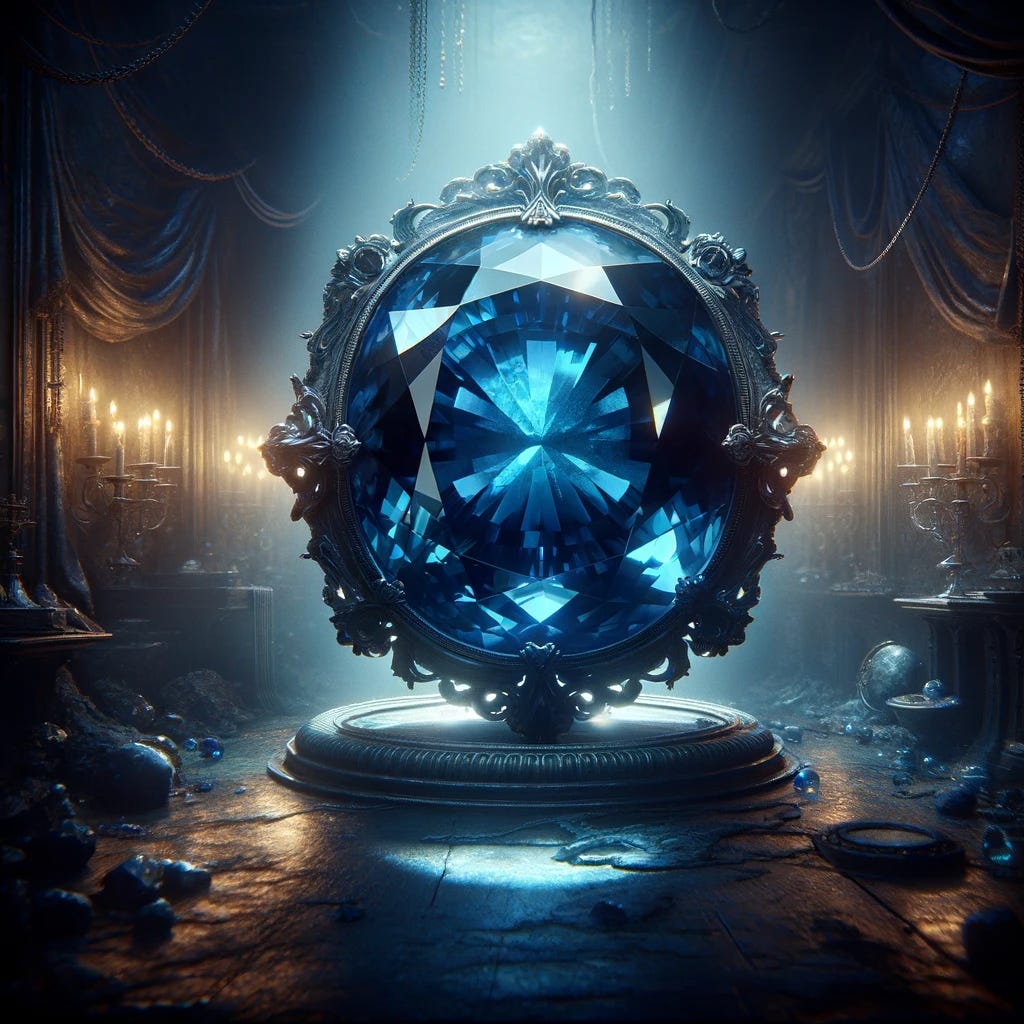
The Valdez sapphire! A great big shining lump of blue crystal—flawless and of perfect color—that was all. I took it up, breathed on it, drew out my magnifier, looked at it in one light and another. What was wrong with it? I could not say. Nine experts out of ten would undoubtedly have pronounced the stone genuine. I, by virtue of some mysterious instinct that has hitherto always guided me aright, was the unlucky tenth. I looked at the bishop. His eyes met mine. There was no need of spoken word between us.
"Has Lady Carwitchet shown you her sapphire?" was his most unexpected question. "She has? Now, Mr. Acton, on your honor as a connoisseur and a gentleman, which of the two is the Valdez?"
"Not this one." I could say naught else.
"You were my last hope." He broke off, and dropped his face on his folded arms with a groan that shook the table on which he rested, while I stood dismayed at myself for having let so hasty a judgment escape me. He lifted a ghastly countenance to me. "She vowed she would see me ruined and disgraced. I made her my enemy by crossing some of her schemes once, and she never forgives. She will keep her word. I shall appear before the world as a fraudulent trustee. I can neither produce the valuable confided to my charge nor make the loss good. I have only an incredible story to tell," he dropped his head and groaned again. "Who will believe me?"
"I will, for one."
"Ah, you? Yes, you know her. She took my wife from me, Mr. Acton. Heaven only knows what the hold was that she had over poor Mira. She encouraged her to set me at defiance and eventually to leave me. She was answerable for all the scandalous folly and extravagance of poor Mira's life in Paris—spare me the telling of the story. She left her at last to die alone and uncared for. I reached my wife to find her dying of a fever from which Lady Carwitchet and her crew had fled. She was raving in delirium, and died without recognizing me. Some trouble she had been in which I must never know oppressed her. At the very last she roused from a long stupor and spoke to the nurse. 'Tell him to get the sapphire back—she stole it. She has robbed my child.' Those were her last words. The nurse understood no English, and treated them as wandering; but I heard them, and knew she was sane when she spoke."
"What did you do?"
"What could I? I saw Lady Carwitchet, who laughed at me, and defied me to make her confess or disgorge. I took the pendant to more than one eminent jeweler on pretense of having the setting seen to, and all have examined and admired without giving a hint of there being anything wrong. I allowed a celebrated mineralogist to see it; he gave no sign—"
"Perhaps they are right and we are wrong."
"No, no. Listen. I heard of an old Dutchman celebrated for his imitations. I went to him, and he told me at once that he had been allowed by Montanaro to copy the Valdez—setting and all—for the Paris Exhibition. I showed him this, and he claimed it for his own work at once, and pointed out his private mark upon it. You must take your magnifier to find it; a Greek Beta. He also told me that he had sold it to Lady Carwitchet more than a year ago."
"It is a terrible position."
"It is. My co-trustee died lately. I have never dared to have another appointed. I am bound to hand over the sapphire to my daughter on her marriage, if her husband consents to take the name of Montanaro."
The bishop's face was ghastly pale, and the moisture started on his brow. I racked my brain for some word of comfort.
"Miss Panton may never marry."
"But she will!" he shouted. "That is the blow that has been dealt me to-day. My chaplain—actually, my chaplain—tells me that he is going out as a temperance missionary to equatorial Africa, and has the assurance to add that he believes my daughter is not indisposed to accompany him!" His consummating wrath acted as a momentary stimulant. He sat upright, his eyes flashing and his brow thunderous. I felt for that chaplain. Then he collapsed miserably. "The sapphires will have to be produced, identified, revalued. How shall I come out of it? Think of the disgrace, the ripping up of old scandals! Even if I were to compound with Lady Carwitchet, the sum she hinted at was too monstrous. She wants more than my money. Help me, Mr. Acton! For the sake of your own family interests, help me!"
"I beg your pardon—family interests? I don't understand."
"If my daughter is childless, her next of kin is poor Marmaduke Panton, who is dying at Cannes, not married, or likely to marry; and failing him, your nephew, Sir Thomas Acton, succeeds."
My nephew Tom! Leta, or Leta's baby, might come to be the possible inheritor of the great Valdez sapphire! The blood rushed to my head as I looked at the great shining swindle before me. "What diabolic jugglery was at work when the exchange was made?" I demanded fiercely.
"It must have been on the last occasion of her wearing the sapphires in London. I ought never to have let her out of my sight."
"You must put a stop to Miss Panton's marriage in the first place," I pronounced as autocratically as he could have done himself.
"Not to be thought of," he admitted helplessly. "Mira has my force of character. She knows her rights, and she will have her jewels. I want you to take charge of the—thing for me. If it's in the house she'll make me produce it. She'll inquire at the banker's. If you have it we can gain time, if but for a day or two." He broke off. Carriage wheels were crashing on the gravel outside. We looked at one another in consternation. Flight was imperative. I hurried him downstairs and out of the conservatory just as the door bell rang. I think we both lost our heads in the confusion. He shoved the case into my hands, and I pocketed it, without a thought of the awful responsibility I was incurring, and saw him disappear into the shelter of the friendly night.
When I think of what my feelings were that evening—of my murderous hatred of that smirking, jesting Jezebel who sat opposite me at dinner, my wrathful indignation at the thought of the poor little expected heir defrauded ere his birth; of the crushing contempt I felt for myself and the bishop as a pair of witless idiots unable to see our way out of the dilemma; all this boiling and surging through my soul, I can only wonder—Domenico having given himself a holiday, and the kit…