Voice-over provided by Eleven Labs
Foreword by Gio Marron
In the dominion of mystery and intrigue, few can weave a web as intricate and compelling as Agatha Christie. "The Hunter's Lodge Case" stands as a testament to her unrivaled ability to craft narratives that ensnare and enthrall us, taking us deep into the heart of human complexity and the enigma of crime.
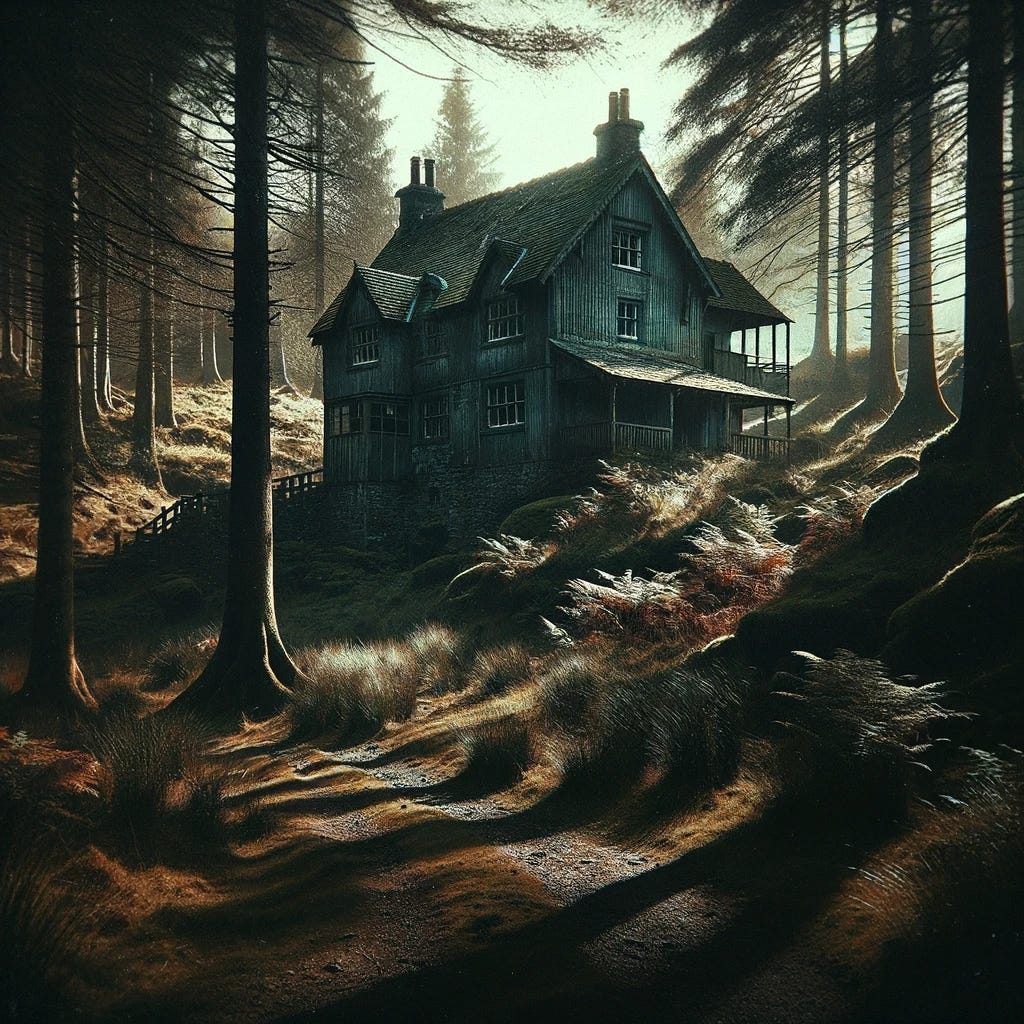
As you turn the pages of this story, you embark on a journey to a world where every detail is a clue and every character a potential key to unraveling a tangled mystery. Christie's mastery lies not just in the puzzle she presents but in the atmosphere she creates—a hunting lodge, remote and shrouded in secrecy, becomes the stage for a drama that unfolds with precision and suspense.
Hercule Poirot, Christie's famed detective, is a force of nature in criminal investigation. His methods, a blend of meticulous observation and psychological insight, are a dance of intellect and intuition. In "The Hunter's Lodge Case," Poirot exemplifies the detective's creed: beneath the chaos and shadows of a crime lies a truth, orderly and waiting to be discovered.
Christie's narrative is a journey through the labyrinth of the human psyche, where motives are veiled, and truths are obscured. It challenges us to look beyond the obvious, to question our assumptions, and to realize that often, the key to the mystery lies in understanding the complexities of human nature.
This story is not just a mystery to be solved; it is a study in storytelling, where suspense and character are woven into a tapestry that captures the essence of the whodunit genre. Christie's work has long been a beacon for those who tread the paths of mystery and suspense in our writing, reminding us that at the heart of every great story lies a fundamental truth about the human condition.
As you examine the mystery of "The Hunter's Lodge Case," prepare yourself for a journey that is as much about discovering the intricacies of the human heart as it is about uncovering the secrets of a crime. In the hands of Agatha Christie, you are in the company of a master, and the journey is as thrilling as the destination itself.
Enjoy the unraveling.
Gio Marron
The famous “little gray cells” of the great detective Poirot function admirably in solving what at first seems a particularly puzzling murder mystery.
“After all,” murmured Poirot, “it is possible that I shall not die this time.”
Coming from a convalescent influenza patient, I hailed the remark as showing a beneficial optimism. I myself had been the first sufferer from the disease. Poirot in his turn had gone down. He was now sitting up in bed, propped up with pillows.
“Yes, yes,” my little friend continued. “Once more shall I be myself again, the great Hercule Poirot, the terror of evildoers! Figure to yourself, mon ami, that I have a little paragraph to myself in Society Gossip. But yes! Here it is!
“‘Go it, criminals—all out! Hercule Poirot,—and believe me, girls, he’s some Hercules!—our own pet society detective can’t get a grip on you. ’Cause why? ’Cause he’s got la grippe himself!’”
I laughed.
“Good for you, Poirot. You are becoming quite a public character. And fortunately you haven’t missed anything of particular interest during this time.”
“That is true. The few cases I have had to decline did not fill me with any regret.”
Our landlady stuck her head in at the door.
“There’s a gentleman downstairs. Says he must see M. Poirot or you, Captain. Seeing as he was in a great to-do,—and with all that quite the gentleman,—I brought up ’is card.”
She handed me the bit of pasteboard. “‘Hon. Roger Havering,’” I read.
Poirot motioned with his head toward the bookcase, and I obediently pulled forth the “Who’s Who.” Poirot took it from me and scanned the pages rapidly.
“Second son of fifth Baron Windsor. Married 1913 Zoe, fourth daughter of William Crabb.”
“H’m,” I said. “I rather fancy that’s the girl who used to act at the Frivolity—only she called herself Zoe Carrisbrook. I remember she married some young man about town just before the war.”
“Would it interest you, Hastings, to go down and hear what our visitor’s particular trouble is? Make him all my excuses.”
Roger Havering was a man of about forty, well set up and of smart appearance.
His face, however, was haggard, and he was evidently laboring under great agitation.
“Captain Hastings? You are M. Poirot’s partner, I understand. It is imperative that he should come with me to Derbyshire today.”
“I’m afraid that’s impossible,” I replied. “Poirot is ill in bed—influenza.”
His face fell.
“Dear me, that is a great blow to me.”
“The matter on which you want to consult him is serious?”
“My God, yes! My uncle, the best friend I have in the world, was foully murdered last night.”
“Here in London?”
“No, in Derbyshire. I was in town and received a telegram from my wife this morning. Immediately upon its receipt I determined to come round and beg M. Poirot to undertake the case.”
“If you will excuse me a minute,” I said, struck by a sudden idea.
I rushed upstairs, and in few brief words acquainted Poirot with the situation. He took any further words out of my mouth.
“I see—I see. You want to go yourself, is it not so? Well, why not? You should know my methods by now. All I ask is that you should report to me fully every day, and follow implicitly any instructions I may wire you.”
To this I willingly agreed, and an hour later I was sitting opposite Mr. Havering in a first-class carriage on the Midland Railway, speeding rapidly away from London.
“To begin with, Captain Hastings, you must understand that Hunter’s Lodge, where we are going, and where the tragedy took place, is only a small shooting-box in the heart of the Derbyshire moors. Our real home is near Newmarket, and we usually rent a flat in town for the season. Hunter’s Lodge is looked after by a housekeeper who is quite capable of doing all we need when we run down for an occasional week-end. Of course, during the shooting season, we take down some of our own servants from Newmarket.
“My uncle, Mr. Harrington Pace (as you may know, my mother was a Miss Pace of New York), has for the last three years made his home with us. He never got on well with my father, or my elder brother, and I suspect that my being somewhat of a prodigal son myself rather increased than diminished his affection toward me. Of course, I am a poor man, and my uncle was a rich one—in other words, he paid the piper! But though exacting in many ways, he was not really hard to get on with, and we all three lived very harmoniously together.
“Two days ago my uncle, rather wearied with some recent gayeties of ours in town, suggested that we should run down to Derbyshire for a day or two. My wife telegraphed to Mrs. Middleton, the housekeeper, and we went down that same afternoon. Yesterday evening I was forced to return to town, but my wife and my uncle remained on. This morning I received this telegram.”
He handed it over to me, and I read:
Come at once. Uncle Harrington murdered last night. Bring good detective if you can, but do come.
Zoe.
“Then as yet you know no details?”
“No, I suppose it will be in the evening papers. Without doubt the police are in charge.”
It was about three o’clock when we arrived at the little station of Elmer’s Dale. From there a five-mile drive brought us to a small gray stone building in the midst of the rugged moors.
“A lonely place,” I observed.
Havering nodded.
“I shall try and get rid of it. I could never live here again.”
We unlatched the gate and were walking up the narrow path to the oak door when a familiar figure emerged and came to meet us.
“Japp!” I ejaculated.
The Scotland Yard Inspector grinned at me in a friendly fashion before addressing my companion.
“Mr. Havering, I think? I’ve been sent down from London to take charge of this case, and I’d like a word with you, if I may, sir.”
“My wife——”
“I’ve seen your good lady, sir—and the housekeeper. I wont keep you a moment, but I’m anxious to get back to the village now…