Voice-over provided by Amazon Polly
The Elephant Island Chronicles is a reader-supported publication. To receive new posts and support my work, consider becoming a free or paid subscriber.
Foreword
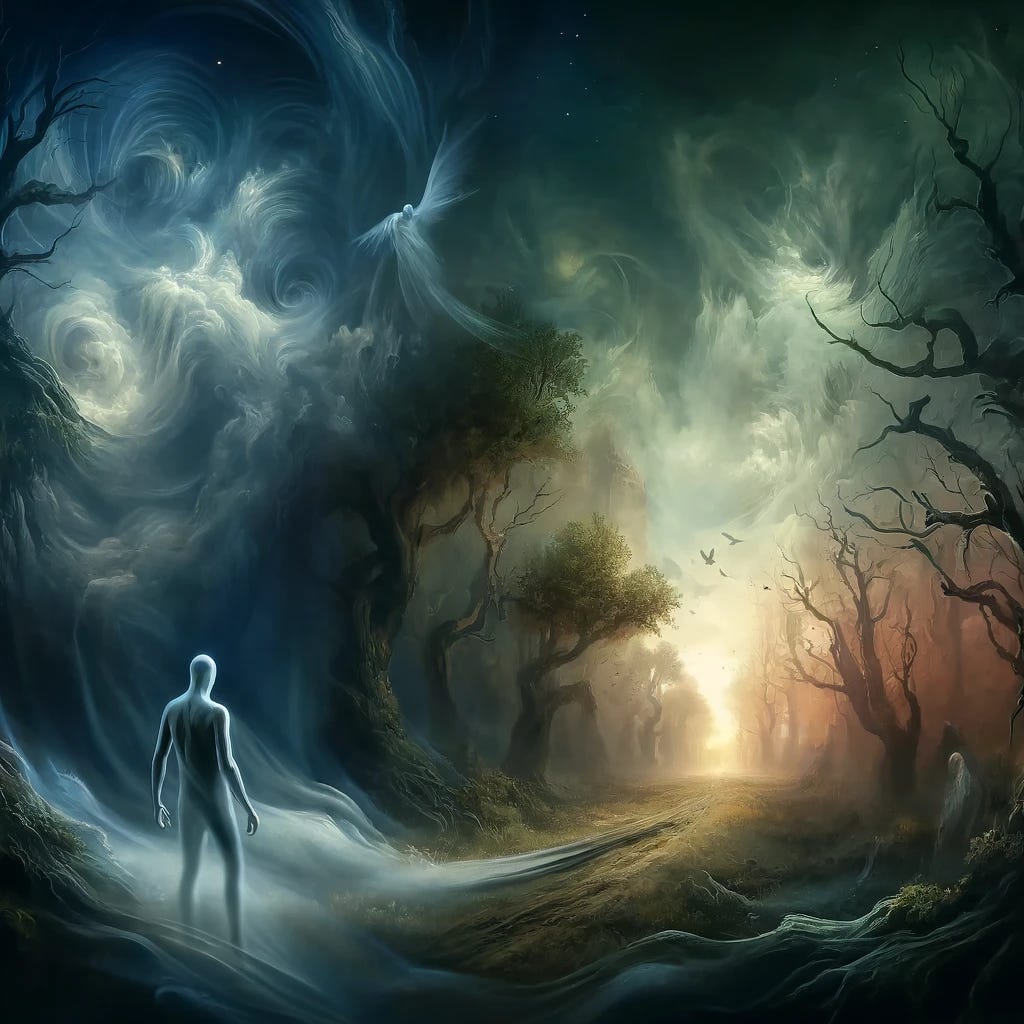
In the shadowy corners of literature, where the boundary between the real and the surreal blurs, Ambrose Bierce stands as a masterful architect of the uncanny. His tales are not merely stories but explorations into the darker recesses of the human psyche, where fear, doubt, and irony reside. "The Realm of the Unreal" is a prime example of Bierce's unique ability to intertwine reality with the fantastic, creating a narrative that is as thought-provoking as it is unsettling.
As readers, we are invited into a world that challenges our perceptions and forces us to question the very fabric of reality. Bierce’s protagonist, much like ourselves, grapples with the disconcerting notion that what we accept as real might be nothing more than an elaborate illusion. Through his journey, we are reminded of the fragility of our own perceptions and the ease with which they can be manipulated by unseen forces.
Bierce’s prose is characterized by a macabre elegance, a style that effortlessly combines the gothic with the satirical. His vivid descriptions and ironic tone create a landscape that is both eerily familiar and disturbingly foreign. In "The Realm of the Unreal," we are not merely passive observers but active participants in a philosophical inquiry that delves into the essence of existence and the nature of reality itself.
This story, like much of Bierce’s work, is a reflection of the author’s own complex views on life, reality, and human nature. Known for his sharp wit and often cynical outlook, Bierce uses his narrative to critique societal norms and human folly, all while keeping the reader on the edge of their seat. His tales are timeless, resonating with readers across generations who find themselves similarly entangled in the existential questions he so deftly poses.
As you embark on this journey into "The Realm of the Unreal," prepare to have your perceptions challenged and your reality questioned. Bierce’s world is one where nothing is as it seems, and every shadow hides a deeper truth. It is a place where the mundane and the extraordinary coexist, where irony and horror are but two sides of the same coin. In this story, you will find not just a narrative, but an invitation to explore the depths of your own mind and the mysteries that lie within.
Welcome to the unreal.
Gio Marron
The Realm Of The UnrealBy Ambrose Bierce
Chapter 1
For a part of the distance between Auburn and Newcastle the road—first on one side of a creek and then on the other—occupies the whole bottom of the ravine, being partly cut out of the steep hillside, and partly built up with bowlders removed from the creek-bed by the miners. The hills are wooded, the course of the ravine is sinuous. In a dark night careful driving is required in order not to go off into the water. The night that I have in memory was dark, the creek a torrent, swollen by a recent storm. I had driven up from Newcastle and was within about a mile of Auburn in the darkest and narrowest part of the ravine, looking intently ahead of my horse for the roadway. Suddenly I saw a man almost under the animal’s nose, and reined in with a jerk that came near setting the creature upon its haunches.
“I beg your pardon,” I said; “I did not see you, sir.”
“You could hardly be expected to see me,” the man replied, civilly, approaching the side of the vehicle; “and the noise of the creek prevented my hearing you.”
I at once recognized the voice, although five years had passed since I had heard it. I was not particularly well pleased to hear it now.
“You are Dr. Dorrimore, I think,” said I.
“Yes; and you are my good friend Mr. Manrich. I am more than glad to see you—the excess,” he added, with a light laugh, “being due to the fact that I am going your way, and naturally expect an invitation to ride with you.”
“Which I extend with all my heart.”
That was not altogether true.
Dr. Dorrimore thanked me as he seated himself beside me, and I drove cautiously forward, as before. Doubtless it is fancy, but it seems to me now that the remaining distance was made in a chill fog; that I was uncomfortably cold; that the way was longer than ever before, and the town, when we reached it, cheerless, forbidding, and desolate. It must have been early in the evening, yet I do not recollect a light in any of the houses nor a living thing in the streets. Dorrimore explained at some length how he happened to be there, and where he had been during the years that had elapsed since I had seen him. I recall the fact of the narrative, but none of the facts narrated. He had been in foreign countries and had returned—this is all that my memory retains, and this I already knew. As to myself I cannot remember that I spoke a word, though doubtless I did. Of one thing I am distinctly conscious: the man’s presence at my side was strangely distasteful and disquieting—so much so that when I at last pulled up under the lights of the Putnam House I experienced a sense of having escaped some spiritual peril of a nature peculiarly forbidding. This sense of relief was somewhat modified by the discovery that Dr. Dorrimore was living at the same hotel.
Chapter 2
In partial explanation of my feelings regarding Dr. Dorrimore I will relate briefly the circumstances under which I had met him some years before. One evening a half-dozen men of whom I was one were sitting in the library of the Bohemian Club in San Francisco. The conversation had turned to the subject of sleight-of-hand and the feats of the prestidigitateurs, one of whom was then exhibiting at a local theatre.
“These fellows are pretenders in a double sense,” said one of the party; “they can do nothing which it is worth one’s while to be made a dupe by. The humblest wayside juggler in India could mystify them to the verge of lunacy.”
“For example, how?” asked another, lighting a cigar.
“For example, by all their common and familiar performances—throwing large objects into the air which never come down; causing plants to sprout, grow visibly and blossom, in bare ground chosen by spectators; putting a man into a wicker basket, piercing him through and through with a sword while he shrieks and bleeds, and then—the basket being opened nothing is there; tossing the free end of a silken ladder into the air, mounting it and disappearing.”
“Nonsense!” I said, rather uncivilly, I fear. “You surely do not believe such things?”
“Certainly not: I have seen them too often.”
“But I do,” said a journalist of considerable local fame as a picturesque reporter. “I have so frequently related them that nothing but observation could shake my conviction. Why, gentlemen, I have my own word for it.”
Nobody laughed—all were looking at something behind me. Turning in my seat I saw a man in evening dress who had just entered the room. He was exceedingly dark, almost swarthy, with a thin face, black-bearded to the lips, an abundance of coarse black hair in some disorder, a high nose and eyes that glittered with as soulless an expression as those of a cobra. One of the group rose and introduced him as Dr. Dorrimore, of Calcutta. As each of us was presented in turn he acknowledged the fact with a profound bow in the Oriental manner, but with nothing of Oriental gravity. His smile impressed me as cynical and a trifle contemptuous. His whole demeanor I can describe only as disagreeably engaging.
His presence led the conversation into other channels. He said little—I do not recall anything of what he did say. I thought his voice singularly rich and melodious, but it affected me in the same way as his eyes and smile. In a few minutes I rose to go. He also rose and put on his overcoat.
“Mr. Manrich,” he said, “I am going your way.”
“The devil you are!” I thought. “How do you know which way I am going?” Then I said, “I shall be pleased to have your…