Gio's World is a reader-supported publication. To receive new posts and support my work, consider becoming a free or paid subscriber.
Voice-over provided by Eleven Labs
Foreword by Gio Marron
In the shadowed realms of human nature, where the flickering light of morality struggles against the encroaching darkness of greed and deception, lies the fertile ground for stories that not only captivate the imagination but also provoke introspection. "The Treasure in the Forest" by H.G. Wells is such a narrative, a timeless exploration of the darker corridors of the human heart, set against the backdrop of imperial ambition and the lush, unforgiving wilderness of a tropical island.
This story, while succinct, encapsulates the essence of humanity's perpetual conflict: the battle between the higher ideals we strive towards and the base instincts we seek to overcome. Through the characters of Evans and Hooker, Wells masterfully portrays the complexity of human motivations, where the lure of untold riches can warp friendships, honor, and even one's sense of self. It serves as a mirror, reflecting the age-old adage that the true character of a person is revealed not in moments of comfort and convenience, but in those of challenge and controversy.
The tropical island, with its dense, impenetrable forests and hidden perils, stands as a powerful symbol for the unknown territories we navigate in our personal quests for meaning and fulfillment. It is a reminder of the inherent dangers in yielding to the siren call of avarice, of allowing our moral compasses to be swayed by the illusory promise of easy rewards. The island's beauty and serenity, juxtaposed with the lethal secrets it harbors, serve as a metaphor for the dual nature of our aspirations and the consequences they entail when pursued without regard for the greater good.
In crafting this foreword, it is my intention not only to usher you, the reader, into the verdant shadows of Wells's imagination but also to encourage a deeper contemplation of the themes woven into the fabric of this narrative. "The Treasure in the Forest" is not merely a tale of adventure and suspense; it is a poignant commentary on the imperfections of human nature and the ethical dilemmas that have perplexed philosophers and laymen alike through the ages.
As you embark on this journey with Evans and Hooker, I invite you to reflect on your own values and the decisions you would make when faced with the allure of untold wealth. Would you heed the lessons etched in the lives of these characters, or would you, too, be ensnared by the treasure in the forest?
May this story be a lantern, illuminating the path to deeper understanding and empathy, reminding us of the treasure that lies not in material wealth, but in the strength of our character and the integrity of our actions.
Gio Marron
The canoe was now approaching the land. The bay opened out, and a gap in the white surf of the reef marked where the little river ran out to the sea; the thicker and deeper green of the virgin forest showed its course down the distant hill slope. The forest here came close to the beach. Far beyond, dim and almost cloudlike in texture, rose the mountains, like suddenly frozen waves. The sea was still save for an almost imperceptible swell. The sky blazed.
The man with the carved paddle stopped. “It should be somewhere here,” he said. He shipped the paddle and held his arms out straight before him.
The other man had been in the fore part of the canoe, closely scrutinising the land. He had a sheet of yellow paper on his knee.
“Come and look at this, Evans,” he said.
Both men spoke in low tones, and their lips were hard and dry.
The man called Evans came swaying along the canoe until he could look over his companion’s shoulder.
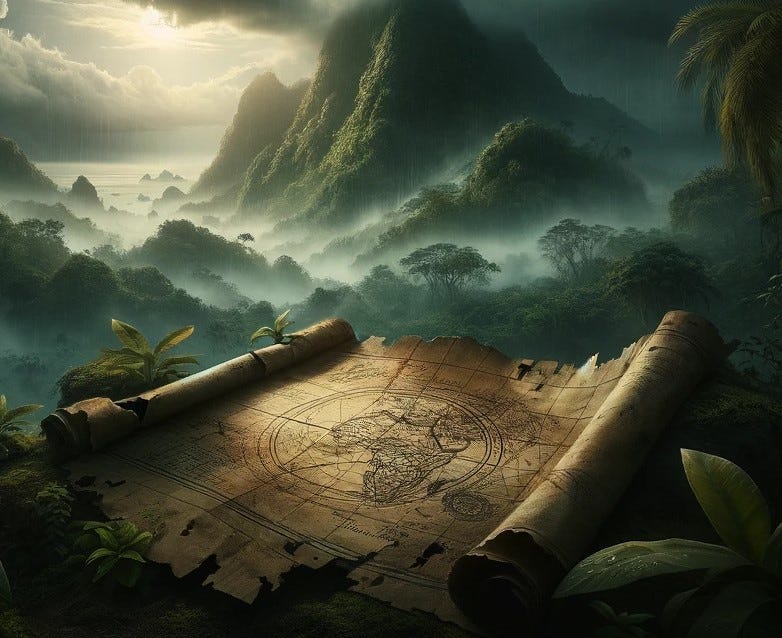
The paper had the appearance of a rough map. By much folding it was creased and worn to the pitch of separation, and the second man held the discoloured fragments together where they had parted. On it one could dimly make out, in almost obliterated pencil, the outline of the bay.
“Here,” said Evans, “is the reef and here is the gap.” He ran his thumb-nail over the chart.
“This curved and twisting line is the river—I could do with a drink now!—and this star is the place.”
“You see this dotted line,” said the man with the map; “it is a straight line, and runs from the opening of the reef to a clump of palm-trees. The star comes just where it cuts the river. We must mark the place as we go into the lagoon.”
“It’s queer,” said Evans, after a pause, “what these little marks down here are for. It looks like the plan of a house or something; but what all these little dashes, pointing this way and that, may mean I can’t get a notion. And what’s the writing?”
“Chinese,” said the man with the map.
“Of course! He was a Chinee,” said Evans.
“They all were,” said the man with the map.
They both sat for some minutes staring at the land, while the canoe drifted slowly. Then Evans looked towards the paddle.
“Your turn with the paddle now, Hooker,” said he.
And his companion quietly folded up his map, put it in his pocket, passed Evans carefully, and began to paddle. His movements were languid, like those of a man whose strength was nearly exhausted. Evans sat with his eyes half closed, watching the frothy breakwater of the coral creep nearer and nearer. The sky was like a furnace now, for the sun was near the zenith. Though they were so near the Treasure he did not feel the exaltation he had anticipated. The intense excitement of the struggle for the plan, and the long night voyage from the mainland in the unprovisioned canoe had, to use his own expression, “taken it out of him.” He tried to arouse himself by directing his mind to the ingots the Chinamen had spoken of, but it would not rest there; it came back headlong to the thought of sweet water rippling in the river, and to the almost unendurable dryness of his lips and throat. The rhythmic wash of the sea upon the reef was becoming audible now, and it had a pleasant sound in his ears; the water washed along the side of the canoe, and the paddle dripped between each stroke. Presently he began to doze.
He was still dimly conscious of the island, but a queer dream texture interwove with his sensations. Once again it was the night when he and Hooker had hit upon the Chinamen’s secret; he saw the moonlit trees, the little fire burning, and the black figures of the three Chinamen—silvered on one side by moonlight, and on the other glowing from the firelight—and heard them talking together in pigeon-English—for they came from different provinces. Hooker had caught the drift of their talk first, and had motioned to him to listen. Fragments of the conversation were inaudible and fragments incomprehensible. A Spanish galleon from the Philippines hopelessly aground, and its treasure buried against the day of return, lay in the background of the story; a shipwrecked crew thinned by disease, a quarrel or so, and the needs of discipline, and at last taking to their boats never to be heard of again. Then Chang-hi, only a year since, wandering ashore, had happened upon the ingots hidden for two hundred years, had deserted his junk, and reburied them with infinite toil, single-handed but very safe. He laid great stress on the safety—it was a secret of his. Now he wanted help to return and exhume them. Presently the little map fluttered and the voices sank. A fine story for two stranded British wastrels to hear! Evans’ dream shifted to the moment when he had Chang-hi’s pigtail in his hand. The life of a Chinaman is scarcely sacred like a European’s. The cunning little face of Chang-hi, first keen and furious like a startled snake, and then fearful, treacherous and pitiful, became overwhelmingly prominent in the dream. At the end Chang-hi had grinned, a most incomprehensible and startling grin. Abruptly things became very unpleasant, as they will do at times in dreams. Chang-hi gibbered and threatened him. He saw …