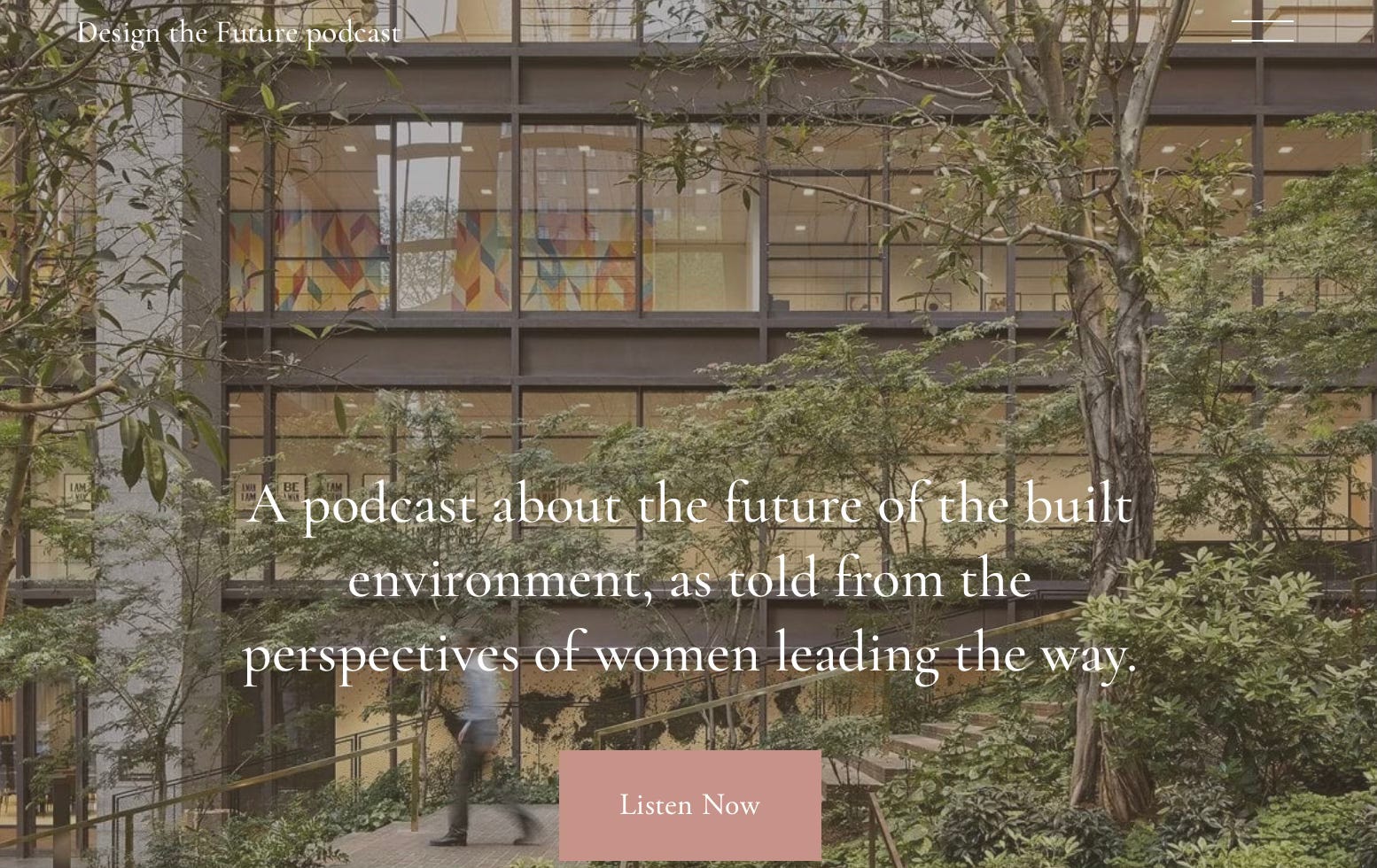
When Lindsay Baker (the head of the International Living Future Institute) and I sat down for this Substack LIVE, we thought we were going to discuss diagnostic frameworks and social movement theory. Instead, a different conversation emerged — one that struck a nerve in both of us and, judging by the chat, many listening live.
This post captures the arc of that conversation, but not the whole of it. Some things are best experienced “in the room.” This exchange cracked open a necessary conversation about why, despite progress and progress stories, we have not yet delivered the systemic shifts that matter most: equitable health outcomes, meaningful declines in building-sector emissions, and codes that lift the baseline for everyone — not just the privileged few. And, importantly, what all changemakers can learn from this — whatever their cause.
To get the full story (and the friction), I strongly recommend listening to the recording on Substack, Spotify or Apple.
Thank you, Michelle Malanca Frey, Alexie Seller, Christina GB, Greg Anson, Jay Sholl, and all others who tuned in live!
If this conversation resonates, please follow, like, share, and engage — it genuinely helps other changemakers discover this global community committed to perfecting our craft.
Where movements begin — and where ours got lost
Lindsay shared her inflection point from 2019, when she was invited into a circle of women recognized as leaders in the climate movement. She realized she didn’t know them — and they didn’t know her.
That moment opened up a question that became the spine of our discussion:
If the global green building community truly were a movement, wouldn’t we know our movement peers?
What followed was a surprising, and at times uncomfortable, unpacking of how the green building sector formed — and why it (mis)behaves the way it does today.
I go deeper into these dynamics in my essays on movement-building and diagnostics, but what came up between us was more personal, more candid, and — unexpectedly — more divergent.
I’ll leave that discovery for the audio.
The pattern we both see: strong nurturing, muddled aims, weak recalibration
In my PhD research — and in the work I’ve published on movement building — effective movements do three interconnected jobs:
* Catalyzing:Naming the problem, defining the possibility, and aligning around a shared aim. This is the work of clarity — turning scattered concern into coherent mobilization and giving people a future they can actually move toward together.
* Nurturing:Building the relationships, trust, and cultural fabric that hold people in the work. This is where belonging forms, norms take root, and the movement develops the emotional resilience to withstand pressure, backlash, and ambiguity.
* Recalibrating:Shifting the baseline conditions — laws, policies, norms, systems — so that the change no longer depends on exceptional people making exceptional choices. This is the work of embedding the new reality into the structure of everyday life.
Lindsay and I both noted how deeply the green building community excels at nurturing. If you’ve been part of this world, you know exactly what I mean: the unabashed hugs, the loyalty, the decades-long friendships.
But when it comes to coalescing around a single aim and recalibrating systems, we’ve been far less aligned.
What Lindsay said here — especially about why this alignment never happened and what derailed it early on — is something I’m not going to summarize.
It’s worth hearing in her voice.
What happens when opportunity hits and a movement isn’t ready
Across successful social movements — civil rights, disability rights, universal suffrage — readiness comes long before the window opens. By the time opportunity arrives, there’s alignment, language, and strategy on the shelf; waiting.
We explored what readiness would has — and has not — looked like across the global green building.
And just as we started to agree, something shifted.
There’s a moment in the conversation where Lindsay pushes my framing in a direction that surprised me — and changed the way I now think about the last 20 years of “green building progress.”
I’m intentionally leaving that moment in the audio for you.
The U.S. challenge — and why Australia offers a clue
I talked about ASBEC — the Australian Sustainable Built Environment Council — and how powerful it is when industry, advocacy, research, and environmental organizations coordinate their recalibration efforts.
The U.S. lacks an equivalent. That alone has consequences.
But what Lindsay added next about American political culture, building regulation, and the structural limits of federal power… was something I had never heard articulated so plainly.
It reframed the entire readiness question.
And it’s a piece I’m holding back here, because the nuance matters — and because you can hear the “ohhhh” moment land in the LIVE recording.
What it would take for the green building “effort” to become a true movement
Without giving away the full scaffolding we built together, here are the contours:
1. Alignment on the goal
Not a dozen versions of “sustainability.” One shared definition.
2. Alignment on language
Words are strategy.We talked about the misuse of regenerative — and what that misuse signals.(There’s a segment here where Lindsay’s background in regenerative work adds heat. You’ll want to hear it.)
3. Alignment on tactics
Especially the tactics we must retire.We named one that is so embedded in the industry that the comments lit up.I’m intentionally not detailing it — because this is one of the most eye-opening parts of the conversation.
4. Becoming politically legible
A movement that avoids politics isn’t a movement.But how that plays out in the U.S. context is… not straightforward.And this is where the biggest divergence — and the biggest convergence — between us showed up.Some things are best heard live.
For other movements: what we hope you take from this
Honoring the wide audience of Changemakers’ Handbook, our conversation broadened beyond green building, touching on:
• how to know whether you’re in a movement or an industry• why shared vocabulary is non-negotiable• what baseline-lifting really requires• how misalignment becomes vulnerability• what backlash reveals about preparation
But the real insight landed in the final five minutes, where Lindsay named something that hit both of us at once.
Rather than flatten that moment here, I’ll let you hear it in context.
If you care about transformation work, this is a conversation worth hearing.
It’s honest, occasionally uncomfortable, and — I think — important.
🎧 Listen to the full Substack LIVE conversation on Substack, Spotify or Apple.
And if you want to go deeper into these themes, here are the pieces referenced:
Changemakers’ Handbook is an audience-supported publication. To receive new posts and support my work, consider becoming a free or paid subscriber.
📚 References & Further Reading
* Lindsay’s Design the Future Podcast — https://www.designthefuturepodcast.com
* Lindsay’s essay, Why Words Matter — The Future of Regenerative Design (Metropolis)https://metropolismag.com/viewpoints/why-words-matter-the-future-of-regenerative-design/
* Australian Sustainable Built Environment Council (ASBEC) —https://www.asbec.asn.au
* My earlier post, How to Build a World-Changing Movementhttps://changemakershandbook.substack.com/p/how-to-build-a-world-changing-movement?r=1i4aw7
* My earlier post, Diagnosing a Flailing Movementhttps://changemakershandbook.substack.com/p/diagnosing-a-flailing-movement?r=1i4aw7
* My earlier post, Flailing, Failing, or Forging Aheadhttps://changemakershandbook.substack.com/p/flailing-failing-or-forging-ahead?r=1i4aw7