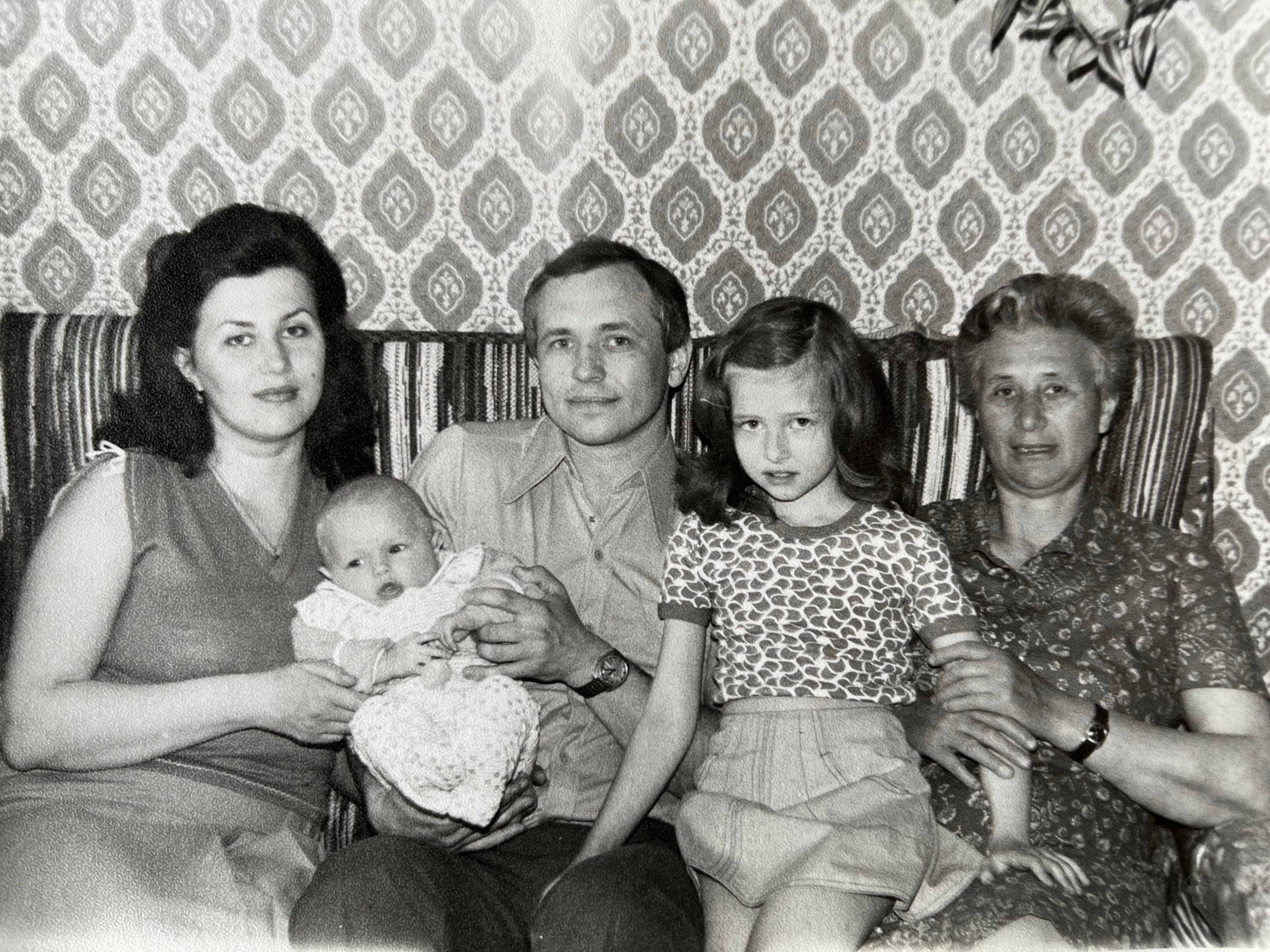
Almost two years ago, I published a piece called Why I Care.
Change-maker’s Handbook (the book) came out in late 2023. I was starting to mine my twenty years of changemaking experience for patterns and lessons that may benefit others, interviewing practitioners, and shaping my PhD research. Re-reading this piece now, I am struck by how many of the themes that would later emerge in my research were already present within it — not as theory or findings, but as lived experience.
Most of you would have never seen this essay, so I thought I would share it again. After the original piece, I’d like to tell you what I now see differently.
_ _ _
Why I Care (2024)
The baby in the photo, I was born and raised in Moscow. Now Russia, then the traumatically imploding Soviet Union and the West’s sandbox for crude experimentation in forging a democracy and a market economy from scratch. Unlike many other countries — including those of the former Soviet Union — Russia had no history of either. This was like teaching a child to swim by throwing them into the deep end: there was no muscle memory to trigger.
Raised by two university professors and a veteran of one of WWII’s all-female front-line battalions, I witnessed what it meant to strip a society of its value system without meaningfully replacing it. Once-respected professionals, my mom and dad were now paid in towel fabric, plates, and promises because anybody who relied on the government was, well, instantaneously overboard without a life raft. Surgeons, police officers, and scientists were bartering on street corners. In shame, nobody was making eye contact.
I was not yet seven when I — clad in layers that kept us somewhat warm via sheer bulk, not smarts — first held my parents’ spot in lines for bread, sugar, or butter in the pitch black of winter mornings. Those were, indeed, separate lines with none of the efficiency of Western food banks.
As it relegated people to shuffling huddles, I looked Need in the eye before I could recognize its power over everybody in my world.
It would be years before I understood the meaning of eating pancakes for dinner every night of the week. By the age of eleven or twelve, I was responsible for growing (often to be canned) our annual supply of vegetables, fruit, and berries during the summer. I still can’t throw food away.
At school, we routinely sat for hours on end without teachers, who were forced out into the fickle market economy to make ends meet. There were no extracurricular activities. Playgrounds got dismembered for parts. All the parents were so preoccupied with surviving that as children, we were raising ourselves.
I remember acknowledging that change was non-negotiable. Still, I knew in my gut that it need not callously decimate people’s lives. Before even hitting my teens, I remember the Moscow intersection where I first committed to finding better ways to do it; ways that did not pull the rug from under people’s feet; ways that protected the environment as well as human dignity; ways that reinvigorated rather than decimated; that unlocked possibility rather than entrenched despair.
My postgraduate research at Cornell University allowed me to delve into broad-spectrum change, and I have not stopped since.
I was in my 20s when, on a flight, I first wrote down my purpose, “To mobilize people to imagine and create realities far better than they have experienced.”
Curiously, this has not changed for me. I don’t know if this is atypical. I accept that one’s purpose may change with time, and I wish we knew more about this; one of my standing invitation for social sciences research.
Even if it took me years to see it clearly, my purpose has been my compass for over three decades.
May I suggest that you have a lot to gain and nothing to lose by giving a go at distilling yours. Section 1 of my book, Change-maker’s Handbook, focuses on purpose and can guide you. It may mean all the difference in the impact and contentment you experience as a changemaker, and I would love to hear from you whether it does!
_ _ _
When I wrote this piece, I was trying to explain myself and my commitment to better equip changemakers for their vital work. Today, I find myself asking a different question. Not why I care but why some people repeatedly find themselves caring in this particular way.
The distinguishing feature is not compassion. Many people are compassionate.
It is not intelligence.
It is not idealism.
It is not even a desire to help.
What keeps catching my attention is something more specific: an inability to fully look away once certain forms of harm, contradiction, or unrealized possibility become visible. A tendency to keep asking:
* Why is it like this?
* Why do we accept this?
* Could this work differently?
* What would it take to change it?
Those questions have followed me for most of my life.
Increasingly, I wonder whether they have followed some of you as well. I’ve been working on something that explores that possibility. More soon.
Changemakers’ Handbook is an audience-supported publication focused on professionalizing chaangemaking in a post-solutions world. Consider subscribing to join future live conversations and to access all posts.
Are you a changemaker? https://open.substack.com/pub/changemakershandbook/p/how-to-spot-a-change-maker-signs?r=1i4aw7&utm_campaign=post&utm_medium=web
Most are not changemakers https://open.substack.com/pub/changemakershandbook/p/most-people-are-not-changemakers?r=1i4aw7&utm_campaign=post&utm_medium=web
What are changemakers for? https://open.substack.com/pub/changemakershandbook/p/what-are-changemakers-for?r=1i4aw7&utm_campaign=post&utm_medium=web
Purpose as fuel for changemaking https://open.substack.com/pub/changemakershandbook/p/playlist-purpose-is-fuel-for-changemaking?r=1i4aw7&utm_campaign=post&utm_medium=web