I am grateful to finally present the long-delayed, final installment of the oral history of the hostage deal that was incepted to capture the emotions that erupted upon the announcement of the deal in January 2025 and has continued to flow forth throughout its duration.
Times of intense emotion are not unusual; indeed, they seem to be the norm lately. What made this intensity different was its febrile complexity. Each joyous step faltered with apprehension. Rage and betrayal paired off with catharsis and defiance. At center stage, hope and despair danced a pas de deux amidst a cacophony of nearly every other emotion a person can feel.
Such a dance is ephemeral. It resists the reductive narratives that history imposes with the confidence of retrospection. It is this delicate mélange that I have endeavored to preserve over the course of three installments: in anticipation of the first hostage release, immediately after that release, and this final one, at the midpoint of the hostage deal.
The interviews for this final installment were conducted between February 4th and March 16th, 2025 or from just over two weeks after the first hostage release of this deal to just over two weeks following the last release. All interviewees witnessed the release of live hostages, some the dead, and none, advancement to the second phase of the deal which was intended to see the return of the remaining 59 hostages and a complete withdrawal of Israeli forces from Gaza.
Each interview was conducted one-on-one, that is, none of the contributors directly interacted with any of the others for this project. What you will hear, however, is something approximating a conversation between all of the participants.
The effect, I’ve come to believe, is something of a macrocosmic synecdoche, which is to say that the conversation affected by the seventeen contributors goes some way towards capturing the range and conflict of emotions felt and thoughts entertained by each individual.
I am extraordinarily grateful to each of the people who contributed to this project. Dalia and Oren report from Tel Aviv, Jennifer from Jerusalem, Darren from Salem, Massachusetts, and Andrew from Britain.
Dalia made aliyah, or a return to Israel, following a life and education in the U.S. Amongst other things, she helps to run Step Forward (which you can find on Facebook and Instagram), a charity founded after October 7th to respond to the need of IDF soldiers for sports equipment.
Jennifer grew up and worked in California before eventually moving to Israel. She had committed much of her life to non-profits, and now works at the Weizmann Institute of Science and volunteers to support families affected by the deployment of a service member.
Darren, in his own words, is “not Jewish. I’m not Israeli. I’m just a guy who sees this situation since 10.7 as the most stark example of good and evil that you can get in an international conflict.” He has committed much of his time in the two years since to educating himself about the history of the region and the conflict, drawing upon an impressive variety of sources.
Oren Kessler, has worked as an editor for Haaretz, correspondent for the Jerusalem Post, deputy director for research at the Foundation for Defense of Democracies, and other roles that concern Israel and the Middle East for around 20 years. His book, Palestine 1936: The Great Revolt and the Roots of the Middle East Conflict, is as definitive a history of a formative period for Zionist and Palestinian national identity amidst the period of British colonization. He also writes on his Substack Subterranea, which I strongly recommend.
Andrew Fox has worked as a senior lecturer in war studies and behavioral sciences at the Royal Military Academy Sandhurst and served three tours in Afghanistan as a paratrooper in the British Army. He is currently a senior associate fellow at the Henry Jackson Society and one of the leading military analysts and commentators on the current Israel-Gaza conflict. His writing and regular podcasts can be found on Substack where he offers a rare depth of timely analysis which I likewise strongly recommend.
An emerging narrative
This installment is a little different from the previous two. Some of the shock of the releases has worn off and the contributors have had more time to reflect. One of the consequences of this is that the conversation goes rather further afield, straying into the many potential consequences of this deal, how Israel is changing, and where Jews fit into a post-10.7 world. It also seems likely that the narrative that will come to define this period is beginning to coalesce; which images made the deepest impact and the most dominant concerns appear to be emerging.
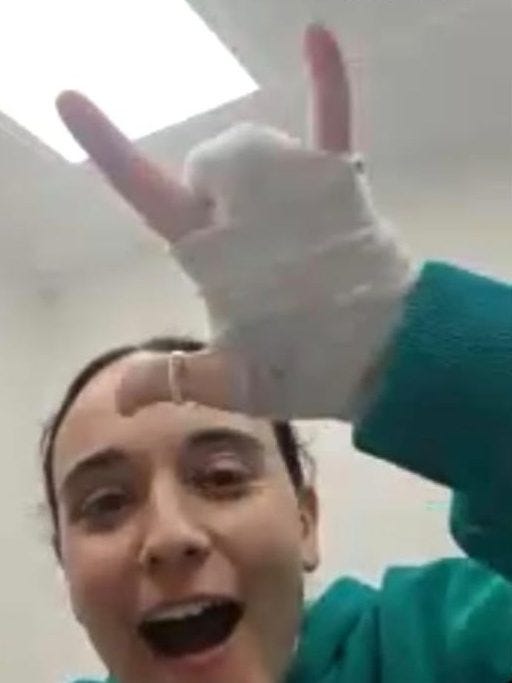
Amongst these images is that of former hostage, Emily Damari, triumphantly raising her mutilated hand upon returning from nearly 500 days of captivity. The astounding resilience of so many of the hostages redounds to the Israeli character and bolsters hope that the hostages may eventually recover from their ordeal. While the physical health of the first hostages released was not immediately imperiled, the release of Or Levy, Eli Sharabi, and Ohad Ben Ami revealed them as skeletal versions of their former selves, an unnecessary reminder of the deprivation the hostages endured for so long. More evil still were the images from the release of Shiri Bibas and her two very young children, along with Oded Lifshitz. The ghoulishness and supreme evil of the “release ceremony” of these four people locked in caskets and displayed as public entertainment is perhaps the perfect encapsulation of the forces aligned towards the eradication of Israel.
Some issues discussed in this third installment are the same as those raised in the previous two, and indeed have persisted in some form or another since the founding of Israel. How can Israel ensure its own safety? How can one have peace with neighbors committed to your eradication? Another recurring theme, the isolation of Israel and Jews, was expounded upon in this installment. Jennifer, having moved to Israel from Berkeley, a place that serves as a stand-in for progressive do-goodery, and worked most of her life in non-profits trying to help other people in the world, reflected on the sense of betrayal that came from watching her friends and colleagues turn against her and her community following October 7th.
While there is an impulse to turn away from the world as the world turns away from Israel, civic society has grown much stronger. Formally or informally, many people work to support the soldiers, hostages, survivors, and their families. Although Israel is in some ways much stronger now, deep fractures remain, especially within the political sphere.
Two missing words
Were I to attempt a distillation of this two-hour installment, I believe I could do it in two words, if only they existed. Several times throughout my interview with him, Oren Kessler commented that a new word is needed to describe the strange commingling of happiness and sadness that runs through so much of this period. “How can you not celebrate leaving the darkness and coming into the light, quite literally…But at the same time, how do you celebrate Yair Horn returning to freedom without being just gutted by the fact that his brother Eitan is still there?” This strange commingling is manifest on seemingly every bench and light post and in every bar and café in Israel. Amidst all the hustle and bustle of normal life, reminders of the hostages are absolutely everywhere. As Dalia puts it: “in some weird way life goes on, but it’s centered around this.”
If Oren’s missing word concerns two competing emotions, mine would describe but one of them: the feeling imbued in reunified people after a long and awful separation. Whether it is the reunion of a family torn asunder or of strangers who you’ve never met but have come to regard as your own family or of the reinvigorated sense of Jewish peoplehood since October 7th, there is an intensity to this feeling that no English word I am aware of manages to capture. Part of it is catharsis, the great, unburdening of grief and worry, as if a dam had burst, allowing life to flow freely through one’s veins again. Part of it is a sense that a great cosmic injustice has begun to be rectified. Part of it is feeling whole again and in the same moment, learning how extensively you had been broken by the absence of another.
Something of a conclusion
An unexpected and delightful consequence of the delay in publication of this installment is that this chapter finally has something of a conclusion. While the deal never progressed to Phase 2, another deal was signed last autumn. On October 13th, 2025 the final living hostages returned to Israel, and on January 27th, 2026, the body of the last dead hostage, Master Sergeant Ran Gvili, was located and returned. For the first time since 2014, no Israelis are being held captive in Gaza.
Upon Gvili’s recovery, dozens of soldiers gathered around his body and sang Ani Ma’amin. Its lyrics are derived from a 12th century declaration of faith that redemption will accompany the coming of the Messiah. This declaration was given its melody in a Nazi cattle car bound for Treblinka. As of publication, the Messiah has not yet returned, but the return of all of the hostages to their home does make redemption feel rather closer.
All of the murdered have been buried by their families. All those who returned alive can finally begin the process of healing, knowing that none of their compatriots are still suffering as they had. This chapter is but the latest in a long and ancient story of Jewish peoplehood. My hope is that this one will serve a similar purpose as those earlier chapters: to strengthen the ties that bind a diverse and complicated people together.
The power of these stories is evident in the well-being of those who remember them. As Darren put it: “I feel envious of the Jews of the country who know where they’re going to be on Friday night. I only know where all my people are going to be on Super Bowl Sunday…they can come together as a country, never mind being there for their neighbor. And that’s a beautiful thing. I’m envious of them in that regard.”
Additional Resources
This is the third installment of the oral history of the first 2025 hostage deal. The first two installments can be found below.
Dalia has recommended the Panim Project, by Elyte, a portrait photographer who has worked to document the faces and testimonials of some of those impacted by October 7th.
When Eli Sharabi first emerged from 491 days in captivity, he appeared a skeletal version of his former self. In the brief time since his release, he has written “Hostage”, an account of his experience. Many of the other former hostages have written about their experience or given interviews, all of which are worth exploring.
Inheritance would like to honor Captain Tomer Shoham, the cousin of one of this installment’s contributors, Oren Kessler. Captain Shoham was an infantry platoon commander and was killed fighting Hamas near Kerem Shalom on October 7th. May his memory be a blessing.
Thanks for reading Inheritance of a Thousand Generations! Subscribe for free to receive new posts and support my work.