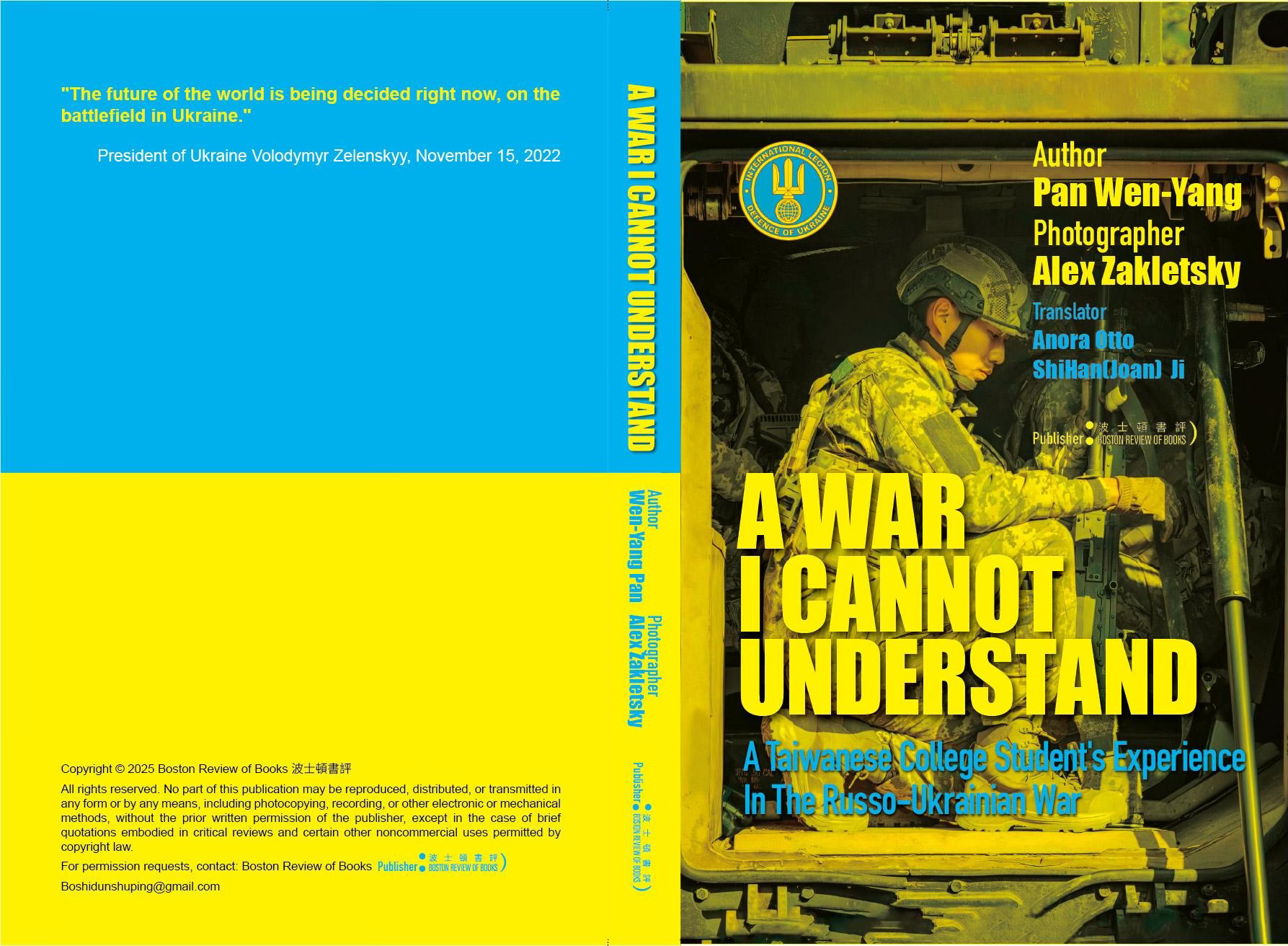
At the end of 2025, Boston Review of Books published an English-language book titled A War I Cannot Understand. It tells the story of Pan Wen-Yang, a university student from Taiwan, who traveled to the Ukrainian front lines twice to fight in support of Ukraine. The book is also accompanied by dozens of photographs taken by Ukrainian military photographer Alex Zakletsky. Today’s article is the editor’s note. If you wish to purchase this book, you can do so on the websites of JF Bookstore, Amazon, and Barnes & Noble.
And the World Remains Silent
——Viewing the Russia-Ukraine War Through the Lens of a Taiwanese Volunteer
Soldier
I learned about Pan Wenyang through Chai Jing’s channel program.
In March 2025, Chai Jing’s channel produced two episodes about Chinese soldiers in the Russia-Ukraine War, including Chinese mercenary Makaron fighting for Russia in the Russian army, and volunteer soldiers fighting for Ukraine in the Ukrainian International Legion : Gao Shan, “Tianxia Weigong”, Zeng Sheng-guang, Wu Zhong-da, Peng Chenliang, Pan Wenyang, and other anonymous volunteers who were interviewed.
These soldiers in the Ukrainian International Legion come from diverse backgrounds and even have subtle political differences. However, on the Russia-Ukraine battlefield, they became brothers who faced life and death together, united by death. Chai Jing’s program meticulously reconstructed the scenes of the deaths of Taiwanese volunteer Wu Zhong-da and Chinese volunteer Peng Chenliang, who were Pan Wenyang’s best friends in the International Legion. In the footage, Pan Wenyang said, “I don’t know how to express why it hurts so much.”
On camera, Pan Wenyang looks very much like a typical Taiwanese college student— thin, refined, and gentle. Without his military uniform, it would be hard to associate him with a soldier.
In fact, Pan Wenyang had just returned to Taiwan from the front lines of the Russia-Ukraine War. This was his second return from the front lines.
In September 2023, 24-year-old Taiwanese college student Pan Wenyang took aleave of absence from Wenzao Ursuline University of Languages, where he was studying, and lied to his family, claiming he was going to study in Poland. He traveled alone by plane to Poland and then crossed the border into Ukraine to join the Ukrainian International Legion.
At that time, the Russia-Ukraine War had been ongoing for one year and seven months.
On February 24, 2022, Russia launched a “special military operation,” invading Ukraine from multiple directions, targeting Kyiv, Kharkiv, Donbas, and southern Ukraine, but met fierce resistance from Ukraine. On September 30, Russian President Vladimir Putin held a ceremony in the Kremlin in Moscow, announcing the formal annexation of four Ukrainian regions — Donetsk, Luhansk, Kherson, and Zaporizhzhia — and signed “accession treaties” with pro-Russian leaders of these regions. However, the Russian military did not fully control these areas, particularly in parts of Kherson and Donetsk, where fighting continued. In September and November 2022, Ukrainian forces recaptured Kharkiv and Kherson regions. Subsequently, Donetsk Oblast in eastern Ukraine became the main battlefield, with fighting concentrated in cities such as Bakhmut, Mariupol, Donetsk, Avdiivka, Maryinka, and Volnovakha.
In November 2023, after eight weeks of training at the recruit camp, Pan Wenyang was sent to the front lines. Prior to this, both Russian and Ukrainian forces were locked in a trench warfare stalemate in Bakhmut and Andriivka, with limited progress for either side. On November 10, Pan Wenyang arrived at a village near Bakhmut, his first time at the front. However, before the fighting fully began, his comrades started falling one after another, especially his team leader and spiritual idol, Eric, whose death caused Pan Wenyang to lose courage. After retreating fromthe front lines to the rear, Pan Wenyang applied to terminate his contract, and in January of the following year, he returned to Taiwan.
In July 2024, Pan Wenyang and his hometown friend Wu Zhong-da flew from Taiwan’s Taoyuan Airport to Ukraine again, joining the Ukrainian International Legion for the second time. In October, Pan Wenyang and Wu Zhong-da entered the front lines in Chasov Yar, located in the Bakhmut district of Donetsk Oblast, the same region as his first deployment. This time, however, it was not a village on the outskirts of Bakhmut but a forest near the city of Chasov Yar. In this forest, Pan Wenyang experienced eighteen days of hellish, intense combat. During the eighteen days of fighting in the Chasov Yar forest, Pan Wenyang lost twenty-four comrades, with ten others seriously injured, including his close friend Wu Zhong-da. From then on, Pan Wenyang felt that a part of himself was buried with his comrades in that forest. In February 2025, he returned to Taiwan and began writing about his firsthand experiences on the Russia-Ukraine battlefield, which became this book.
Since the Russia-Ukraine War broke out in February 2022, its brutality has been widely reported in global media, focusing primarily on its impact on civilians, the destruction of infrastructure, and systematic human rights violations. But how brutal is the battlefield itself? What is the reality of soldiers’ casualties? There seems to be little reporting on this, and understandably, it is difficult to report. Pan Wenyang’s account directly describes the eighteen days of fighting in the Chasov-Yar forest, confronting readers with the front lines of the Russia-Ukraine War, helping them understand how this twenty-first-century war is fought and why Pan Wenyang described the battle as a giant “meat grinder.”
When Pan Wenyang arrived in Ukraine, the Russia-Ukraine War had already reached a stalemate, with both sides repeatedly contesting narrow front lines in eastern Ukraine. The widespread use of modern weapons such as drones, artillery, precision-guided missiles, and landmines, combined with traditional infantry tactics, resulted in an extremely high death rate on the battlefield. Soldiers in exposed trenches or open fields were easy targets, often unable to see each other, yet constantly bombarded by artillery shells. When Pan Wenyang went to the front lines for the second time, he was thrust into this “meat grinder” battlefield, characterized by high casualty rates and relentless attrition, its bloodiness and brutality comparable to the trench warfare of World War I.On November 10, 2023, after completing eight weeks of recruit training, Pan Wenyang went with his comrades to the Bakhmut front in Donetsk Oblast. Earlier, in May 2022, Russian forces began shelling the area, launching a strong offensive on August 1. After ten months of intense fighting, in May 2023, Russia claimed full control of the Bakhmut district. On June 5, Ukrainian forces launched a counteroffensive in the Bakhmut district, recapturing several key locations near Bakhmut city by September but failing to fully retake the city itself. Russian and Ukrainian forces continued to battle back and forth in villages near Bakhmut. This was when Pan Wenyang entered the battlefield.
At the same time, Russian forces launched a large-scale offensive on another city in Donetsk Oblast, Avdiivka. Deploying significant forces, including regular troops and the Wagner Group, they employed “meat grinder tactics,” attempting to break through Ukrainian defenses with human wave assaults. Avdiivka quickly became another massive “meat grinder” after Bakhmut. Many of Pan Wenyang’s comrades from the recruit camp were sent to this highly dangerous location, and one of his instructors, Denis, was reported killed in Andriivka within a week. Pan Wenyang received this devastating news while preparing for combat in a safe house on the Bakhmut front.
Subsequently, in that same safe house, Pan Wenyang received news of the death of his team leader, Eric, followed by the deaths of Ragnar, Dog, and Sierra…
In July 2024, Pan Wenyang and Wu Zhong-da returned to Ukraine to join the Ukrainian International Legion, at a time when the Russia-Ukraine War had entered an even more intense stalemate. Both sides, exhausted by the high attrition of prolonged warfare, saw increasingly fierce battles on the front lines.
Following the Bakhmut campaign (May 2022 to May 2023) and the Avdiivka campaign (October 2023 to February 2024), Russian forces shifted their focus, targeting Chasov Yar, approximately ten to fifteen kilometers west of Bakhmut. On April 4, 2024, Russian forces launched their first direct assault on Chasov Yar. At the same time, in August 2024, Ukrainian forces initiated a cross-border offensive into Russia’s Kursk Oblast. The emergence of the Kursk front diverted significant Ukrainian forces, making the fighting in Donetsk Oblast’s front lines even more challenging. In October, Russian forces breached the canal defense line, entering the center of Chasov Yar and occupying most of the city. Ukrainian forcesretreated to the western and southern parts of the city, where fighting remained intense, primarily in the form of urban warfare. The three major battlefields in Donetsk Oblast — Bakhmut, Avdiivka, and Chasov Yar — became infamous as “meat grinders.” A 2024 report by Asia Times noted that Russian casualties in eastern Ukraine reached up to 1,000 per day. These battlefields terrified most soldiers, and volunteers in the Ukrainian International Legion were no exception.
Pan Wenyang and Wu Zhong-da returned to the Ukrainian International Legion in July. Upon arrival, Pan Wenyang found that the Legion was no longer merely assisting Ukrainian forces but had become a main force on the front lines. At this point, volunteers in the Ukrainian International Legion were not only sent to the front lines but also tasked with the most dangerous assault missions. The Legion’s First Battalion, due to heavy casualties, had to be disbanded for the second time, and the entire Legion was given a one-month break for reorganization. Pan Wenyang’s Second Battalion was entirely converted into a light infantry assault unit, the most dangerous type of unit on the Russia-Ukraine battlefield, often referred to by both Russian and Ukrainian soldiers as “cannon fodder.” Pan Wenyang was assigned such dangerous tasks in the forests near Chasov Yar. While heading to the front-line position, Pan Wenyang once noticed a team of Ukrainian soldiers in a trench, led by a young, boyish team leader, with the rest of the soldiers mostly over sixty years old. During his two trips to Ukraine, Pan Wenyang repeatedly observed war-weariness among Ukrainian soldiers and even heard of some who suffered mental breakdowns after multiple deployments to the front. Whenever news of heavy casualties from fierce battles reached the rear, the Ukrainian International Legion would experience waves of desertions.
On October 13, 2024, Pan Wenyang entered the forest near Chasov Yar to join the fighting, as Ukrainian forces were retreating under relentless Russian attacks. Inthe Chasov Yar forest, Pan Wenyang and his comrades endured eighteen days of combat, shifting from assault to defense and back to assault, with bombs falling like rain on their forest, leaving it strewn with blood and flesh.
These infantrymen faced circling drones or suicide drones overhead, anti-personnel mines scattered on the ground, and artillery shells raining down at any moment.Once detected by a drone, stepping on a mine, firing a shot, or being spotted by thermal imaging, they would be immediately pinpointed, followed by dozens of artillery shells raining down, killing many soldiers instantly. On this battlefield,guns were of little use, and as a machine gunner, Pan Wenyang was an even easier target for artillery. He was taught to change positions immediately after firing a shot, or he would be precisely targeted and have no chance of survival.
When Pan Wenyang entered the Chasov Yar forest, the land before him had been bombarded repeatedly by artillery, turning black, like a scene from hell. In the first battle in the forest, nearly all the Sri Lankan and Colombian soldiers in Pan Wenyang’s company were killed or injured. In the second battle, Pan Wenyang’s nine-man squad accidentally entered a death zone, and he witnessed his close friend Wu Zhong-da’s waist being blown open by a bomb, dying in agony nearby, powerless to help.
In those eighteen days of two battles, Pan Wenyang saw his comrades fall one by one, with a total of twenty-four killed and ten seriously injured. The dead included not only Ukrainian soldiers but also Russian soldiers. During a Russian encirclement in the Chasov Yar forest, Pan Wenyang was forced to use his machine gun to kill a Russian soldier. He felt unbelievable and trembled all over, as he had killed a complete stranger, which pained him deeply.
In fact, in Chai Jing’s Russia-Ukraine interviews, she first spoke with a Chinese youth named Makaron, a mercenary in the Russian army. In the program, Makaron described the Russian side’s situation as even worse than the Ukrainian side’s. He fought in Bakhmut, the same front Pan Wenyang visited during his first deployment. Because Ukrainian forces refused to abandon the city, Russian forces remained stationed there, and Makaron was among them. On the Russia-Ukraine battlefield, the Russian army employed human wave tactics, resulting in casualty rates several times higher than those of the Ukrainians, making Makaron realize he could die at any moment. When Makaron tried to leave, he was told his contract would automatically renew until the war ended, and he was even briefly imprisoned in a dungeon by the Russian army.
After eighteen days of fighting in the forest, Pan Wenyang retreated to a safe house, only to learn of the death of his close friend Peng Chenliang. Peng Chenliang was originally a drone operator but applied to join Pan Wenyang’s Second Battalion to fight alongside him. Before his official transfer, he was sent to Toretsk, a small town a dozen kilometers from the Bakhmut front, for a reconnaissance mission. The mission was unexpectedly extended, and due to insufficient manpower, inadequate equipment, and lack of support, Peng Chenliang was killed.
On October 29, as Pan Wenyang prepared for a second counteroffensive in the Chasov Yar forest, he sent a message to Peng Chenliang but received no reply. On the afternoon of November 4, upon hearing of Peng Chenliang’s death, Pan Wenyang sent another message, asking if the news was true: “I miss you so much.” This time, Peng Chenliang would never reply.
Within a week, Pan Wenyang lost his two closest brothers in the Ukrainian International Legion: Wu Zhong-da, who was like a father, taking him through streets and alleys to find good food; and Peng Chenliang, who was like a brother, cooking dumplings for him at home. Pan Wenyang felt that his family in Ukraine was gone, and his spiritual pillar in the Legion had collapsed once again.
Since February 2022, how many people have been killed or injured in the Russia-Ukraine War? The Russian government has released no official data, while Ukraine periodically publishes figures, though they are generally believed to be lower than the actual numbers.
According to estimates by the Center for Strategic and International Studies (CSIS), from February 2022 to May 2025, Russian military deaths numbered approximately 250,000, with total casualties exceeding 950,000, projected to reach 1 million by the summer of 2025. A joint estimate by BBC Russia and the Russian independent media outlet Mediazona, as of May 2025, put Russian military deaths between 170,000 and 246,000, with 111,368 identified by name, and total casualties likely higher. CSIS estimated Ukrainian military deaths between 60,000 and 100,000, with total casualties around 400,000. Ukrainian President Volodymyr Zelenskyy’s updated data from February 2025 reported over 46,000 military deaths and 380,000 injuries, aligning closely with CSIS estimates. The United Nations Office of the High Commissioner for Human Rights (OHCHR) confirmed that, as of April 30, 2025, at least 13,134 Ukrainian civilians were killed and 31,867 injured, noting that the actual figures are likely higher due to difficulties in collecting data in war zones.
As the war continued, this high casualty rate also affected the Ukrainian International Legion, leading to low morale and insufficient volunteer recruitment.When Ukrainian President Zelenskyy announced the formation of the Ukrainian International Legion on February 27, 2022, Ukrainian officials claimed over 20,000 volunteers from fifty-two countries had signed up. The New York Times (March 25, 2023) and Kyiv Independent questioned these numbers, estimating a maximum of 3,000 to 4,000 volunteers, dropping sharply to 1,000 to 2,000 by May 2024. Many volunteers feared becoming “cannon fodder,” significantly reducing their willingness to join the Ukrainian battlefield.
However, for Pan Wenyang, who experienced the war firsthand, these were not just numbers but his brothers: “Every corpse, every way of dying, has become an indelible memory for me.”
Carrying the indelible memories of death, grief, and fear, Pan Wenyang returned to Taiwan in February 2025 and completed this firsthand account of the war. In daily life, he is not an eloquent person, even somewhat tongue-tied and inarticulate, but in his heart, many voices intertwine, shouting and weeping. He felt that he could not find peace unless he wrote these voices down, that he had to write them out. He wanted to write about his sorrow, fear, anger, doubts, despair, and questioning of the meaning of war, the meaning of life, and the meaning of this world.
Before going to the Russia-Ukraine battlefield, Pan Wenyang studied political philosophy and international relations at university. The lofty vocabulary and theories in the classroom, though difficult to understand, were something he deeply believed in: the future of the world lay within them. After returning from the battlefield to the classroom, Pan Wenyang’s thoughts would involuntarily drift to the distant Ukrainian battlefield. He didn’t know how to explain his feelings to classmates who had never experienced the battlefield. Because justice, truth, courage, and victory were no longer abstract concepts but the flesh and blood of the comrades he lived with day and night.
When the media reports on the Russia-Ukraine War, when scholars comment on it, when politicians haggle over it, when people discuss it and sing war songs, they always revolve around abstract terms like democracy versus dictatorship, freedom versus brutality, resistance versus aggression, courage versus evil, but rarely talk about the living individuals on the battlefield, the living lives. “They were so kind, so wonderful,” Pan Wenyang said.
In Adam Hochschild’s book Spain in Our Hearts: Americans in the Spanish Civil War, 1936-1939, Albert Camus is quoted as saying: “My generation keeps Spain in their hearts; there they learned that one can be just but still be defeated, that force can conquer the spirit, and that courage often goes unrewarded.” When I showed this quote to Pan Wenyang, he exclaimed, “Yes, that’s exactly it.” Pan Wenyang even occasionally felt confused, unsure of whom he was fighting for, who was orchestrating the war, and who would ultimately reap its rewards.
As Pan Wenyang was writing his firsthand account of the Russia-Ukraine War after returning to Taiwan for the second time, on February 28, Ukrainian President Zelenskyy met with U.S. President Donald Trump and Vice President J.D. Vance at the White House. Due to a dispute, the meeting ended unhappily. The talks were intended to discuss a U.S.-Ukraine mineral agreement and the issue of peace in Ukraine, but Trump and Vance, in front of a group of reporters, accused Zelenskyy of lacking gratitude for U.S. aid, and the meeting was abruptly canceled, with Zelenskyy asked to leave the White House. At this time, Chasov Yar, where Pan Wenyang had fought and lost twenty-four brothers, had been almost entirely occupied by Russian forces, with the city’s infrastructure nearly completely destroyed. On March 8, media reported that Russian special forces, using a natural gas pipeline near Sudja, launched a surprise attack on Sudja in Russia’s Kursk Oblast, which was occupied by Ukrainian forces. Ukrainian positions in Kursk faced severe threats, with some areas forced to retreat and at risk of encirclement. Far away in Taiwan, Pan Wenyang, in his book, couldn’t help but ask: Is this world really worth sacrificing ourselves for?
This is not only Pan Wenyang’s confusion but also the first reaction of many: Why abandon a good life to join the Ukrainian International Legion in faraway Ukraine, to die in someone else’s war? Many media outlets and friends called Pan Wenyang and his comrades “mercenaries,” which made Pan Wenyang somewhat angry, as none of the soldiers in the Ukrainian International Legion traveled thousands of miles to fight for money. Moreover, they had to endure poor food and accommodations in the Legion, unsafe safe houses at the front, and the pain of their comrades constantly disappearing.
Pan Wenyang did not shy away from discussing the various problems and dissatisfaction within the Ukrainian International Legion, such as internal conflicts, insufficient weapons and equipment, and language barriers. In fact, the Legion’sissues have been reported by the media. Kyiv Independent conducted a series of investigations from 2022 to 2024, exposing leadership misconduct, including theft of weapons, sexual harassment, poor command, and assigning soldiers to high-risk missions. An August 2022 investigation revealed that the First Battalion’s commander was suspected of stealing Western-supplied light weapons and threatening soldiers. A third part of the investigation in August 2024 further noted that, despite these issues being reported to the Ukrainian Ministry of Defense and the President’s Office, the commanders involved were not replaced, indicating insufficient reforms. Additionally, a March 25, 2023, New York Times report titled “Stealing Glory: American Volunteers in Ukraine Lie, Waste, and Bicker” detailed problems among American volunteers in the Ukrainian International Legion and other volunteer groups.
In fact, the Second Battalion of the Ukrainian International Legion, where Pan Wenyang served, also faced numerous issues. On June 18, 2025, Colonel Ruslan Miroshnichenko (code name “Santa Claus”), who established and commanded the Second Battalion from September 2022 to November 2024, posted on his personal social media, stating that he strongly disagreed with statements made by the current Legion commander, Oleksandr Yakymovych in a public interview, accusing him of spreading a series of false claims. “Yakymovych claimed in the interview that there were no losses in the Chasov Yar offensive, which is a lie. In October 2024, we lost more than 20 people, including those killed and injured, with some wounded unable to be evacuated from the battlefield. The radio carried the cries for help from soldiers slowly dying in open terrain.” “The commander sent the unit into combat on the third day after arriving in the mission area, without adequate reconnaissance, communication, fire support, or logistics. This decision led to catastrophic consequences, which were subsequently covered up.” Furthermore, Colonel Ruslan Miroshnichenko pointed out that some Ukrainian media and journalists had intentionally or unintentionally spread lies. The battle Colonel Ruslan Miroshnichenko referred to was the same one Pan Wenyang experienced in the forest near Chasov Yar, where Wu Zhong-da died. According to Pan Wenyang, the Second Battalion lost 22 people, nearly a third of its strength, with 10 others seriously injured, resulting in a casualty rate of nearly 50%.
Pan Wenyang and his comrades were not unaware of these issues; they also recognized the dangers and feared being sent to the “meat grinder” battlefield. In September 2024, when Pan Wenyang and Wu Zhong-da joined the SecondBattalion of the Ukrainian International Legion for the second time, this previously relatively safe battalion had been restructured into an assault unit tasked with the most dangerous missions. Pan Wenyang’s comrades tried to find ways to transfer to other battalions but, after several failed attempts, reluctantly signed their contracts. Given such dangers, why did Pan Wenyang and his comrades still come to Ukraine to fight for Ukraine?
For Pan Wenyang’s team leader, the American Eric, it was about fighting for the belief in freedom and democracy; for Pan Wenyang’s friend from China, Peng Chenliang, it was the best way to prove a love for freedom; for “Tianxia Weigong,” it was seeing a children’s cancer hospital in Kyiv bombed on television, killing many children and nurses, that brought him to the Ukrainian battlefield. For Pan Wenyang, it all stemmed from his nature and admiration for heroes. After joining the Ukrainian International Legion, influenced by his spiritual idol Eric, he came to understand what it meant to fight for beliefs and ideals. However, as Eric, Wu Zhong-da, Peng Chenliang, and other comrades remained forever in Ukraine’s black soil, Pan Wenyang knew he was now inseparable from this land, and he had to fight for his brothers.
In late April 2025, Pan Wenyang went to Ukraine for the third time, determined to fight for his brothers to the end — that’s what he thought and what he did. “Because they were so kind.” There was no heroism or idealism. After news of Wu Zhong-da and Peng Chenliang’s deaths spread, photos of them circulated online, each showing them holding a stray war cat, their eyes full of warmth.
In late May 2025, Pan Wenyang called me from Ukraine, saying he had joined the paratroopers and would go to the front lines in two days. Due to military secrecy, he didn’t tell me where he was going. Two or three days later, I saw news: on June 2, Russia and Ukraine held a second round of direct peace talks in Istanbul, Turkey, lasting only about an hour, failing to reach a ceasefire agreement, with peace seeming far off. The day before the talks, on June 1, Ukraine launched a large-scale drone attack codenamed “Spider Web,” deploying 117 FPV drones to strike five Russian air bases. This was the largest Ukrainian drone attack on Russian air bases in the war, causing significant losses to Russian forces, who vowed to retaliate. I don’t know if Pan Wenyang was involved in the fighting, whether he is safe, whether he had to witness his brothers fall again, or whether he had to experience countless deaths once more — Ukrainian, Russian, and innocent civilian deaths.
At this moment, the world seems to no longer be outraged by Zelenskyy’s humiliation at the White House, and many didn’t even notice the fighting on June 1 or the failed talks on June 2, as the world turned its attention to a new hotspot: a Chinese female student at Harvard’s graduation ceremony said, “If a little boy dies in a war he neither started nor understood, a part of me dies with him.”
Pan Wenyang had said something similar, that a part of him and his fallen brothers would forever remain in the forest of Chasov Yar.
This is the greatest irony of this world: while the world mocks the Chinese student’s hypocritical performance, it seems to have forgotten the thousands of boys who have already died on the Russia-Ukraine battlefield, and the thousands more who will die there.
As this afterword was completed, Russia’s retaliatory actions had begun. From June 5 to 7, 2025, Zelenskyy posted on the social media platform X, detailing Russia’s relentless drone and missile attacks across Ukraine. These attacks killed civilians, including the family of a rescue worker, injured dozens, and targeted cities with no military value. Zelenskyy called it terrorism, urging the world to pressure Russia toward peace and warning that inaction makes one complicit. On X, Zelenskyy continuously reported on Ukraine’s situation, but the world remained silent.
On May 15, due to touching on sensitive political and historical topics on YouTube, Chai Jing’s book Seeing, published in mainland China twelve years ago, was banned. On June 9, in her latest video, “Chai Jing Responds to the Ban of Seeing: Truth Has the Power of a Thousand Tons,” Chai Jing said, “That year taught me, no matter how noisy the outside world’s gongs and drums, I don’t sing songs of praise or war songs. The true singer gives voice to the silence at the bottom of people’s hearts.” The “that year” Chai Jing referred to was 2003, when she reported on the SARS epidemic in Beijing. From that year on, Chai Jing turned her lens toward the silent majority during the epidemic, pursuing the topics she wanted to cover.
In 1955, after surviving a concentration camp and remaining silent for a full ten years, the Jewish boy Elie Wiesel wrote a book in Yiddish: Un di Velt Hot Geshvign (And the World Remained Silent). This book is the original version ofwhat later became the famous Night. This later Nobel Prize winner spent his life asking the world one question: Why does humanity tolerate such unimaginable crimes? Why does the world remain silent?
The title of this article borrows from Wiesel’s book, and the world is still silent.