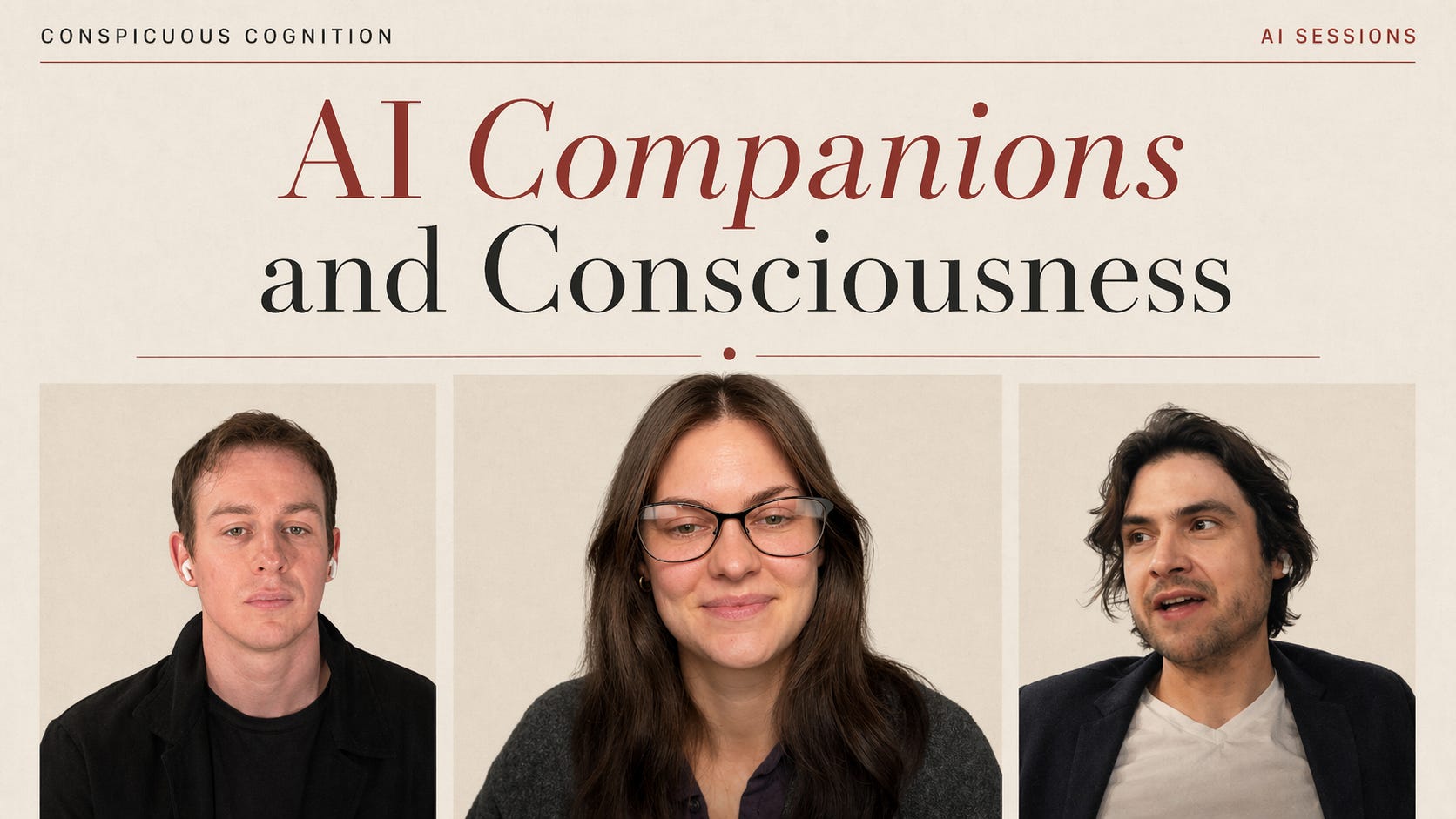
In this episode, Henry and I spoke to Rose Guingrich about AI companions, consciousness, and much more. This was a really fun conversation!
Rose is a PhD candidate in Psychology and Social Policy at Princeton University and a National Science Foundation Graduate Research Fellow. She conducts research on the social impacts of conversational AI agents like chatbots, digital voice assistants, and social robots. As founder of Ethicom, Rose consults on prosocial AI design and provides public resources to enable people to be more informed, responsible, and ethical users and developers of AI technologies. She is also co-host of the podcast, Our Lives With Bots, which covers the psychology and ethics of human-AI interaction now and in the future. Find out about her really interesting research here.
You can find the first conversation that Henry and I had about Social AI here.
Conspicuous Cognition is a reader-supported publication. To receive new posts and support my work, consider becoming a free or paid subscriber.
Transcript
Note: this transcript is AI-generated and may feature mistakes.
Henry Shevlin (00:01)
Hi everyone and welcome to the festive edition of Conspicuous Cognitions AI Sessions. We’re here with myself, Henry Shevlin, my colleague Dan Williams and our guest today, Rose Guingrich, who we’re very lucky to have on the show to be talking about social AI and AI companions with us. We did do an episode on this two episodes ago, which featured me and Dan chatting about the rising phenomenon of social AI. And so if anyone wants a basic sort of primer on the topic, go back and listen to that as well. But today we’re going to be diving into some of the more empirical issues and looking at Rose’s work on this topic.
So try to imagine a house that’s not a home. Try to imagine a Christmas all alone and then be reassured that you don’t have to spend Christmas all alone. In fact, nobody ever needs to spend Christmas alone ever again because their AI girlfriend, boyfriend and B friend, husband or wife will be there to warm the cockles of their heart throughout the festive season with AI generated banter and therapy. Or at least this is what the promise of social AI might seem to hold. And in fact, just in today’s Guardian here in the UK, we saw an announcement that a third of UK citizens have used AI for emotional support. Really striking findings.
So cheesy intro out of the way. Rose, it’s great to have you on the show. Tell us a little bit about where you think the current sort of social AI companion landscape is at right now and what the major sort of trends and use patterns you’re seeing are.
Rose E. Guingrich (01:36)
So right now it appears as though we are moving toward an AI companion world where people are less judgmental about people using AI companions. It’s much less stigmatized than it was a couple of years ago. And now, of course, we’re seeing reports where, for example, three quarters of U.S. teens have used AI companions and about half are regular users and 13% are daily users. And so we’re seeing this influx of AI companion use from young people and also children as well, of course, from the reports that we’ve seen about teens using AI as a companion.
And I think looking forward, we’re only going to see more and more use of AI companions as companies recognize that the market is ready for these sorts of machines to come into their lives as these social interaction partners. And then if you look even further forward, these chatbot companions are going to soon transition into robot companions. And so there we’re going to see even more social impacts, I think, based on embodied conversational agents.
Dan Williams (02:46)
Can I just ask a quick follow up about that, Rose? So you said that this is becoming kind of more prevalent, the use of these AI companions. You also said it’s becoming less stigmatized. Do we have good data on that? Do we have data in terms of which populations are stigmatizing this kind of activity more or less?
Rose E. Guingrich (03:06)
So in terms of the stigma, we don’t have a lot of information about that. But we can look at, for example, a study that I ran in 2023 where I looked at people’s perceptions of AI companions, both from those who were users of the companion chatbot Replica and those who were non-users from the US and the UK. And the non-users perceptions of AI companions and people who use AI companions at that time was fairly negative. So for example, non-users indicated that it’s a sad world we live in if these things are for real. These AI companions are for people who are social outcasts or lonely or can’t have real friends.
And now in the media at least, we see a lot more discourse on AI companions and sharing about having AI companions. And one thing I can point to are subreddits. For example, My Boyfriend Is AI that has 70,000 companions. It is explicitly labeled as companions, whereas other subreddits are weekly visitors, visitors, users. This is companions and people on the subreddit are talking about their AI girlfriend, boyfriend, partner, whatever, and finding community there. Now, if you look at that subreddit though, you also see people talking about disclosing their companion relationship to friends or family and receiving backlash, but then there are also people who are indicating that people are seeing this as, this could maybe be valuable to you, I don’t think it’s necessarily a weird thing, but I think that’s also due to the shifting of social norms based on how many reports we’re seeing about AI companion use and knowing that people also use not just specifically AI companions as social interaction partners but also these GPTs like Claude, Gemini, etc. that people are turning to as companions as well and also being quite open about it.
Henry Shevlin (04:59)
It’s been really fascinating to see, because I think we met, would it have been summer 2023, Rose, or maybe 2022, at an event in New York and the Association for the Scientific Study of Consciousness, presenting a paper on your 2023 study. I was presenting a paper on social AI and AI consciousness. And it felt like then absolutely no one was talking about this. Replica was already pretty successful, but basically no one I spoke to had even heard of it. And then it’s really in the last couple of years that things have accelerated fast. And now basically every couple of days, a major newspaper has some headline about people falling in love with their particular companion or sometimes tragic incidents involving suicides or psychosis, or sometimes just sort of observation level studies about what young people today are doing and so forth. Is that your perception that this is accelerating fast?
Rose E. Guingrich (05:53)
Definitely. And we’re also seeing an emerging market of AI toys. So AI companions that are marketed specifically for children. And so even though right now mainly we’re seeing companion use from young people, young adults, we’re now shifting it toward children as well. Ages 3 through 12 is what these toys are marketed for. And they’re marketed as a child’s best friend. So these are going to be the forever users, right? Starting young with AI companions and then moving forward into robot companions that will someday have in our homes, well, it’s just a natural progression of what this is going to look like.
Dan Williams (06:28)
Can I ask a question just about the kind of commercial space here? So there is a company like Replica and they make, I guess, bespoke social AIs, AI companions. Presumably though, the models that they’re using underpin those AIs and not as sophisticated as what you’ve got with OpenAI and Anthropic and these other, you know, Google’s Gemini and so on. Is that right? Are they using their own models? And if they are, then presumably those models aren’t as sophisticated as these sort of cutting edge models used by the leading companies in the field.
Rose E. Guingrich (07:02)
I suppose it depends on what you mean by sophistica…